


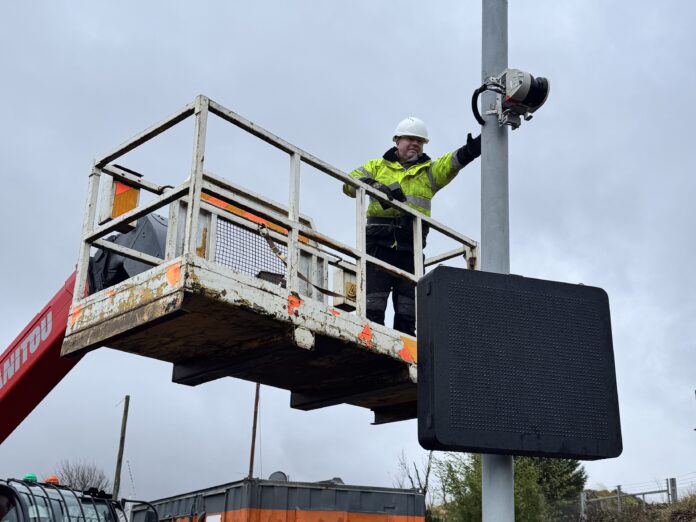
Preparations are underway at the Global Centre of Rail Excellence (GCRE)for a new bridge strike trial, due to begin in January.
Led by the Rail and Station Innovation Company (Rasic), GCRE will be the site for a trial of ‘Bridge Bouncer’, a new roadside safety system designed to reduce the number of over-height vehicles striking low railway bridges.
The system delivers clear, timely alerts to drivers before they reach the point of risk, shifting bridge-strike prevention from static signs to a more active intervention that supports better decision making.
This trial is funded by Innovate UK as part of the Department for Transport ‘First-Of-A-Kind’ programme. Rasic testing of Bridge Bouncer is taking place in partnership with the Global Centre of Rail Excellence.
Installation has begun on the GCRE site, with controlled testing due to begin in January to validate performance and gather evidence to support wider deployment.
There are more than 1,800 bridge strikes every year in the UK. Each incident costs Network Rail around £100,000 when engineering response and train delays are considered, placing the total annual cost to the rail network estimated to be above £150 million. Driver misjudgements remain the leading cause of strikes, which is why new approaches are required.
GCRE is a new, purpose-built facility being developed in South West Wales for international rail research, testing and net zero technology development. The 700-hectare site has the potential to become Europe’s leading cluster for rail and sustainable mobility innovation.
GCRE Director of Strategy and Skills, Rob Forde, said:
“It’s fantastic to be working with Rasic and providing testing facilities for their innovative Bridge Bouncer system.
“The impact of bridge strikes on road users, the highway network, police and rail operators like Network Rail is very significant, with real world economic costs every single week. It’s great to see creative teams like Rasic taking on the challenge of solving the problem.
“By working with the Rasic team, we’re able to provide facilities for innovation to help accelerate the testing and development of this idea as part of the First of a Kind programme.”
Managing Director of Rasic Ltd, Marcus Mayers, said:
“Bridge Bouncer is focused on addressing a familiar and costly problem with a clearer, more effective approach. The support from GCRE has been outstanding — practical, enthusiastic and fully committed to helping us progress at pace.
“With Innovate UK’s backing, this trial gives us the opportunity to show how better thinking and better delivery models can reduce bridge strikes, improve safety and generate real value for the rail industry.
“Looking ahead, our ambition is not only to prove the solution, but to help evolve the business model for railway-related road safety. There is a major opportunity for the industry to achieve better outcomes, fewer incidents and substantial savings through smarter, data-driven approaches to strike prevention.”
Since 2017/18, the FOAK programme has been funded by the Department for Transport and managed by Innovate UK, in partnership with Innovate UK Business Connect. It aims to overcome barriers that often prevent new entrants bringing innovative technologies to the rail market.
Funding is awarded through competitions, with successful applicants partnering with rail industry supporters to develop, test, and demonstrate their products, enabling a smoother path to commercialisation.
The First of a Kind (FOAK) 2025 competition is based around four themes, with winners receiving funding to help develop novel technologies centred around AI for Complex Processes, Platform Train Interface, Personal Safety and Bridge Strikes.


