


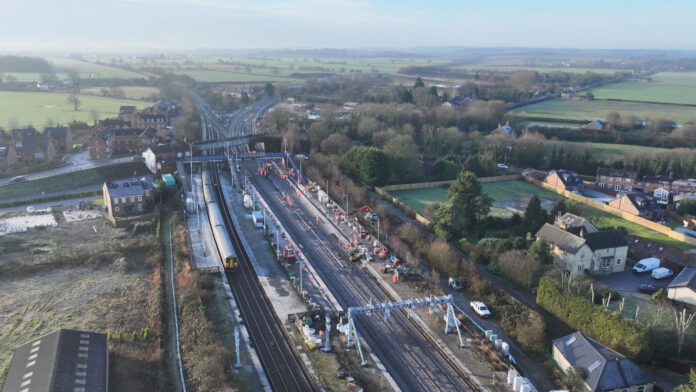
The Transpennine Route Upgrade (TRU) has completed more than a month of intensive engineering work between Leeds and York, marking another significant step towards faster, greener and more frequent rail services across the North.
Over a 32-day programme, hundreds of engineers delivered a complex package of upgrades, including the installation and commissioning of 70 new signals, renewal of 3km of track and the replacement of 11 switches and crossings. Alongside this, work on overhead line equipment is preparing the route for electric services, supporting long-term decarbonisation.
Church Fenton was at the heart of the activity. Tracks through the area were remodelled and platforms 3 and 4 realigned, enabling higher line speeds and reducing future journey times. A new passing loop has also been installed, allowing faster services to overtake stopping trains and increasing overall capacity on this busy section of the route.
James Richardson, Managing Director of the Transpennine Route Upgrade, said the programme demonstrated the pace and scale of change now being delivered across the route: “This has been a strong start to the year. Working around the clock through the Christmas period and into January, our teams have safely delivered critical upgrades that will bring real benefits for passengers and support economic growth across the North.”
To keep passengers moving during the works, more than 1,600 services were diverted via the Castleford route, supported by TRU’s £100m investment in dedicated diversionary lines. Where required, over 1,400 rail replacement bus and coach journeys were operated across the programme.
Andrew Allwright, TRU Programme Delivery Lead for Northern, thanked customers and communities for their patience, noting the scale of collaboration required to deliver the milestone.
The programme deployed 879 rail wagons, 45 engineering trains, three large cranes and three tamping machines, underlining the industrial scale of the operation. With this phase complete, TRU says 2026 will see further tangible improvements for passengers as the transformation of the Transpennine corridor continues.


