


Targeted upgrades linked to the Midland Main Line (MML) electrification programme are already delivering major benefits for UK rail freight, improving network resilience and enabling larger container trains to operate across one of Britain’s most strategically important inland corridors.
While the Government paused the wider Midland Main Line electrification programme in summer 2025, Network Rail has continued progressing key infrastructure works that strengthen freight capability across the East Midlands route.
The corridor connecting Birmingham, Nuneaton, Leicester and Peterborough plays a crucial role in the national freight network, providing one of the few practical inland alternatives to routing freight traffic through London. It also connects key logistics hubs and inland terminals across both the East and West Midlands.
However, parts of the route have historically struggled to accommodate modern high-cube container traffic because of clearance restrictions beneath older bridges and structures.
Work originally carried out for electrification between Sileby, Loughborough and Trent created additional clearance for larger freight containers, laying the foundations for further freight improvements even after electrification was paused.
Network Rail has since identified additional opportunities to unlock freight capacity without requiring major new capital investment.
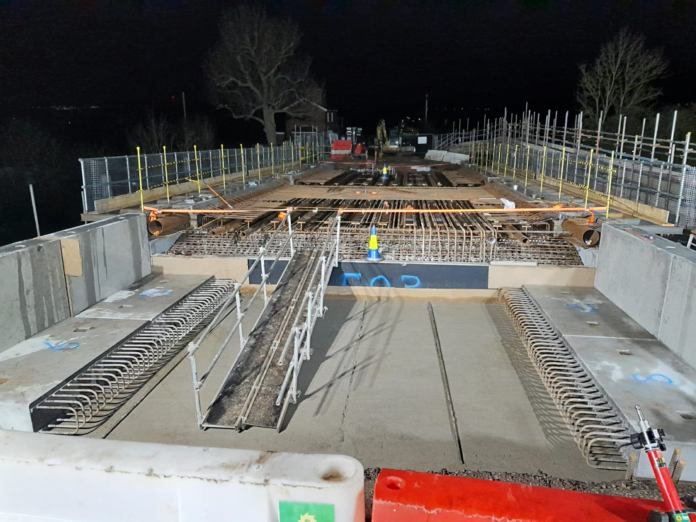
A key example is the replacement of Kirk Hill bridge near Sutton Bonington in Nottinghamshire. Although originally planned as part of electrification works, the bridge replacement continued because of the freight benefits it would deliver.
The old structure was demolished during Christmas 2025 engineering possessions, while the new bridge deck was installed during overnight weekend works earlier this year to minimise passenger disruption.
By April 2026, larger-gauge freight trains were already operating beneath the new structure in both directions, improving access between East Midlands Gateway and major East Coast ports.
The scheme delivers several operational advantages beyond freight growth. The raised bridge now allows larger container services to use a more direct inland route, reducing dependency on road freight and easing pressure on congested highways.
The improved clearance also allows tamping machines easier access to the area, helping remove a long-standing speed restriction and improving operational reliability.
Importantly, the upgraded structure has also been futureproofed for any future restart of Midland Main Line electrification, with sufficient clearance for electric or bi-mode rolling stock.
Alongside Kirk Hill, Network Rail has also confirmed additional clearance improvements across sections including Trent High Level, Ratcliffe Junction-Toton, Attenborough Junction-Toton and the Trent-Nottingham-Boultham Junction route toward Lincoln.
The work reflects a growing industry focus on extracting greater freight capability and operational flexibility from existing infrastructure through targeted upgrades rather than relying solely on large-scale enhancement programmes.
Katie Oliver, Network Rail lead portfolio manager, said the project demonstrated how relatively focused infrastructure interventions could unlock wider economic and operational benefits.
“By taking a fresh look at what the existing railway can handle, we’ve unlocked real benefits for freight, passengers and the wider economy — without the need for big new spending,” she said.
“Kirk Hill shows what can be achieved by upgrading older infrastructure: removing long-standing constraints, enabling larger freight trains and keeping the route ready for future electrification.”
For freight operators and logistics businesses, the enhancements provide greater route flexibility and improved resilience across a network that is becoming increasingly important as intermodal freight volumes continue to grow.
The upgrades also align with wider rail freight ambitions around decarbonisation and modal shift, particularly as logistics operators face increasing pressure to reduce road mileage and emissions across supply chains.
For the wider rail sector, the project may also offer a blueprint for how incremental infrastructure upgrades can continue delivering operational value even where larger enhancement programmes face delays or changing government priorities.


