


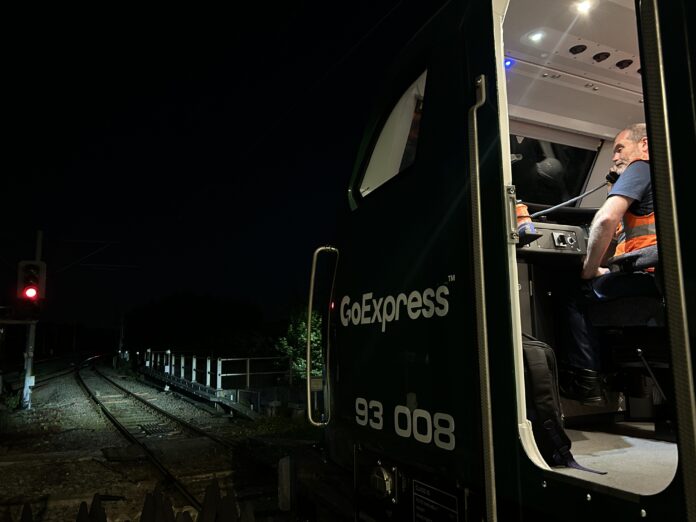
GoExpress has officially begun live operational trials aimed at demonstrating how high-speed electrified rail could transform time-critical logistics across the UK.
Working alongside Network Rail, Freightliner Ltd and Rail Operations Group, the company has now moved from concept into real-world testing on live infrastructure, with overnight trial operations taking place on the Crewe to Wigan corridor.
The programme marks an important milestone for the emerging express rail logistics market, testing whether existing passenger-capable infrastructure can also support fast, low-carbon freight services operating at significantly higher speeds than traditional rail freight.
The trials are focused on gathering operational data, refining processes and demonstrating that rail can move premium logistics traffic overnight between major cities with the speed and reliability currently expected from road-based courier and parcel networks.
Adam Parkinson, Founder and CEO of GoExpress, said the company’s ambition was not simply to move freight by rail using traditional methods.
“We are not here to move logistics by rail in the way it has always been moved. We are here to move it the way it should be moved – fast, clean, simple, and with high reliability,” he said.
The proposition is built around a growing industry challenge. UK logistics networks are facing mounting pressure from driver shortages, increasing delivery expectations, congestion and decarbonisation requirements, while businesses continue to demand faster and more predictable supply chains.
GoExpress believes electrified rail infrastructure could help address several of those pressures simultaneously.
Rather than relying solely on conventional slower freight operations, the company is exploring whether existing electrified main lines can support overnight, high-speed logistics movements capable of handling time-sensitive cargo between major urban centres.
The current trials are taking place during overnight engineering windows when passenger services are reduced, allowing operators to test movements on the West Coast Main Line without impacting daytime operations.
This week’s trial programme includes four overnight services operating between Crewe and Wigan with incremental speed increases designed to test operational performance and infrastructure compatibility under real conditions.
The overnight operation model is central to the wider proposition. By utilising periods when passenger traffic is low, operators could potentially unlock additional value from existing railway infrastructure while avoiding some of the capacity constraints that affect daytime freight operations.
For the wider rail sector, the trials also raise important questions about the future role of rail freight in supporting modern supply chains.
Historically, UK rail freight has focused heavily on bulk commodities, aggregates, containers and slower intermodal traffic. However, changing logistics demands and pressure to reduce road emissions are driving renewed interest in higher-value, higher-speed freight applications.
The trials could also have wider implications for rail decarbonisation policy.
Electric rail freight already produces significantly lower carbon emissions than road haulage, but much of the focus to date has centred on traditional freight flows. If high-speed logistics models prove commercially viable, they could open up additional opportunities for modal shift away from road transport, particularly in the fast-growing parcel, e-commerce and premium delivery sectors.
The operational data gathered during the trial period will now be closely watched across both the rail and logistics industries, particularly as the sector continues to explore how existing infrastructure can be used more efficiently without major new capital investment.
For SMEs across the rail supply chain, the emergence of express rail logistics could also create future opportunities in rolling stock conversion, digital operations, overnight maintenance planning, freight terminal development and last-mile integration services.
While the trials remain at an early stage, they represent another example of the rail sector exploring how existing infrastructure and electrified corridors can be adapted to meet changing economic and environmental demands.
GoExpress says the trial phase is intended to demonstrate that high-speed rail logistics is no longer a theoretical concept, but something capable of operating on the UK network today.


