



Train services across Wales and the West of England are becoming more reliable, with fewer cancellations and more trains arriving on time following a major programme of infrastructure improvements and operational reforms by Network Rail.
The Office of Rail and Road (ORR) has confirmed it is formally closing its enforcement action against Network Rail’s Wales & Western region after concluding that the organisation has successfully implemented a long-term performance improvement plan introduced following a regulatory investigation in 2024.
The investigation found that shortcomings in Network Rail’s infrastructure and operational practices were contributing to poor train performance across the region, prompting the regulator to require a comprehensive programme of improvements.
Since August 2024, Network Rail has invested heavily in infrastructure upgrades and introduced a series of operational changes designed to improve reliability and reduce disruption for passengers.
The results have been significant. Passenger train cancellations fell by more than 20 per cent by the end of the 2025/26 financial year, while the proportion of services arriving within three minutes of schedule improved from 77.6 per cent to 79.4 per cent.
A major focus of the improvement programme was the Thames Valley area, where Network Rail targeted known performance hotspots through upgrades to track, overhead line equipment, axle counters and points. The company also introduced welfare officers at key stations to help reduce trespass incidents, one of the recurring causes of delays on the network.
Elsewhere, resilience improvements have been delivered on the Great Western Main Line, including flood mitigation works at Chipping Sodbury aimed at reducing weather-related disruption.
Alongside physical infrastructure investment, Network Rail has implemented a range of organisational and operational reforms. These include strengthening leadership capability, enhancing train control operations, establishing dedicated timetable planning taskforces, improving incident management processes and introducing new approaches to stranded train recovery and operational learning.
The regulator said these measures have delivered sufficient progress to conclude the enforcement process, although it acknowledged that further improvements are still needed to meet passenger expectations.
Graham Richards, ORR’s Director of Planning and Performance, said the progress demonstrated the value of sustained focus on performance improvement.
“Following concerted efforts from Network Rail, and continued engagement by our teams at ORR, I am pleased to see that passengers in Wales & Western are experiencing better, more reliable train services,” he said.
“Nevertheless, we know that for many passengers train performance is not what they would expect, so we are continuing to work with train operators and Network Rail across the country on how to further improve performance.”
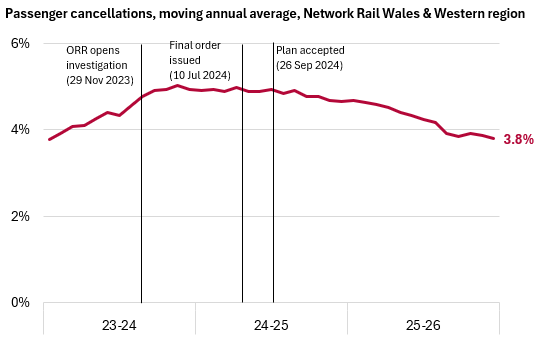
For Network Rail, the closure of the enforcement action represents an important milestone, particularly as the wider rail industry prepares for the transition towards Great British Railways and increasing integration between infrastructure and train operations.
Mark Killick, Managing Director for Network Rail’s Wales & Western region, said customers were already beginning to see the benefits of the changes introduced over the last two years.
“Customers are seeing a more reliable railway, reflecting the extensive improvements we’ve delivered over the last two years,” he said.
“We know delays and cancellations still impact journeys, so while this progress is a positive step, we continue to work closely with our industry partners to deliver an ever more reliable railway for our customers.”
The improvement in performance is particularly significant for a region that includes some of the country’s busiest commuter routes into London, as well as key intercity and regional services across South Wales, the Thames Valley and the South West.
For rail suppliers and contractors, the outcome also highlights the growing importance of targeted asset management, resilience improvements and data-driven operational planning in delivering measurable performance gains. Many of the interventions implemented across the region focused on improving the reliability of existing assets rather than major new infrastructure projects, demonstrating how focused investment and operational reform can deliver tangible benefits for passengers.
While ORR has now closed its formal enforcement action, the regulator made clear that scrutiny of performance across the network will continue as it works with Network Rail and train operators to drive further improvements in reliability and customer experience.
The latest results suggest that coordinated infrastructure investment and operational reform can deliver meaningful performance improvements, providing a blueprint that could influence approaches elsewhere on the network as the railway continues its transition towards a more integrated operating model.