


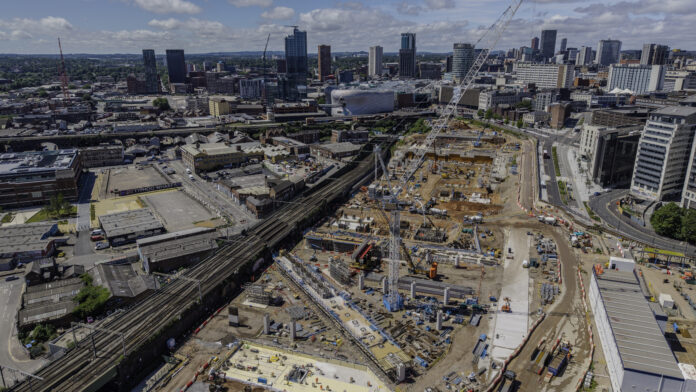
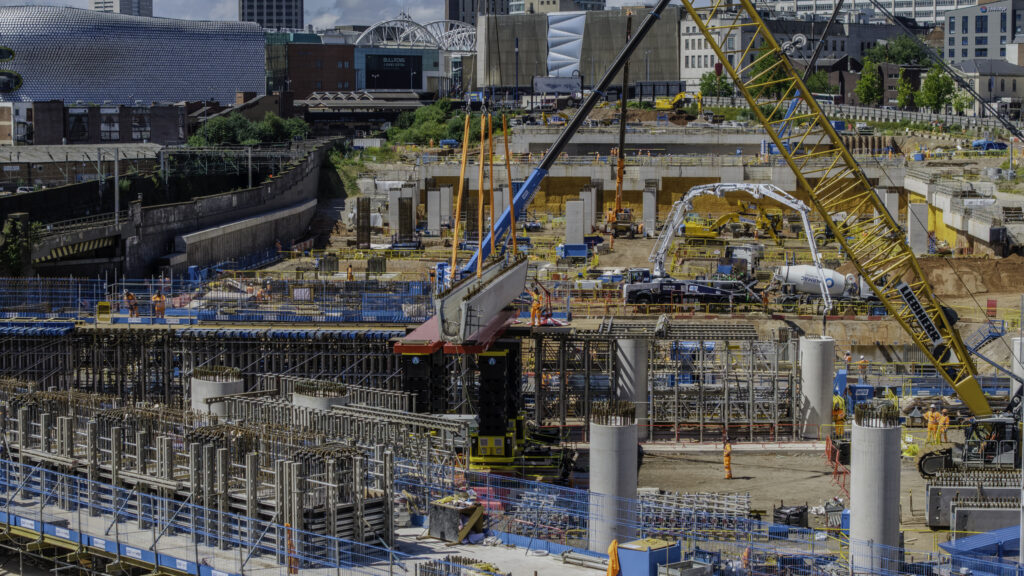
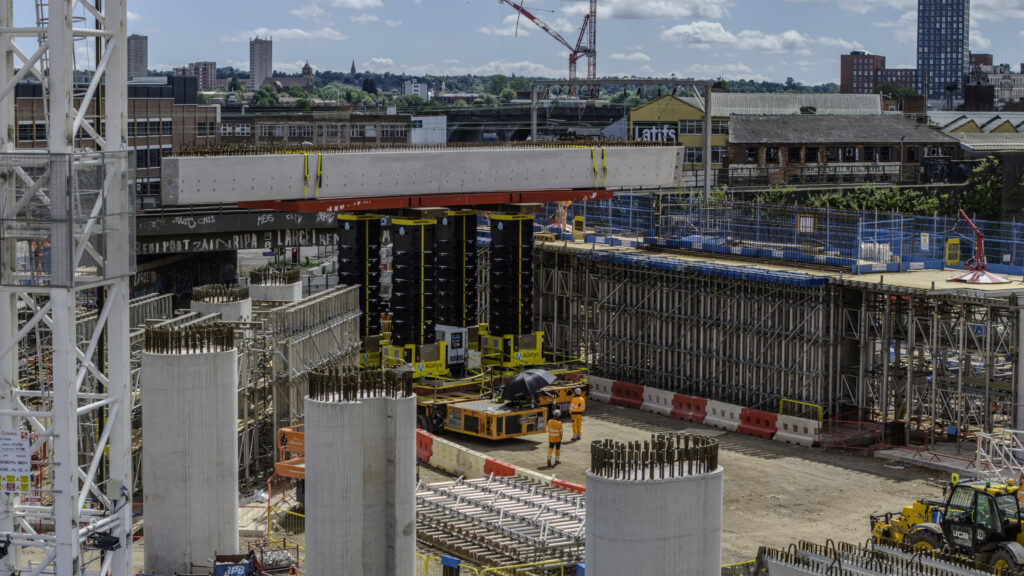
Construction of the platform deck at Birmingham’s HS2 Curzon Street station has reached a major milestone, with the first of more than 550 giant concrete beams now being installed to support the station’s seven high-speed platforms.
The start of beam installation marks a visible new phase in the development of the flagship terminus, following the completion earlier this year of all 2,011 foundation piles that underpin the station.
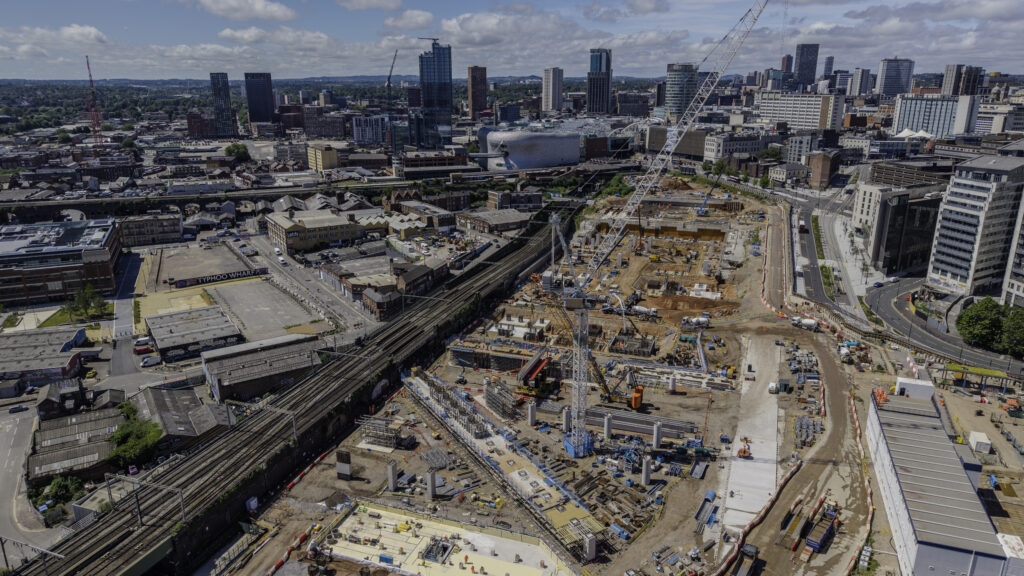
Once complete, Curzon Street will become the centrepiece of HS2’s West Midlands network, stretching around 450 metres between Moor Street station and Millennium Point beneath a vast arched roof comparable in size to London St Pancras International.
The work is being delivered by HS2’s construction partner, Mace Dragados, with specialist subcontractor MPB responsible for lifting the precast concrete beams into place.
Initial construction is focused on the section of the station above the future tram corridor, allowing the area to be handed over to the Midlands Metro Alliance as early as possible so work can begin on extending the tram network through Digbeth towards Birmingham City’s new stadium.
Building the station from the ground up
Although construction has been progressing for several years, much of the work has so far taken place below ground.
Alongside the completion of the station’s piling works, engineers have constructed an eight-metre-high retaining wall at the western end of the site and excavated around 47,000 cubic metres of material to create a level platform for construction.
Attention has now shifted to the station’s superstructure.
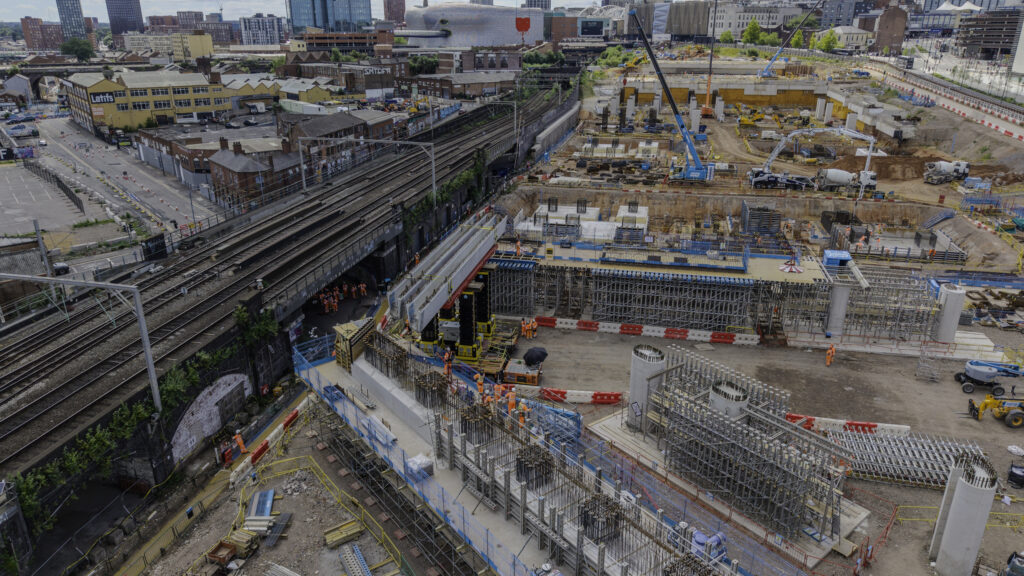
A total of 556 reinforced concrete beams will form the basis of a 13,370 square metre deck, roughly equivalent to two football pitches, supporting much of the station’s seven platforms and connecting them to the approach viaducts entering Birmingham from the east.
The beams, manufactured by Irish precast specialist Shay Murtagh Precast, range from seven to 34 metres in length and weigh between 14 and 58 tonnes.
In total, the project will install 488 U-shaped beams and 68 L-shaped beams.
Deliveries are carefully scheduled during the early hours to minimise disruption on local roads before installation begins.
Complex engineering alongside a live railway
While many of the beams can be lifted directly into position using crawler cranes, around 120 sections located closest to the operational railway require a different approach.
These beams are being installed using self-propelled modular transporters (SPMTs), specialised 96-wheel vehicles capable of lifting and positioning heavy loads with exceptional precision.
The technique allows construction to continue immediately adjacent to the existing railway without disrupting services into Birmingham New Street station.
HS2 Ltd Project Client for Curzon Street, Jonathan Berry, said: “We’ve been making good progress with the construction of the station, but up to now, it’s mostly been beneath the ground, focused on the piling and foundations that will underpin the building.
“That’s why it’s great to see the first beams in position as we begin to assemble the enormous deck that will support our seven high-speed platforms.
“Once complete, Curzon Street will become a new gateway to Birmingham, offering easy access to the city centre and connections to onward destinations via tram, bus and rail, improving journeys and supporting growth across the West Midlands.”
Supporting wider regeneration
Curzon Street station forms a central part of Birmingham’s wider regeneration plans, with future connections into the city centre, Digbeth and Eastside, alongside a new tram stop located beneath the station.
At peak construction, more than 1,000 people are expected to be working on the project, both directly and through Mace Dragados’ UK supply chain.
To accommodate the growing workforce, construction teams will shortly move into a new temporary office complex opposite Millennium Point, which will coordinate the next stage of the programme.
Martyn Woodhouse, Project Director at Mace Dragados Joint Venture, said: “Lifting these first beams into place is a major logistical and engineering achievement, and a testament to the coordination across our teams and supply chain.
“Each installation has been carefully planned to ensure it’s carried out safely and efficiently, particularly in such a constrained and operational environment.
“This work is laying the groundwork for the platforms and brings us another step closer to delivering a world-class station for Birmingham.”
Moving towards railway systems
The milestone also reflects the broader transition of the HS2 programme from heavy civil engineering towards railway infrastructure and systems installation.
Once complete, Curzon Street will serve as the Birmingham terminus for the first phase of HS2, linking the city with London while creating additional capacity on the existing West Coast Main Line for commuter and freight services.
The wider HS2 programme remains subject to a comprehensive reset led by Chief Executive Mark Wild, aimed at improving delivery efficiency and reducing overall costs while progressing construction across the route.


