


As technology reshapes how the railway plans and protects its work, TES’s Senior Delivery Managers say trust, honesty, and people remain fundamental to getting it right.
Possession management sits at the sharp end of the railway. It is the discipline that turns a plan drawn up weeks in advance into a safe, deliverable reality on the ground, often while that plan is still changing hours before the first boot goes on ballast. For Colchester-based contractor TES 2000 (TES), it is also where some of the industry’s biggest tensions come to a head: between planning and reality, technology and people, and today’s contract and tomorrow’s industry.
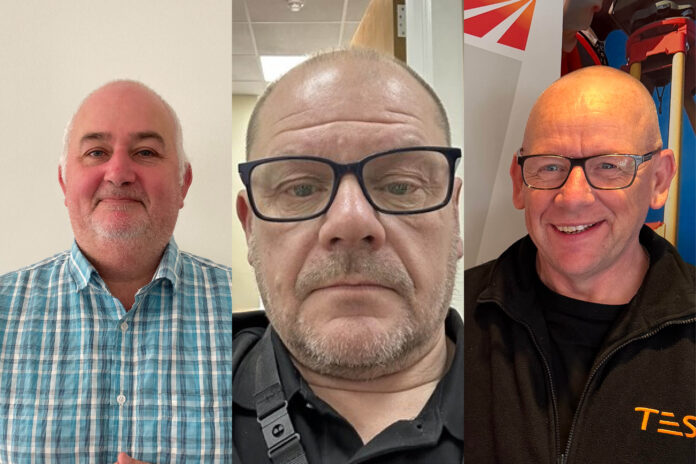
Rail Industry Connect spoke to Anthony Wright, Head of Possession Management at TES, along with Senior Delivery Managers Mark Day (North East) and Lee Gambrill (Sussex), about how the discipline has evolved, where technology is helping, where caution is needed, and what they believe sets TES apart.
A Discipline Built on Managing Unpredictability
Although the tools and processes around possession planning have evolved, the team believes one fundamental challenge has remained constant: unpredictability. “From my experience over the last 15, 17 years, it hasn’t changed at all,” said Lee, reflecting on his time across Thameslink, Sussex, Wessex and Kent. Possessions booked months in advance can still shift significantly by the time they are delivered, he said.
Anthony, who spent seven years planning possessions for Network Rail before joining TES, sees it from both sides. “There’s constant change, but it’s not from TES,” he explained. “You can put a possession in 120 weeks out and change it. Probably 100% of the footprint changes in its life cycle. That’s the nature of the railway.“
Much of that change, the team agrees, is driven by reactive fault-fixing rather than poor intent. “Faults account for a tiny fraction of what engineers actually deliver, but they usually take up the vast majority of the staff effort to fix,” Anthony said. Technology has accelerated that cycle. Where a track walker’s report once sat on a desk for days, trains now report faults in real time. “It’s a good thing,” Lee said, “but we’re at the sharp end of it, because any change affects our resourcing.“
For TES, the answer has never been to fight that unpredictability, but to be exceptionally good at responding to it. “We just have to adapt to it”, Anthony said. “A lot of it is the relationship we have with the client, sitting down and discussing what they want, what we can give, and where we need them to meet us halfway.“
Embracing Technology, With Caution
There is a growing acceptance in the rail industry that technology’s role in possession management will continue to expand. T3D (physical disconnection of signalling by S&T staff) and T3A, alongside systems like Resonate, are steadily reducing the number of people needed on track for certain possessions. Mark pointed to stations such as York, Leeds, Newcastle and Doncaster moving toward digital disconnection, work that once needed eight or nine possession support staff.
“Taking people off track and out of harm’s way is exactly the right thing to do, and TES needs to be at the forefront of that solution,” Anthony said. “I think a lot of people still believe that detonators and stock boards, which have been here since 1860, will still be here in 2040. That’s not going to happen.”
TES is set to trial geofencing technology, principally on the North East route, and Anthony sees a clear use case for newer starters building experience under supervision. But he is equally clear it is not a silver bullet. “It has its place, but it’s not the saviour of incidents,” he said. “It gets tricky to geofence a small area inside somewhere like York Station, where someone might be walking just one of eight tracks.”
“But as a company tendering for contracts, we know technology will be a requirement,” He added. “We have to embrace it where it genuinely helps, particularly new starters, not just to tell a client, ‘look what we’ve got.’“
That philosophy sits behind TES’s own back-to-basics training, including site orientation courses that teach staff to read physical survey maps and understand fixed points on the ground, skills the team has found are directly linked to on-site safety. “We’ve proved that a lot of people don’t know what an underbridge looks like on a map,” Anthony said. “That could be the literal difference between someone going to the wrong access point and putting a block out on an open line.“
What Sets TES Apart
What differentiates TES is not a particular system or piece of equipment, the team says, but the trust built through honest conversations, visible leadership and consistent delivery. “The relationship we have with the client is built on trust,” Anthony said. “We’re open and honest. If we can’t do something, we tell them we can’t.“
Mark, who has seen client relationships transform over the past two years on the North East route, puts it down to simple presence. “Going to see them and speaking to them face to face makes all the difference,” he said. “It’s much harder to build that kind of relationship over the phone or by email alone.”
For Lee, that closeness is also what retains good staff. “TES are very keen to support and enhance staff that are showing promise,” he said. “We’ve got that continuity of high-quality staff because the company is happy to invest in those people.” It’s a point Anthony, after two years at TES, says drew him to the business in the first place.
Looking Ahead to Great British Railways
As the industry prepares for the transition to Great British Railways (GBR), the team expects the move towards digital possessions to continue regardless of the wider structural reforms. Lee predicts the changes will ultimately open up opportunities elsewhere in the supply chain, even if possession support roles in their current form decline. Anthony expects GBR’s public sector status to ease some of the commercial friction surrounding access, while greater route-level decision-making could create a more responsive organisation.
Their shared message to the wider industry is simple. “It’s all about adapting,” Lee said. “We’ve got to adapt to what the landscape looks like when that change happens.” For TES, adapting does not mean replacing experience with technology. It means using new tools where they improve safety and delivery, while retaining the relationships, local knowledge and honest conversations that allow teams to manage the railway’s inevitable uncertainty.
TES is a family-run railway engineering and safety-critical contractor based in Colchester, providing possession management, OHL construction and isolations, permanent way maintenance, technical projects, and training services across the Anglia, Sussex, and North East routes.
To learn more about TES and its possession management services, contact [email protected] or call 01206 799 111.


