


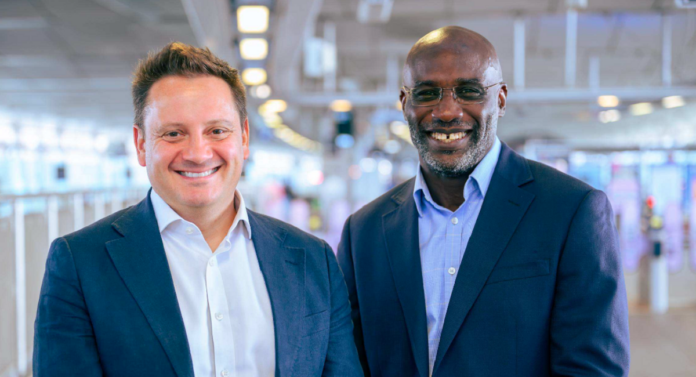
Rail Delivery Group has appointed Dan Mann and Ola Ogun as co-CEOs, putting two existing members of its Executive Team in charge as the organisation prepares for significant changes to its role under Great British Railways.
The pair will succeed Jacqueline Starr, who is due to leave her position as RDG Chief Executive in October 2026. RDG said the appointments are intended to provide continuity as the railway moves towards the establishment of GBR, which the government expects to become operational in 2027.
The decision to appoint joint chief executives brings together two different areas of industry experience. Mann has a predominantly operational railway background, while Ogun has led RDG’s financial and corporate functions, including responsibility for the settlement of more than £11bn of rail revenue annually.
Their appointment comes at a particularly significant point for RDG itself. Under the government’s plans for rail reform, a number of industry functions currently undertaken by the organisation are expected to move into GBR, including important retail industry management and back-office responsibilities.
Operational and financial experience combined
Mann began his railway career on Railtrack’s graduate programme in 2001 before holding operational management positions across Railtrack, Network Rail and train operating companies.
He joined RDG in 2012 and became a member of its Executive Team in 2022, most recently serving as Director of Industry Operations.
His work at RDG has included industry-wide programmes such as the Network Performance Board and Traincrew Programme, alongside initiatives focused on skills, workforce diversity and routes into railway careers.
Mann said: “It is a privilege to be appointed co-CEO of RDG alongside Ola. Rail has been at the heart of my career for more than 25 years and I remain as passionate as ever about the role it plays connecting people and places, supporting communities and contributing to Britain’s economy.
“RDG has an important role to play in getting the railway working more as one, supporting our members and putting customers at the heart of everything we do. Ola and I bring different but complementary experience and we share a strong commitment to partnership, accountability and excellence.”
Ogun brings experience of industry’s financial architecture
Ogun joined RDG in 2018 and has held a series of senior positions, including Chief Financial Officer and Chief Financial and Operating Officer.
His responsibilities have extended well beyond RDG’s internal finances. Alongside the settlement of more than £11bn in railway revenue each year, he has overseen major industry programmes as well as technology, people, procurement, legal and governance functions.
That experience could prove particularly relevant during the transition to GBR as existing industry systems, responsibilities and organisational boundaries are restructured.
Ogun said: “This is a significant period of change for the industry as we look to bring track, trains and stations together – but it is also an opportunity to continue building a customer-focused railway.
“Dan and I are aligned in our ambition to provide clear, inclusive and effective leadership, maintain a strong focus on delivery and ensure RDG continues to support the rail industry through its next chapter.”
RDG’s role set to change under rail reform
The appointment is significant not simply because RDG is changing leadership, but because the organisation those leaders inherit is itself facing substantial change.
The Railways Bill currently progressing through Parliament is intended to create GBR as the railway’s central coordinating organisation, bringing infrastructure management and the majority of passenger operations together. Government plans envisage GBR taking responsibility for areas including passenger services, infrastructure, timetabling and ticket retailing.
Some functions currently performed by RDG are explicitly earmarked for transfer.
The government has confirmed that retail industry management functions currently provided by RDG – including management of common systems, licensing independent ticket retailers and arrangements around commission – will move into GBR. GBR is also expected ultimately to consolidate the websites and apps of 14 passenger operators into a single retail platform.
That creates a different leadership challenge from simply maintaining RDG’s existing operation. Mann and Ogun will need to oversee ongoing delivery for members and the wider industry while supporting the transfer and reshaping of functions as the future railway structure takes form.
The government currently expects GBR to become operational around 12 months after the Railways Bill receives Royal Assent, while the transfer of DfT-contracted passenger operators into public ownership is expected to be completed by the end of 2027.
Continuity through transition
Mann and Ogun have already begun working with Starr ahead of her departure, with RDG saying the handover is intended to provide continuity for employees, members and delivery partners.
Their appointment means RDG will enter the next phase of rail reform under leaders who already have detailed knowledge of its operational, commercial and corporate responsibilities.
That institutional knowledge could become increasingly important as the transition accelerates. The task facing RDG over the coming period is not simply to prepare for GBR, but to continue operating critical industry functions while determining how those responsibilities, systems and expertise fit into the future structure.
For Mann and Ogun, the measure of that transition will therefore be both continuity and change: keeping essential industry services functioning while helping reshape an organisation whose role will inevitably evolve as GBR takes on more of the railway’s central responsibilities.


