


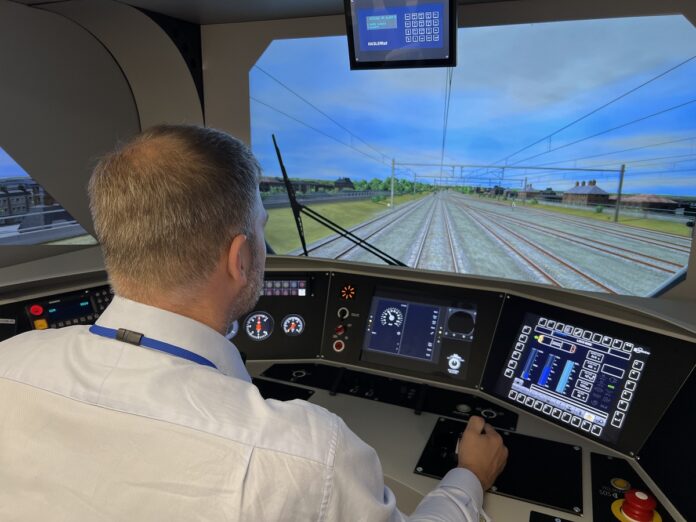
Direct Rail Services (DRS) has launched a new suite of ETCS driver training simulators in Carlisle as the freight operator prepares its workforce for the wider rollout of digital signalling across the UK rail network.
The Nuclear Transport Solutions rail division has installed a virtual cab simulator alongside a number of desktop systems at its Regents Court facility, allowing drivers to train on the European Train Control System (ETCS) without requiring access to the operational railway.
Funded by Network Rail as part of the ETCS rollout, the simulators will enable DRS to recreate a wide range of operational scenarios and give drivers repeated exposure to the different situations they could encounter when operating under digital signalling.
The investment highlights one of the less visible but critical elements of the industry’s transition to ETCS: ensuring drivers and other operational staff are prepared for a fundamentally different way of operating the railway.
Preparing drivers for in-cab signalling
ETCS replaces conventional lineside signalling with information presented directly to the driver in the cab, requiring new competencies and operational procedures.
The new DRS simulators have been designed to reproduce real-world driving conditions and ETCS operation, giving drivers an opportunity to become familiar with the technology and practise their responses in a controlled environment.
That allows unusual, complex or safety-critical situations to be recreated repeatedly without occupying train paths or introducing additional risk onto the live railway.
Tony Hewitson, Rail Director at NTS, said: “The introduction of these new ETCS training simulators marks a significant milestone for DRS and demonstrates our commitment to training excellence and the future of the railway.
“As digital signalling technology becomes more widely adopted across the network, it is essential that our drivers have access to the highest standards of training. This simulator provides a realistic and engaging environment that helps develop competence, confidence and operational readiness while maintaining our unwavering focus on safety.”
People as important as technology in ETCS transition
The facilities form part of preparations associated with the East Coast Digital Programme (ECDP), which is introducing ETCS on the East Coast Main Line.
While much of the focus surrounding digital signalling is inevitably placed on onboard equipment and infrastructure, successful implementation also depends on thousands of people being trained to operate and maintain the new system.
For freight operators in particular, access to realistic simulation provides an opportunity to build driver competence without depending entirely on scarce access to ETCS-equipped routes and trains.
Chris Hobden, Programme Director for ECDP at Network Rail, said: “Making a successful switch to digital signalling is about people as much as the technology involved. Network Rail is investing in these facilities to ensure drivers have both the competence and confidence to drive in ETCS.
“Digital signalling will provide a safer, more capable and more reliable railway for rail freight, supporting its growth and contribution to our economy and environment.”
CORYS technology reflects evolving UK system
The simulators have been designed and delivered by French train simulation specialist CORYS.
According to the company, the systems use its latest UK ETCS platform, which has been developed with UK passenger and freight operators since 2018 and is being updated as the operational system develops.
That ability to keep simulation aligned with the railway itself will be important as ETCS deployment expands and operating experience grows.
John Madden, Commercial Director at CORYS, said: “CORYS is proud to support DRS’s ETCS driver training as part of the East Coast Digital Programme. The DRS simulators benefit from the latest UK ETCS platform, built with UK freight and passenger operators since 2018 and continuously updated as the real system evolves.
“Working in partnership with the DRS team has been a genuine pleasure, and their Carlisle training facility is state-of-the-art. We look forward to supporting the wider ETCS rollout as it extends across the network.”
Simulation expands training possibilities
One of the principal advantages of simulation is the ability to expose drivers to situations that may be difficult or impractical to reproduce during conventional training.
Different operational conditions can be introduced in a repeatable environment, allowing instructors to assess decision-making and reinforce procedures without affecting live services.
The combination of a virtual cab and desktop simulators also gives DRS greater capacity to incorporate ETCS into its wider driver training and development programme.
Dale Howcroft, DRS ETCS Operations Specialist, said: “This simulator gives our drivers the opportunity to gain hands-on experience with ETCS in a safe and controlled environment.
“It allows us to recreate a wide range of scenarios and support consistent, high-quality training that will benefit both our people and our customers.”
Building the workforce for a digital railway
For the wider industry, the Carlisle facility demonstrates that the transition to digital signalling extends well beyond installing new equipment on trains and alongside the railway.
ETCS changes how drivers receive information and interact with the signalling system, meaning workforce preparation has to progress alongside infrastructure and rolling stock modifications.
That is particularly important for freight operators whose locomotives and drivers can work across large parts of the national network and will increasingly need to move between conventionally signalled and ETCS-equipped routes.
DRS’s new simulators provide a controlled environment in which that transition can begin before drivers encounter the same situations on the operational railway – helping turn investment in digital signalling technology into practical operational capability.


