


The Railway Industry Association (RIA) has launched a framework designed to improve how Britain’s rail strategies are developed, coordinated and delivered, warning that disconnected plans risk undermining long-term investment and confidence across the rail supply chain.
The publication, A Checklist for Rail Strategies, is intended to help government, Great British Railways (GBR), devolved authorities and industry organisations assess whether their plans form part of a coherent and deliverable long-term vision for the railway.
Its release comes as the industry prepares for significant structural reform, with GBR taking shape and mayoral authorities assuming greater responsibilities for regional transport planning.
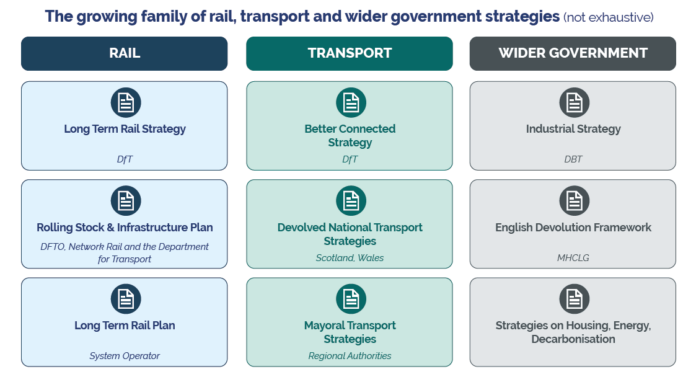
RIA argues that the growing number of national, regional and local strategies presents an opportunity to improve coordination, but also creates a risk of fragmentation if plans are developed independently without clear links between their objectives, investment requirements and delivery responsibilities.
Rather than evaluating existing policies or recommending specific investment priorities, the checklist provides a structured approach to testing whether strategies are aligned, realistic and capable of being implemented.
Six areas to test whether rail strategies are deliverable
Developed with input from RIA members and industry experts, the framework examines strategies through six areas: outcomes, service proposition, enablers, capabilities, accountability and engagement, and coherence.
Together, these are intended to establish whether a strategy has a clear purpose, identifies the railway services required to achieve its objectives and explains how the necessary infrastructure, resources and organisational capabilities will be delivered.
The approach also considers whether responsibilities are clearly allocated and whether individual strategies align with wider transport, economic and regional development plans.
For the rail supply chain, these considerations are particularly significant because investment decisions in manufacturing facilities, specialist equipment, recruitment and training often depend on confidence in the industry’s long-term direction.
A strategy that identifies ambitions without explaining how they will be funded, prioritised or delivered may offer limited certainty to businesses deciding whether to expand their capabilities.
RIA’s framework is designed to identify these weaknesses before major decisions are made, rather than after projects have entered delivery.
Rail investment must be linked to wider economic outcomes
One of the checklist’s central messages is that rail strategies should begin by identifying the outcomes they are intended to achieve, rather than starting with proposed railway schemes.
RIA argues that the railway should be considered in the context of wider economic and social objectives, including housing development, regional growth, freight movement and connectivity.
This means establishing what improvements are required before determining which services, infrastructure enhancements or operational changes will best deliver them.
The approach could have important implications for how future rail projects are developed and justified.
Rather than considering infrastructure investment in isolation, strategies would need to demonstrate how proposed improvements contribute to broader government and regional priorities.
For example, plans to increase railway capacity would need to be considered alongside future housing growth, employment development and freight requirements, helping establish a clearer relationship between transport investment and economic outcomes.
RIA believes this would support more informed decisions about where limited funding can deliver the greatest long-term benefit.
Clearer priorities needed as affordability pressures continue
The checklist also calls for greater transparency around the choices and trade-offs involved in railway planning.
Decisions about growth, affordability, capacity and long-term value should be clearly explained and supported by evidence, rather than left implicit within individual strategies.
This is particularly relevant as the industry faces competing demands for infrastructure renewals, enhancements, rolling stock investment and operational improvements.
RIA’s approach recognises that not every ambition can necessarily be delivered simultaneously, making it important for strategies to explain how priorities have been established.
A clearer understanding of those choices could also help suppliers distinguish between long-term aspirations and investment programmes with a credible route to delivery.
The association argues that strategies should establish a clear relationship between the outcomes being pursued, the railway services needed to achieve them and the capabilities and investments required to support those services.
This should be considered across five, ten, fifteen and thirty-year planning horizons, helping connect immediate delivery decisions with longer-term infrastructure and workforce requirements.
Breaking down barriers between national and regional planning
Another key recommendation is to clarify organisational responsibilities while avoiding the creation of new planning silos.
As GBR develops and mayoral strategic authorities take on greater transport responsibilities, different organisations will continue to pursue priorities reflecting their respective economic and geographic needs.
RIA acknowledges that these differences are legitimate, but argues that the connections between strategies must remain visible and understood.
This includes identifying where regional transport ambitions depend on national railway investment, where infrastructure capacity is shared between passenger and freight services, and where decisions taken by one organisation could affect the priorities of another.
The framework encourages organisations to establish clear accountability while enabling teams to work across institutional boundaries.
For the industry, this could help address situations where regional development ambitions, infrastructure planning and operational requirements are not sufficiently coordinated.
It could also provide greater clarity for contractors and suppliers working across multiple programmes, particularly where projects depend on decisions involving several public bodies.
RIA warns against strategies becoming ‘on the shelf’ documents
The checklist places particular emphasis on the need for strategies to remain active throughout their intended lifespan.
RIA argues that publishing a strategy should not be treated as the end of the planning process.
Instead, organisations should establish governance arrangements, assign responsibility for delivery, monitor progress and revisit assumptions as economic, operational and financial circumstances change.
This would allow strategies to evolve while retaining a clear connection to their original objectives.
The approach is intended to reduce the risk of long-term plans becoming disconnected from actual investment decisions or being superseded by new strategies without a clear explanation of what has changed.
Robert Cook, Policy and Public Affairs Director at RIA, said: “As Great British Railways is created and Mayoral Strategic Authorities are taking on increasingly significant roles, we have a real opportunity to bring the rail industry’s strategies and plans together into one coherent, deliverable system. Too often, individual documents are produced in isolation, without a clear line of sight between the outcomes we are trying to achieve and the investment needed to deliver them.
“This checklist sets out five simple messages for anyone commissioning, producing or updating a rail strategy: start with outcomes, be honest about priorities and trade-offs, set out a clear vision for the future railway, clarify responsibilities without creating silos, and treat strategies as living plans rather than documents that sit on a shelf. Used early and revisited often, it can help surface gaps and improve alignment before major decisions are taken, giving the supply chain greater confidence to invest in people, skills and capability.”
Greater certainty for the rail supply chain
The publication highlights a longstanding concern within the rail industry about the relationship between long-term policy ambitions and the certainty required for businesses to invest.
Rail manufacturers, engineering contractors and specialist suppliers frequently make investment decisions over timescales extending well beyond individual funding periods or project contracts.
Developing new products, expanding production facilities and training specialist employees all require confidence that future demand will justify the expenditure.
Where infrastructure programmes are delayed, revised or delivered inconsistently, businesses can face difficulties maintaining capability and planning future investment.
RIA’s checklist does not attempt to resolve these challenges through specific funding recommendations. Instead, it seeks to improve the quality and consistency of the strategies underpinning future decisions.
By encouraging organisations to identify dependencies, clarify priorities and establish realistic delivery arrangements, the framework could help provide a more credible picture of future railway requirements.
A test for the industry’s next phase of reform
The publication comes at an important point for the railway, with the establishment of GBR expected to reshape how infrastructure, operations and long-term planning are coordinated.
At the same time, regional authorities are increasingly seeking greater influence over transport investment to support local economic growth and development.
The challenge will be ensuring that these different ambitions contribute to a functioning national railway rather than producing competing programmes that are difficult to reconcile.
RIA’s checklist provides a practical means of testing that alignment without prescribing what individual strategies should contain or which projects should receive funding.
For government and industry leaders, the wider message is that producing more strategies will not necessarily lead to better outcomes unless those documents establish clear priorities, realistic delivery pathways and accountability.
For the supply chain, the potential benefit is greater visibility of future requirements and stronger confidence that long-term plans will translate into actual investment.
As Britain’s railway enters a period of major structural change, the effectiveness of its strategies will ultimately be measured not by the ambitions they describe, but by whether they lead to coordinated decisions, sustained investment and improvements that can be delivered across the network.


