

In a sector where lives depend on precision and pressure is constant, the biggest risk often goes unseen: the wellbeing of the people who keep our railway running. The railway industry is built on pride, resilience and strength, but resilience without support can quietly become something far more dangerous.
TES is one of many organisations across the industry working to break the stigma around mental health. Through its long-standing involvement in the Railway Mental Health Charter (a collaborative initiative led by Southeastern and RSSB), TES continues to join like‑minded partners who believe that wellbeing is a shared responsibility, not a competitive exercise.
It is well known within the sector that unsociable hours, lone working, and relentless operational pressures are ‘just the way it is’ – where mental health is taboo, not to be discussed, surrounded by a culture that has been one of ‘man up and get on with it.’ TES has chosen a different path.
Rail Industry Connect sat down with Paul Ambler (Operations Director), Suzanne Catchpool (Head of People Operations), Bianca Molloy (Managing Director), and Carley Anderson (Talent Acquisition Partner) to talk about how they are breaking down barriers to seeking support and redefining what genuine wellbeing support looks like on the ground.
A Culture Built on Openness
At TES, the tone is set from the top. Paul Ambler is refreshingly candid about why mental health is not only important to him but also to the business as a whole. He has been open with colleagues about his own struggles and described how welfare check-ins have become a natural part of management conversations: discussions with managers are not only focused on project delivery and KPIs, but also start with the human, asking ‘how are you?’
“One of the first things we speak about now, rather than the work, is checking in on the individuals — making sure they’re okay, what’s going on within their teams,” Paul explained.
Bianca Molloy, winner of the RailStaff Wellbeing Person of the Year 2024, was clear about the philosophical shift underpinning all of it:
“We don’t want anyone to feel like they have to hide how they’re feeling. It’s okay to have difficult days, and it’s okay to show it. What matters is that people know they have the space to feel a range of emotions — because that’s the reality of being a human being.”
The TES Wellbeing Group: From Initiative to Infrastructure
TES’s Mental Health and Wellbeing Group pre-dates the pandemic, born from a proactive recognition that welfare cases were rising. Suzanne Catchpool, a Mental Health First Aider and Head of People Operations, has evolved this group into a lifeline with genuine reach.
Suzanne discussed how this is a collective effort:
“With Mental Health First Aid training now embedded across the business and trained ambassadors available to staff, we are able to be there for people in real time, when they need it the most, not just from 0800 – 1630”.
Suzanne continued to explain:
“The ambition is to move beyond a model where difficult conversations are passed to HR/People & Culture and instead build a culture where every manager feels equipped to hold them”.
“We want people to feel comfortable enough to have that conversation — to say, ‘You don’t feel okay. That’s okay. Do you want to talk about it?'” Explained Bianca.
TOUGH Enough to Speak
One of the most tangible expressions of TES’s commitment to mental health and wellbeing of the workforce is its TOUGH campaign, an acronym developed internally and rolled out to staff via a physical leaflet to spark conversation on ‘Time to Talk’ day that was highlighted on 5th Feb 2026. In an industry where not everyone is active on channels such as LinkedIn and emails can be lost, the decision to put something directly into people’s hands was a deliberate one – and one that saw a direct impact on those who didn’t know they needed reassurance of support.
Each letter carries its own instruction:
- T — Take a moment — Stop for a second. Breathe. Clear your head. Even a short pause can help you stay calm and focused.
- O — Open Up — If something’s bothering you, don’t bottle it up. Talking to someone you trust can make a big difference.
- U — Understand It’s OK Not to Be OK — Everyone has tough days. It’s not a sign of weakness. You deserve support, just like anyone else.
- G — Give Yourself a Chance / Give Time to Others — Look after yourself, and if you notice a mate struggling, check in with them. A quick chat can go a long way.
- H — Have the Conversation — If something doesn’t feel right, speak up. Whether it’s with a mate, a supervisor, or an MHFA, starting the conversation is the toughest step, but it’s the one that helps the most.
The leaflet also carries something just as important as the acronym itself:
Names. Real Mental Health First Aiders, based across TES’s Colchester and Sussex operations, the real people supporting our people. This sits alongside external support lines, including:
- Samaritans (116 123)
- Mind (0300 123 3393) and
- Shout text support (text SHOUT to 85258).
Signposting, TES believes, is only meaningful when it is specific.
As Bianca explained, “Vulnerability can create space for vulnerability — when someone feels safe to open up, it often gives others permission to do the same.”
Facing the Hard Conversations
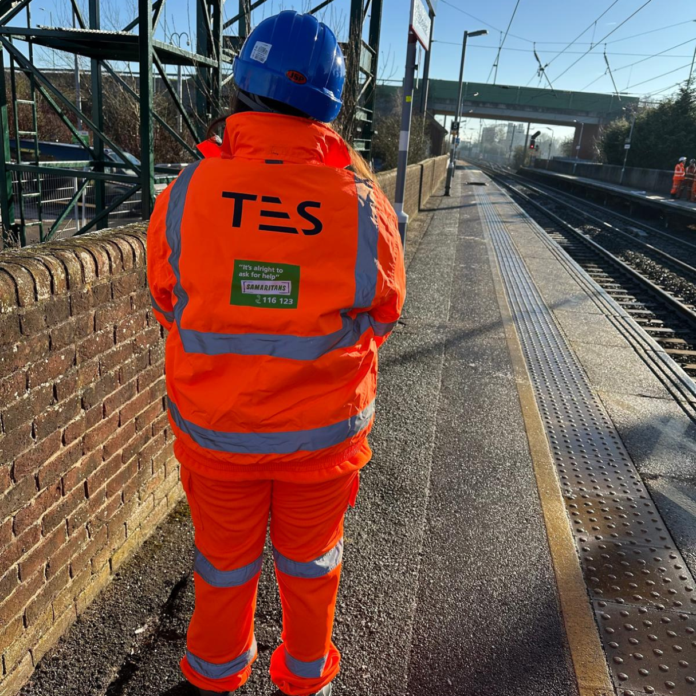
TES has taken a direct and proactive approach to suicide prevention, aligning our actions with emerging industry expectations and the principles set out in BS 30480: Suicide Prevention in the Workplace. This new British Standard provides guidance for organisations on identifying suicide risk, supporting employees in crisis, and embedding compassionate, preventative practices across the workforce. In this spirit, TES has partnered with the Samaritans to ensure support is visible at the point of need — including placing the Samaritans number (116 123) and logo on the back of PPE so help is accessible on site, at the moment it may be needed most.
Paul described this as rare within the industry. He also shared a candid account of a late-night welfare call from a senior site colleague in crisis. What followed was an emotional 45 minutes on the phone, and a welfare meeting booked by the following morning. That colleague, Paul said, is now in a much better place. And this is where the people-first approach truly shines.
As Paul put it: “Work is not the be-all and end-all. The individual matters more than delivering the work. And people are aware of that — it does get out through word of mouth.”
Wellbeing Starts with Security
The TES team were thoughtful about something often absent from wellbeing conversations: financial security as a foundation for mental health. Carley Anderson linked TES’s people agenda with a clear commitment to pay rates that surpass the minimum wage, treating fair compensation as an extension of the TES duty of care. As Carley put it, “Maslow’s hierarchy applies here too, when a team feels financially secure, they are better positioned to prioritise their mental health.”
Bianca reinforced the point, adding:
“Financial wellbeing is part of mental wellbeing and we recognise that. We’re operating in one of the toughest commercial climates rail has seen, and we’re working hard with our clients to improve where we can. It’s a balance: keeping our people secure in their jobs while continuing to push for the reward and recognition they deserve.”
A Message for the Wider Industry
TES has been a committed member of the Railway Mental Health Charter for five years, standing alongside operators, suppliers and industry bodies who share the same goal: to create a culture where mental health is spoken about openly and support is accessible to all. Through ambassador events, shared resources, and joint learning across the Charter community, TES continues to contribute to and learn from the wider industry effort. But the team were candid that there is still often a reluctance across the sector to talk openly about this work.
Carley pointed to something that makes the conversation urgent for the whole industry:
“As the younger generation comes through the workforce, mental health is a significant factor for them. It’s something we need to broadcast more widely to get the younger generation into TES and the wider industry.”
TES is proving that in an industry grappling with an ageing workforce, the most effective way to attract talent is to become a place where people feel genuinely valued. As Paul concluded, “We’re trying to make a difference to people. That’s the overarching thing. We want them to know that we’re there if they need us.”
Mental health in rail is a collective challenge — and a collective opportunity. TES is proud to stand alongside the many organisations, ambassadors and individuals across the Railway Mental Health Charter who are working to make our industry a place where people feel valued, supported and safe to speak up. Because real change happens when we do it together.
Would you like to partner with TES to expand wellbeing awareness?
TES, where Together, Everyone Succeeds.
Email info@tes2000.co.uk, visit tes2000.co.uk or call 01206 799 111.