


Avanti West Coast generated more than £5bn of value for the UK economy last year, according to a new report examining the wider economic, social and environmental impact of intercity services on the West Coast Main Line.
The independent study, produced by transport consultancy Steer, estimates that every £1 invested in Avanti West Coast’s services, workforce and supply chain generates £5.10 in wider economic value.
More than £4bn of the overall impact is attributed to benefits created by running intercity rail services, including passenger time savings, improved connectivity between major economic centres, productivity gains and the environmental and social benefits associated with reducing car and domestic air travel.
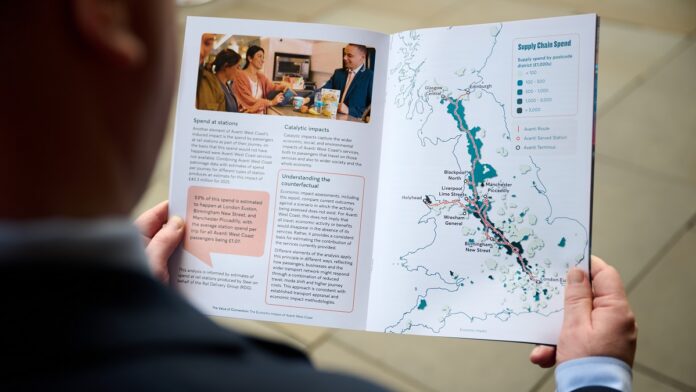
The report, launched at Avanti’s Stakeholder Conference in Manchester, also highlights the scale of expenditure flowing through the railway supply chain, with more than £700m spent with suppliers across the UK.
£4bn attributed to benefits of connectivity
The study attempts to quantify the value created by connecting cities and regions along the West Coast Main Line rather than looking solely at the operator’s direct financial contribution.
London accounts for £1.6bn of the identified economic, social and environmental benefits, followed by £1.2bn in North West England and £640.9m in the West Midlands. The report attributes a further £304m to Scotland and £154m to Wales.
The findings underline the economic role of long-distance rail connectivity between some of Britain’s largest cities and employment centres.
Andy Mellors, Managing Director at Avanti West Coast, said: “This report highlights the wider impact of Avanti West Coast in creating value through everyday railway journeys.
“We’re incredibly proud to serve the towns, cities and regions across the West Coast Main Line. It is important that the value we create extends beyond the railway itself – supporting jobs and businesses, improving connectivity between major economic centres, and delivering benefits for customers, communities and taxpayers alike.”
Rail journeys replace road and air travel
Steer’s assessment also places significant value on the environmental impact of passengers choosing rail instead of other modes.
During 2025, journeys made on Avanti services are estimated to have avoided more than two billion kilometres of road travel and 261,000 tonnes of carbon emissions.
The report values the resulting environmental benefits at more than £100m, alongside wider benefits associated with reducing road congestion.
It also estimates that Avanti services replace more than one million air journeys annually, equivalent to avoiding more than 114,000 tonnes of CO2 emissions.
For the wider rail industry, those figures add to the economic case for maintaining competitive intercity journey times, frequency and reliability. The environmental advantages of rail depend not simply on operating lower-carbon transport, but on providing a service capable of attracting passengers who might otherwise drive or fly.
More than £700m flowing into rail supply chain
The report also provides an indication of the economic footprint created by operating a major intercity railway.
Avanti spends more than £700m with suppliers, covering activities ranging from train and station cleaning and catering to food and drink provision, fleet maintenance and upgrade programmes.
Of that expenditure, 41% goes to suppliers in London, 20% to North West England and 17% to the West Midlands. Scotland and Wales each account for 7%.
A further £100m is invested in Avanti employees through salaries, uniforms, equipment and training.
The subsequent spending of earnings by Avanti employees and workers throughout its supply chain is estimated to generate another £523.1m of economic activity, equivalent to supporting a further 6,500 UK jobs.
That multiplier effect demonstrates how expenditure on railway operations can extend through regional economies and supply chains well beyond the operator itself.
Social value estimated at £471m
Steer also estimates that Avanti generated approximately £471m of social value through community partnerships, accessibility initiatives and education programmes.
More than 2,000 young people were supported through educational initiatives, while 290 community projects were delivered across the route.
Passenger Assistance use increased by 30%, which the operator includes within its wider work to improve accessibility and inclusion.
Mellors said: “The true value of train travel is often overlooked, with each journey made having a different, individual reason. Our services enable people to travel for work, study, leisure, or to see friends and family, and provide access to opportunities which enable businesses to grow and allow communities to thrive.”
Making the economic case for intercity rail
The report arrives at an important point for the West Coast Main Line, with the railway preparing for structural reform and major decisions continuing over how future passenger growth and capacity will be accommodated.
Its £5bn headline figure is a modelled assessment of wider value rather than revenue generated directly by Avanti. That distinction is important, but so too is the wider argument behind the analysis.
Assessing an intercity railway purely through fares, operating costs or subsidy captures only part of its economic role. Business connectivity, labour market access, supply chain expenditure, congestion reduction and the ability to shift journeys from road and air all contribute to the case for rail investment.
For the industry, the report therefore provides another attempt to put a financial value on something often harder to demonstrate: the economic activity enabled by reliable connections between Britain’s major cities.
As decisions are made about the future structure and investment priorities of the railway, demonstrating those wider benefits will become increasingly important in making the case for maintaining and improving intercity connectivity.


