


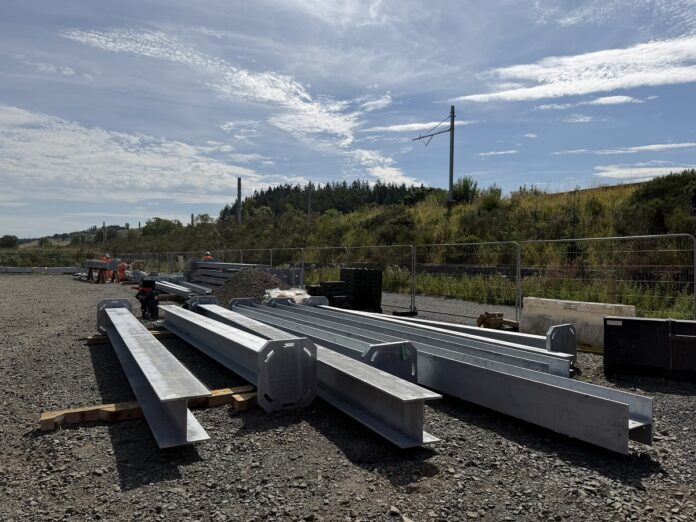
Electrification of the Borders Railway is becoming increasingly visible, with engineers beginning to install the steel masts that will eventually support overhead wires for a new generation of battery-electric trains.
The work forms part of a £26.2 million Scottish Government investment to electrify 13km of the route between Edinburgh and Tweedbank, supporting plans to introduce battery-electric rolling stock in the early 2030s.
Since construction began in March, teams have concentrated on installing foundations for around 350 new overhead line structures. Approximately half of those foundations have now been completed, allowing work to move onto the erection of steel masts and supporting equipment between Tweedbank and Bowshank Tunnel near Stow.
Most construction is being carried out overnight and at weekends to limit disruption to passenger services.
Once the structures have been erected, engineers will move onto installation of the overhead wiring, followed by testing and commissioning ahead of the future introduction of battery-electric trains.
One of the significant advantages for the project is that electrification was considered when the Borders Railway was rebuilt ahead of its reopening in 2015.
Bridges, stations and other infrastructure were designed with the possibility of future electrification in mind, reducing the amount of reconstruction now required to accommodate overhead line equipment.
Lynsey Maclean, Scheme Project Manager at Network Rail, said: “This is an exciting stage of the project because people can now start to see the railway changing. A huge amount of work has gone into planning and building the foundations, much of it behind the scenes, so seeing these new structures appear is a real achievement.
“What makes this project unique is that many of the decisions needed for electrification were taken when the railway was rebuilt more than a decade ago. That means we’re able to deliver this significant upgrade with far less disruption than would otherwise have been needed.
“We know the Borders Railway plays an important role in communities across the region. We’re making good progress in this next phase, and I’d like to thank passengers and our neighbours for their patience and understanding as work continues over the coming months.”
The project forms part of Scotland’s wider strategy to reduce diesel operation on the railway through a combination of conventional electrification and battery-electric rolling stock.
Partial electrification can allow battery trains to recharge while operating beneath overhead wires before continuing onto sections without conventional electrification, potentially reducing the amount of infrastructure required compared with wiring an entire route.
The latest milestone was marked by a visit from Calum Kerr, MSP for Midlothian South, Tweeddale and Lauderdale.
He said: “It was fantastic to see the progress being made on the Borders Railway electrification project and to meet the team delivering this important investment. The Borders Railway has already transformed connectivity for communities across the region, and these improvements will help make rail travel even more sustainable and reliable.
“I will continue to support efforts to extend the Borders Railway so that the whole region can benefit from the economic and social opportunities that improved rail links can bring.”
The Borders Railway currently runs between Edinburgh Waverley and Tweedbank and reopened to passengers in September 2015 after more than four decades without services along much of the route.
The latest investment represents another significant development for the line, with infrastructure originally designed to accommodate future electrification now being put to use as Scotland prepares for the next generation of rolling stock.


