


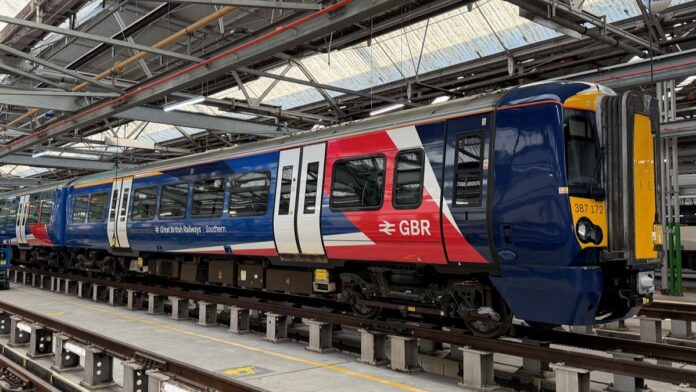
The first Great British Railways (GBR)-branded train has officially been unveiled, marking another major milestone in the government’s rail reform programme and the continued transition towards a unified, publicly owned railway.
The newly branded Class 387 train, operated by Southern, was unveiled in Brighton ahead of Govia Thameslink Railway (GTR) entering public ownership on 31 May 2026. The move will bring Thameslink, Southern, Great Northern and Gatwick Express services under Department for Transport Operator Limited (DFTO) control.
The launch represents one of the clearest public signals yet of how Great British Railways will begin reshaping the identity and structure of Britain’s railway following decades of fragmentation under privatisation.
The new red, white and blue GBR branding is expected to gradually appear across trains, stations, staff uniforms and digital platforms as operators transfer into public ownership over the next 18 months.
The government said the phased rollout is designed to ensure value for taxpayers while creating a more unified passenger experience across the network.
Transport Secretary Heidi Alexander described the unveiling as “an important step towards building a more joined-up, publicly owned railway that puts passengers first”.
The latest transfer means around 80% of future GBR passenger journeys will soon be taking place on publicly owned operators. Existing publicly owned operators already include LNER, Northern, Southeastern, TransPennine Express, South Western Railway, c2c and Greater Anglia, with Chiltern Railways and Great Western Railway scheduled to follow later in 2026.
Alongside physical branding changes, the government also confirmed the GBR identity will form part of a new integrated ticketing app designed to simplify rail travel. The platform will include journey planning, best-price ticket purchasing without booking fees and Passenger Assist functionality.
The announcement also reinforces the wider operational integration already taking shape across parts of the railway. In recent months, operators and Network Rail routes have increasingly been moving towards unified leadership structures, integrated station management and joint operational teams ahead of GBR formally becoming operational.
For the rail industry and supply chain, the unveiling is significant not simply as a branding exercise, but as another indicator that structural reform is now moving from policy into visible operational delivery.
The move towards a single national identity is likely to have wider implications across procurement, digital systems, customer information, standards and operational governance over the coming years.
For SMEs and suppliers, greater standardisation under GBR could eventually reduce complexity created by multiple operator-specific requirements, although transition periods may also create short-term uncertainty around branding, contracts and system integration.
The government also used the announcement to highlight performance improvements among publicly owned operators. c2c and Greater Anglia continue to rank among the country’s strongest performers for punctuality and reliability, while South Western Railway has accelerated the rollout of its Arterio fleet since entering public ownership.
The GBR programme is expected to complete by the end of 2027, ultimately bringing passenger services under a single integrated organisation responsible for operating, maintaining and improving Britain’s railways.


