

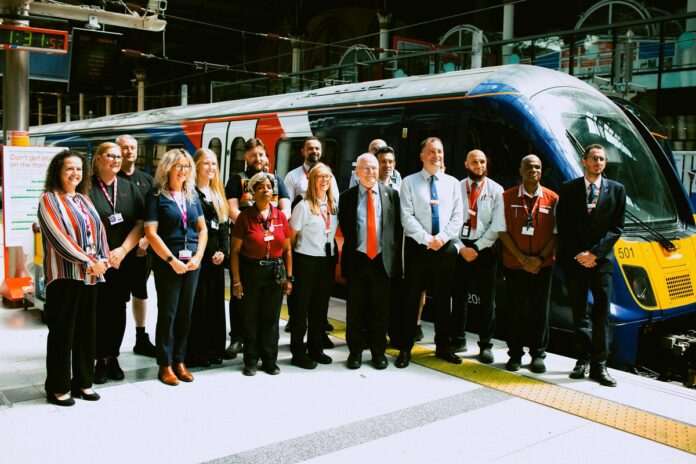
The first trains carrying the new Great British Railways (GBR) identity have been unveiled in the East of England, marking another milestone in the Government’s programme to integrate track and train operations ahead of the creation of Great British Railways.
Rail Minister Lord Peter Hendy joined GBR Anglia Managing Director Jamie Burles at London Liverpool Street station to reveal the first c2c and Greater Anglia trains in the new red, white and blue GBR Anglia livery.
The launch represents the public face of the new integrated railway, which brings together c2c, Greater Anglia and Network Rail Anglia under a single leadership team to improve operational coordination, reliability and customer service across the region.
Track and train brought together
GBR Anglia is one of a growing number of integrated railways being established ahead of the formal creation of Great British Railways, alongside GBR South Eastern, GBR South Western and most recently GBR West Midlands.
The new structure is intended to enable infrastructure managers and train operators to make decisions jointly, improving service resilience while simplifying accountability.
Rail Minister Lord Peter Hendy said: “Track and train are two sides of the same coin but for too long they operated independently of each other, with passengers and taxpayers left to bear the consequences.
“By uniting track and train under one identity and leadership in Anglia, we’re creating a more reliable service that will put passengers first. It’s all part of our plan to deliver the biggest reform of our railways in a generation, creating more growth, jobs and homes as we work to set up Great British Railways.”
Early operational benefits
While the new branding provides a visible symbol of the reforms, Network Rail said closer collaboration between infrastructure and train operators is already delivering practical benefits.
One example has been the approval of Greater Anglia’s Class 720 fleet to operate on the c2c network, providing greater operational flexibility when trains are unavailable or services are disrupted.
Joint planning between c2c, Greater Anglia and Network Rail Anglia has also helped support major events, including additional services for Southend United supporters travelling to Wembley.
Meanwhile, collaboration between Greater Anglia and Network Rail has enabled a trial of overnight Friday Stansted Express services after engineering work was reviewed and adjusted while maintaining essential maintenance activities.
Jamie Burles, Managing Director of GBR Anglia, said: “Seeing the first GBR Anglia trains together at London Liverpool Street is a proud moment and a clear sign of the railway we are building. More importantly, the new identity reflects c2c, Greater Anglia and Network Rail Anglia increasingly planning and delivering as one railway.
“We are already creating greater flexibility across our train fleets, planning major events more effectively and using closer track-and-train working to trial new services for customers.
“There is much more to do, but we have made a strong start. Our focus is on turning that progress into better journeys and a more reliable, responsive and efficient railway for everyone who depends on us.”
Gradual rollout across the region
Passengers will begin seeing more trains carrying the GBR Anglia branding over the coming months as vehicles undergo planned maintenance and repainting.
Existing Greater Anglia and c2c branding will be replaced progressively, while the internationally recognised Stansted Express brand will be retained under the new identity as GBR Stansted Express.
The new branding will also be introduced gradually across stations, signage, customer communications and staff materials.
During the transition, passengers will continue to see a mixture of GBR Anglia, Greater Anglia and c2c branding across the network, with no changes to train services, ticketing or customer arrangements.
The unveiling is another visible step in the Government’s rail reform programme as integrated regional railways continue to be established ahead of Great British Railways taking responsibility for a more unified, passenger-focused railway.