


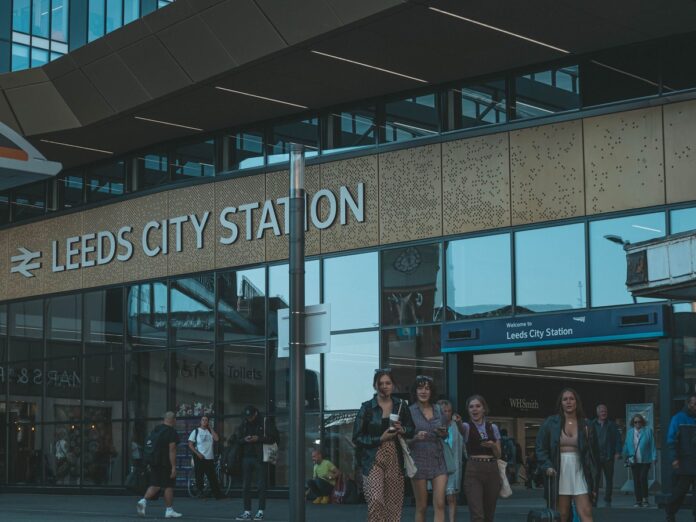
Leeds railway station is set for a £300 million transformation after the Government confirmed an additional £200 million investment to improve passenger capacity, accessibility and connections across one of the North’s busiest transport hubs.
Announced as part of the Budget on 28 October 2026, the funding will support a major programme of improvements scheduled for completion by 2030, including a new central overbridge, three additional station entrances, expanded concourse space and an extension to platform 14.
The investment is intended to tackle congestion at a station already handling more than 27 million passengers annually, while preparing the infrastructure for future demand associated with the Transpennine Route Upgrade (TRU) and Northern Powerhouse Rail (NPR).
The additional funding brings the Government’s stated investment in the station improvements to £300 million.
Major changes to station layout and passenger capacity
The proposed improvements will address some of the capacity and circulation challenges at Leeds, which is the UK’s third busiest railway station outside London.
A new central overbridge will provide additional routes through the station, helping distribute passenger movements more effectively and reducing pressure on existing circulation areas.
The scheme will also increase the number of ticket barriers by nearly 40%, creating additional capacity at gatelines where passengers can currently experience congestion during busy periods.
Lift capacity will be increased to improve accessibility, while expanded concourse areas will provide more space for passengers moving between platforms, entrances and station facilities.
Platform 14 will also be lengthened, supporting the station’s ability to accommodate future operational requirements.
The improvements are designed to make journeys through Leeds station quicker and easier, particularly during peak periods when passenger numbers place considerable pressure on existing facilities.
Three new entrances to improve city centre connectivity
A significant element of the programme involves creating three additional entrances, improving connections between the railway station and surrounding parts of Leeds city centre.
The new access points will strengthen links to the South Bank, the Dark Arches and Princes Square.
These improvements are intended to make the station more accessible from different parts of the city while supporting regeneration and commercial development around the railway.
Leeds South Bank has been identified as an important area for future economic growth, making improved connections to the station particularly relevant to the city’s wider development plans.
By creating more direct pedestrian routes, the scheme could also reduce the need for passengers to move through the busiest parts of the station when accessing surrounding destinations.
Transport Secretary Heidi Alexander said: “Leeds station is the gateway to West Yorkshire, and this extra £200 million investment will turn it into a station this city can be proud of: modern, welcoming and built for the people who rely on it every single day.
“The great cities of the North deserve better transport and that’s exactly what we’re delivering. We’re paving the way for Northern Powerhouse Rail, forging stronger connections across the region and backing the infrastructure that creates jobs, builds homes and puts passengers first as we work to set up Great British Railways.”
Preparing for Transpennine Route Upgrade and Northern Powerhouse Rail
The investment is closely linked to the wider programme of railway improvements planned across northern England.
Leeds is a critical interchange for regional and intercity services, with approximately eight in ten train services in West Yorkshire starting or terminating at the station.
Its capacity and operational performance therefore have implications for railway connectivity across the wider region.
The Government says the station improvements will help prepare for the £11 billion Transpennine Route Upgrade, which is intended to increase passenger capacity by 30% and electrify key sections of railway across the North.
As TRU progresses, improved infrastructure at Leeds will be important in accommodating additional passengers and supporting more reliable connections between major cities.
The station investment also forms part of preparations for Northern Powerhouse Rail, which aims to provide faster, more frequent services between northern cities.
The Government’s ambition is to create a high-frequency, ‘turn-up-and-go’ railway, with multiple trains per hour on key routes.
Delivering those improvements will require sufficient capacity not only on the railway itself but also at major stations where passengers interchange between services.
Passenger numbers expected to rise significantly
The case for investment is reinforced by forecasts of substantial passenger growth.
Leeds station currently handles more than 27 million passengers annually, with the Government forecasting an increase of almost 12 million passengers per year by 2043.
That would place additional pressure on station entrances, concourses, gatelines, lifts and pedestrian routes unless capacity is increased.
The proposed works are intended to address existing congestion while providing infrastructure capable of accommodating future growth.
For the rail industry, the programme illustrates the importance of station capacity in delivering wider network enhancements.
Additional train services and increased route capacity can only deliver their full benefits if stations are able to manage the resulting passenger movements safely and efficiently.
The planned overbridge, expanded gatelines and additional entrances are therefore important components of the wider railway investment programme, rather than simply improvements to passenger facilities.
West Yorkshire investment gathers momentum
The announcement follows the Government’s confirmation earlier in October that a new railway station will be developed at Bradford Interchange as part of Northern Powerhouse Rail.
Together, the Leeds and Bradford projects represent significant proposed investment in two of West Yorkshire’s principal transport hubs.
The schemes are intended to complement wider regional transport plans, including the proposed West Yorkshire Mass Transit system and the development of the Weaver Network.
West Yorkshire Mayor Tracy Brabin welcomed the Leeds funding, highlighting the station’s importance to the regional economy.
“Leeds Station is the beating heart of our region’s transport network, connecting millions of people to jobs, education and opportunity every year – and it’s only going to get busier.
“This investment will benefit passengers and businesses, help to unlock the capacity we need for future growth and create a gateway to West Yorkshire that reflects our ambition.
“Together with our wider plans for West Yorkshire’s Weaver Network, we’re building a better-connected region which works for all.”
Significant programme for the rail supply chain
With the Government targeting completion by 2030, the station transformation represents a substantial programme of railway infrastructure and construction activity over the coming years.
The works will involve changes to passenger circulation, station structures, platform infrastructure and accessibility facilities within a heavily used operational railway environment.
Delivering the improvements while maintaining passenger services will require careful coordination between construction activities, station operations and wider railway programmes.
The new overbridge and entrances will also need to integrate with the existing station layout and surrounding urban infrastructure.
For contractors and specialist suppliers, the programme could generate opportunities across civil engineering, structural works, station systems, accessibility infrastructure and associated construction disciplines.
The Government has not detailed the procurement arrangements or construction phasing in its announcement, meaning further information will be required before the precise opportunities for the supply chain become clear.
The additional £200 million commitment nevertheless provides greater funding certainty for a project intended to address both immediate passenger needs and longer-term railway growth.
With improvements scheduled for completion by 2030, Leeds station is set to become a central element of the wider programme to increase rail capacity and connectivity across West Yorkshire and northern England.


