


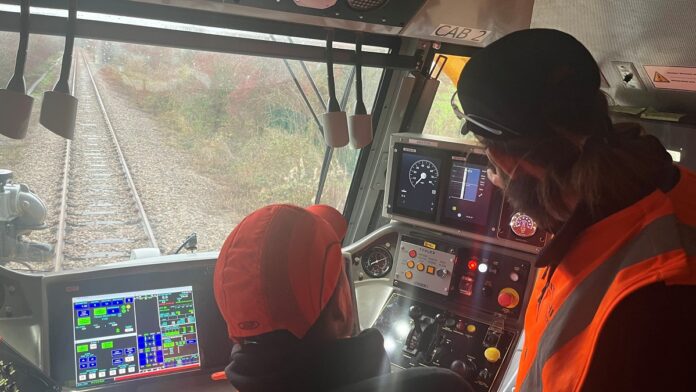
Loram has begun installing European Train Control System (ETCS) equipment on a second rail grinding machine, marking another milestone in preparing Britain’s specialist engineering fleet for the transition to digital in-cab signalling.
The installation is being carried out on C44 Rail Grinder C44-02 at Loram’s engineering facility in Derby, using ETCS technology supplied by Hitachi Rail.
The project is Loram’s first ETCS installation funded through the East Coast Digital Programme (ECDP), which is preparing the East Coast Main Line for the removal of conventional lineside signals and the introduction of digital train control.
The work follows the successful introduction of Hitachi Rail’s ETCS equipment on Loram’s new RGC rail grinding unit earlier in 2026, providing a foundation for extending the technology across the company’s existing C44 fleet.
For the wider rail industry, the project represents an important step in demonstrating how digital signalling can be integrated into specialist on-track machinery, ensuring that maintenance and engineering operations can continue as the network transitions away from traditional signalling systems.
Preparing specialist engineering fleets for digital operation
While much of the focus surrounding ETCS deployment has centred on passenger and freight rolling stock, specialist engineering vehicles also need to be equipped to operate on digitally signalled routes.
Rail grinders perform an essential role in maintaining rail profiles, managing rail wear and supporting track condition across the national network.
As conventional lineside signals are removed from sections of the East Coast Main Line, these machines will need compatible onboard signalling equipment to continue operating under the new arrangements.
Loram’s C44 fleet comprises three rail grinders deployed by Network Rail to support track maintenance and asset management activities.
The latest installation is being undertaken in collaboration with Hitachi Rail, Network Rail and Colas, which operates the C44 grinder.
Work on C44-02 began in June 2026, with Loram’s Derby-based engineering and installation teams carrying out the fitment with support from the wider project partners.
Lee Tinney, Managing Director of Loram EMEA, said: “Following successful introduction of ETCS to our RGC Rail Grinder I am delighted that we are now expanding our ETCS fitment programme to the C44 grinder fleet, three of which are deployed by NR to support track maintenance and management teams across the network.
“I’d like to thank Loram’s engineering and installation teams, as well as our partners at Hitachi Rail, Network Rail, the East Coast Digital Programme and Colas for their support with this fitment programme, which is helping us to showcase how ETCS can be fitted to On Track Machines both cost effectively and at pace.”
Testing programme to begin in Derby
Following the installation work, C44-02 is scheduled to undergo static testing at the Rail Technical Centre (RTC) in Derby.
Dynamic testing will then take place at Network Rail’s test track facility at Melton towards the end of 2026, allowing the installed equipment to be assessed under operational conditions.
Subject to the successful completion of testing and commissioning, the machine is expected to be handed back to Colas for operational deployment in early 2027.
Initially, C44-02 will operate with its ETCS equipment in dormant mode, allowing it to continue working on the existing railway while the necessary approvals and assurance processes are completed.
Activation of ETCS Level 2 will follow an agreed programme aligned with Network Rail’s plans to remove conventional lineside signals from the southern section of the East Coast Main Line and other approved routes.
Once the machine has been evaluated in operational service, Loram intends to begin fitting ETCS to a third rail grinder, C44-03, at its Derby facility.
This phased approach will allow lessons from installation, testing and operational deployment to inform subsequent conversions.
Supporting the East Coast Main Line’s transition to digital signalling
The East Coast Digital Programme is delivering a fundamental change in how trains are controlled on one of Britain’s busiest main lines.
ETCS Level 2 enables movement authorities and signalling information to be communicated directly to the driver’s cab, reducing reliance on conventional lineside signals.
However, the transition requires more than equipping passenger trains and locomotives. Specialist maintenance vehicles must also be capable of operating within the new signalling environment.
Network Rail sees the work being undertaken with Loram as an opportunity to establish approaches that can be applied to other types of on-track machinery.
Chris Hobden, Programme Director for the East Coast Digital Programme at Network Rail, said: “We’re pleased to see continued progress from Loram, and partner collaboration, to deliver digital in-cab signalling to another on track machine. This pioneering work with grinders will provide valuable learnings for the OTM sector as a whole.
“Progressing OTM fitment is an important part of our overall strategy to get to signals away on the East Coast Main Line, the end goal being a more reliable, more capable and even safer railway for customers.”
The project highlights an important consideration for the wider rollout of ETCS across Britain’s railway: the need to ensure that engineering fleets are not left behind as infrastructure is modernised.
Unlike conventional passenger rolling stock, on-track machines often incorporate specialist equipment, operating systems and vehicle configurations, making digital signalling integration a potentially complex engineering challenge.
Demonstrating repeatable and cost-effective installation methods could therefore help reduce the time and resources required to prepare other engineering vehicles for digital operation.
Hitachi Rail highlights importance of fleet compatibility
Hitachi Rail is supplying the ETCS technology for the installation, building on its involvement in the earlier RGC rail grinder project.
The company believes extending digital signalling capability to specialist machinery is essential to achieving the wider benefits of the East Coast Digital Programme.
Paul Maynard, Vice President of Mainline Signalling at Hitachi Rail SRS UK, said: “The installation of ETCS on a second Loram rail grinder highlights the momentum behind digital railway transformation in the UK. As the East Coast Digital Programme continues to progress, it is essential that engineering fleets are equipped to operate seamlessly within a digital signalling environment.
“For Hitachi Rail, this is another important example of how we are applying our digital signalling expertise across a diverse range of rail vehicles, supporting the industry’s transition to ETCS.
“By working collaboratively with our industry partners, we are demonstrating that ETCS can be delivered effectively on specialist on-track machinery, helping to unlock the benefits of increased safety, improved operational flexibility and greater network performance.”
Wider implications for the on-track machine sector
The installation on C44-02 forms part of a broader industry challenge to prepare a diverse fleet of engineering and maintenance vehicles for the introduction of digital signalling.
On-track machines are critical to maintaining and renewing railway infrastructure, frequently operating during engineering possessions and undertaking specialist activities that cannot be performed by conventional rolling stock.
Ensuring these vehicles remain compatible with future signalling arrangements will be essential to maintaining engineering access and operational flexibility as more routes adopt ETCS.
The collaboration between Loram, Hitachi Rail, Network Rail and Colas provides an example of how vehicle owners, operators, technology suppliers and infrastructure managers can work together to address those requirements.
With testing scheduled for later this year and operational deployment expected in early 2027, the next stage will be demonstrating that the installation performs reliably in service and that the approach can be repeated across additional machines.
As the East Coast Digital Programme progresses towards the removal of lineside signals, the successful integration of specialist engineering fleets will be an important part of ensuring the transition delivers its intended safety, capacity and reliability benefits without compromising the railway’s ability to maintain its infrastructure.


