

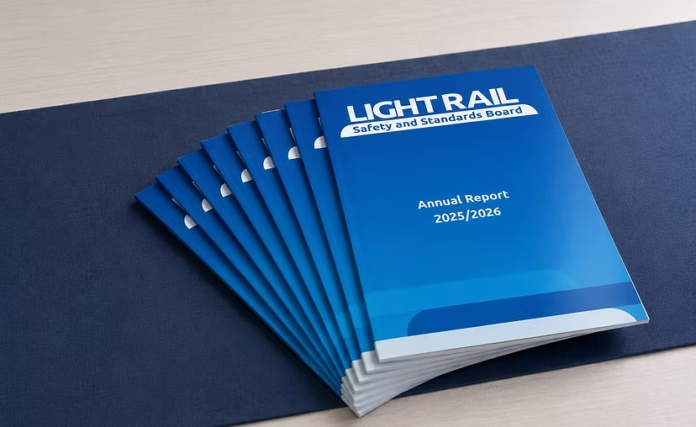
The Light Rail Safety and Standards Board has estimated that its centralised approach has delivered more than £33 million in added value to the UK light rail sector, while updated modelling shows a 27 per cent reduction in overall safety risk.
The figures are contained in LRSSB’s 2025/26 Annual Report, the first published under its three-year strategy running to 2028.
The report says the estimated savings reflect the value of developing research, guidance, standards and safety tools once for the whole sector, rather than requiring individual operators, owners and authorities to procure similar work independently.
LRSSB said the approach had also supported continued Department for Transport backing, including a new three-year Grant Funding Agreement and associated Memorandum of Understanding. fileciteturn0file0
A major focus during the year was the latest update to the sector Safety Risk Model, based on data from all seven UK tram networks.
Estimated total collective risk has fallen to 9.39 Fatalities and Aggregated Injuries per year, a reduction of 27 per cent compared with the previous model. Total fatal risk fell by an estimated 1.59 fatalities per year.
The report said risk exposure had reduced across all population groups, although members of the public continue to account for the highest proportion of total and fatal risk. Events outside the direct control of tram operators, including the actions of road users and pedestrians, remain the largest source of overall risk.
Hazardous events showing the greatest reductions included collisions between trams and pedestrians, assaults on tram systems, collisions involving unauthorised members of the public and collisions with road vehicles at crossings.
The ten highest-risk hazardous events still account for more than 60 per cent of the sector’s overall risk profile, while the top ten risk precursors account for more than 65 per cent.
LRSSB said further reductions were expected as operators continue to introduce overspeed protection, driver vigilance systems and rolling stock replacement programmes.
The report also highlights a major upgrade to the Tramway Accident and Incident Reporting system, known as TAIR.
The upgraded platform provides improved reporting, data management and integration with operators’ existing systems through an application programming interface. It also includes enhanced regulatory reporting, GDPR compliance, asset location data and metadata.
Around 4,000 previously unavailable records were added to TAIR during the year as part of a programme to complete gaps in historical data. The platform now contains around 62,000 entries, strengthening the evidence available for risk modelling and sector analysis.
LRSSB also launched a national safety campaign aimed at passengers, pedestrians, employees and others who come into contact with tram networks. The campaign was adopted across the UK light rail sector, with effectiveness surveys undertaken following its introduction.
Research, development and innovation accounted for around one-third of LRSSB’s budget during the year.
Projects included the evaluation of the Starling artificial intelligence platform for real-time monitoring and predictive analysis, virtual reality training, collision avoidance technologies, pedestrian crossing risk reduction and research into automated tram operation.
The organisation also continued work on a digital safety and cyber security programme based on guidance from the Institution of Engineering and Technology and the National Cyber Security Centre. A programme of audit visits is under way alongside the development of training, guidance and risk assessment tools.
Another significant development was the launch of SkillsHub, a sector-wide learning and competence platform.
Five tram networks were live on the system by the end of the reporting period, with Blackpool and London scheduled to join in July 2026. More than 2,500 courses had been completed, with LRSSB estimating that the platform had saved around 630 hours of administration time.
Active users are expected to rise to around 1,400 once the additional networks are onboarded.
The organisation also expanded its standards work during the year. Its library now includes more than 80 documents available free of charge, with ten Safety Management System tools and four additional guidance documents published in 2025/26.
LRSSB has appointed a dedicated Standards Manager and strengthened its relationship with the British Standards Institution, giving it oversight of more than 25 active urban rail working groups and developing standards.
The report also confirms that LRSSB has completed its move to become a fully independent organisation, with a revised membership model and board structure giving tram operators, owners and authorities greater direct involvement in its work.
Despite becoming independent, it will retain close links with UKTram and continue to collaborate on projects of shared interest.
LRSSB completed 83 per cent of its planned activities during the year. Eight per cent will continue into 2026/27, while nine per cent are being reassessed.
Chief Executive Carl Williams said: “I would like to thank all our partners for their efforts over the past few years as we could not deliver such impressive results alone.
“Such progress in a relatively short space of time takes everyone invested in the sector to be fully behind our mission to prevent incidents and reduce harm.”