


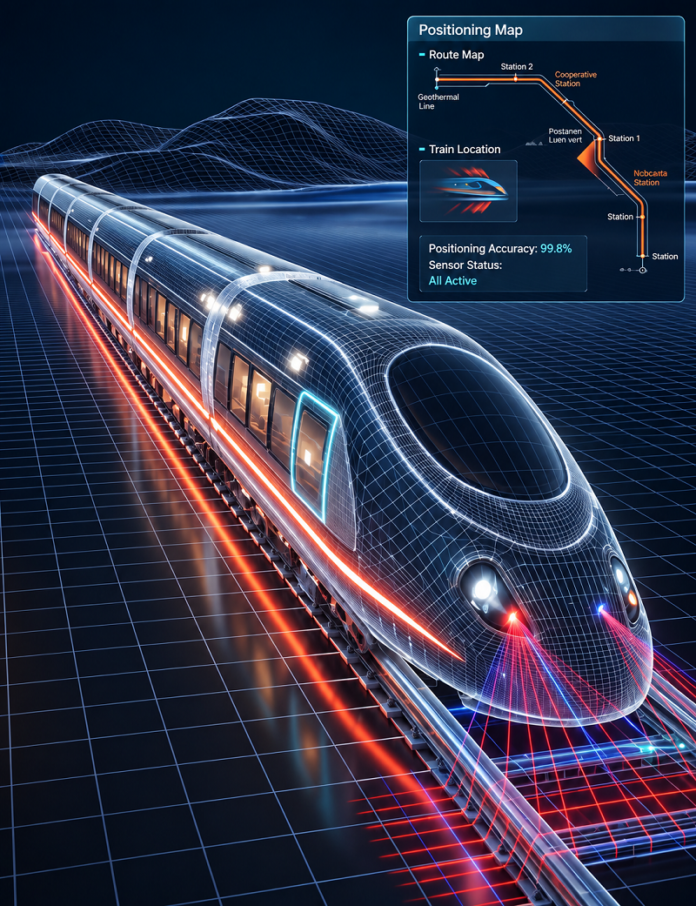
MoniRail has secured new Government-backed funding to accelerate the development and commercialisation of its quantum navigation technology, with plans to undertake operational trials on the London Underground network.
The funding, awarded by Innovate UK through its Quantum Missions Primer Phase 2 initiative, will support the development of the Rail Quantum Inertial Navigation System (RQINS), designed to provide accurate train positioning where conventional satellite navigation signals are unavailable.
The technology could help railway operators identify the precise location of train and track faults, enabling faster maintenance interventions and reducing disruption.
From research to commercial application
The latest investment builds on previous Innovate UK funding that supported the initial demonstration of RQINS and the development of a product maturity roadmap in 2025.
The next phase will focus on implementing that roadmap, developing the first commercial version of the system and progressing a second-generation solution.
MoniRail is leading a consortium involving Imperial College London, the University of Sussex, Spectomiq, PA Consulting, Transport for London (TfL), GBRX, Durham University and QinetiQ.
Imperial College London and the University of Sussex will provide quantum sensor technology, while QinetiQ and Durham University will contribute map-matching and embedded software expertise.
TfL will provide access to testing facilities and support live operational trials on London Underground. PA Consulting will contribute technical integration expertise.
GBRX, the technology and innovation body for Great British Railways, will help ensure the system can also be developed for use on Britain’s mainline railway.
Improving fault detection and railway reliability
Accurate positioning is particularly challenging in tunnels and other environments where satellite navigation signals cannot be received.
Quantum inertial navigation offers a potential alternative, enabling positioning information to be generated without continuous reliance on external satellite signals.
For railway maintenance, this could improve the accuracy with which faults are identified and located, reducing the time required to investigate and address infrastructure problems.
Peter Ainsworth, CEO of MoniRail, said: “Understanding train-position with high degrees of accuracy is critical for the ongoing safety of the railway. It means that a detected fault can be located and fixed quickly, reducing potential delays. The funding awarded as part of the Government’s investment in quantum technologies provides the key next step in the ongoing development and commercialisation of the RQINS concept and will help us to take it from proven concept to a commercially viable product that can be used on a live railway.
“Collaboration is always at the heart of our work at MoniRail and this project could not take place without our consortium partners, who each bring different expertise to the table. Working alongside TfL and GBRX from the outset will ensure the product is something that the railway can use.”
Potential for wider mainline deployment
The project follows an earlier mainline railway test of quantum navigation technology and represents another step towards operational deployment.
Toufic Machnouk, Managing Director of GBRX, said: “Quantum navigation is a highly consequential strategic technology for network systems like railways. The world’s first mainline test earlier this year was an important step in understanding how quantum navigation performs in the operating environment. This next phase will help us understand what it will take to engineer the technology for operational application, and to help us see how we can accelerate that development.”
Science, Innovation and Investment Minister Chris McDonald welcomed the investment, highlighting its wider industrial potential.
“Quantum has long been an exciting technology, but now real world applications are within our grasp.
“UK innovators are showing us what these breakthroughs could mean for our lives in the near future, from cutting down on train delays, to earlier appointments at in-demand areas of the NHS, to keeping our armed forces safe and connected as they protect our country.
“We’re backing teams across the UK to turn bright ideas into products that make a real difference, growing the economy, creating new jobs, and ensuring we can be leaders in Quantum technology for decades to come.”
The project will now focus on demonstrating whether the technology can meet the practical demands of operational railway environments.
Successful development could provide rail operators with a new tool for improving asset monitoring, fault location and network reliability, particularly across underground and tunnelled infrastructure where satellite-based positioning remains limited.


