


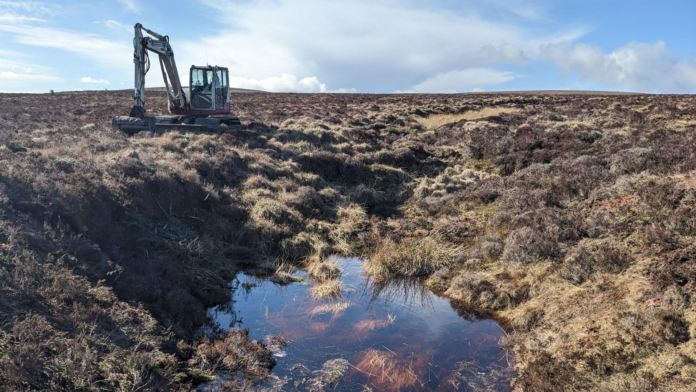
Network Rail has completed a major peatland restoration project in partnership with Forth Rivers Trust and NatureScot, restoring 273 hectares of degraded peatland in central Scotland to strengthen biodiversity, improve flood management and support the railway’s long-term climate resilience.
The project, at Knoxfauld Farm north of Dunblane, is expected to lock away around 40,000 tonnes of carbon dioxide over the next century, while helping to reduce flood risk and create healthier habitats for wildlife.
Nature-based approach to climate resilience
Working alongside local farmer Vince Janse, specialist teams restored the peatland by blocking historic drainage channels and reshaping parts of the landscape to allow water to be retained naturally.
Healthy peatlands act as important carbon stores while slowing the movement of water through river catchments during periods of heavy rainfall. Restoring these ecosystems can therefore help reduce downstream flood risk while supporting a wide range of plants and wildlife.
The project forms part of Network Rail’s wider sustainability strategy and contributes towards targets set by the Office of Rail and Road (ORR) to improve and create habitats across the railway estate.
With climate change expected to increase the frequency of extreme weather events, the rail infrastructure owner says nature-based solutions will play an increasingly important role in improving network resilience.
James Morrison, Head of Sustainability and Social Value at Network Rail, said: “This project shows the value of working in partnership to restore our natural environment. Healthy peatlands play an important role in storing carbon, supporting biodiversity and managing water naturally across the landscape.
“We’re committed to finding practical ways to tackle climate change and build a more resilient railway. Working with Forth Rivers Trust on the restoration of Knoxfauld Farm peatland is a great example of how nature-based solutions can deliver lasting benefits for both the environment and the communities we serve.”
Early environmental benefits
Project partners say the environmental improvements have already become visible, with restored habitats quickly attracting native species.
Charlotte Neary, Project Manager at Forth Rivers Trust, said: “Healthy peatlands are one of our most valuable natural habitats, storing carbon, increasing climate resilience, and providing a home for rare wildlife. The results of this project were visible within weeks, with dragonflies, amphibians and native bog plants already thriving in newly restored habitats.
“The project is a powerful example of how partnership working between a family-run farm, environmental organisations, and an infrastructure provider, can deliver lasting benefits for nature, climate and local communities.”
The initiative also forms part of a wider European programme supporting ecosystem restoration.
Ewan Lawrie, Freshwater Advisor at NatureScot, said: “Ecosystem restoration using nature-based solutions is key to tackling the twin climate and biodiversity crises. One of 17 projects across Europe, the major project at Knoxfauld is part of work delivering the upscaling of restoration by working in partnership, seizing funding opportunities to deliver benefits at a catchment scale.”
Supporting a more resilient railway
The restoration project was funded through a combination of partner investment, including support from the Horizon 2020 MERLIN programme via NatureScot.
As the railway faces increasing challenges from climate change, initiatives such as peatland restoration highlight the growing role of environmental management alongside traditional engineering. By restoring natural landscapes that capture carbon, support biodiversity and help regulate water flows, Network Rail is using nature-based solutions to improve the resilience of both the railway and the communities it serves.


