


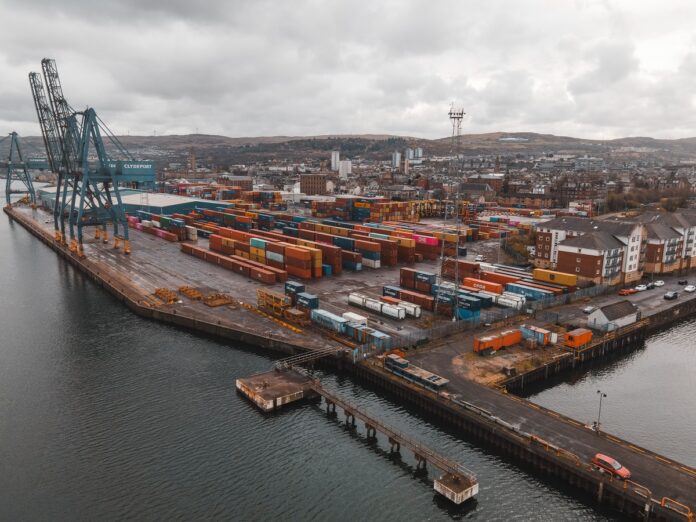
A dedicated national planning policy for freight and logistics could give rail freight terminals and intermodal facilities greater weight in development decisions, as the Government seeks to improve the infrastructure supporting UK supply chains.
The Chartered Institute of Logistics and Transport UK (CILT(UK)) has welcomed the revised National Planning Policy Framework (NPPF), published on 17 August, which introduces a standalone policy covering freight and logistics development.
Policy E3 explicitly includes rail terminals and intermodal facilities alongside storage and distribution sites, HGV operating centres, lorry parking and ports.
For the rail sector, the change is significant. Freight terminals depend heavily on suitable land, good connections to the strategic transport network and increasingly substantial electricity infrastructure. Competition for appropriate sites, particularly around major cities and logistics corridors, has long been a constraint on developing new rail freight capacity.
CILT(UK) argues that giving freight its own national planning policy should help ensure these requirements are considered earlier rather than freight infrastructure being accommodated after wider development decisions have already been taken.
Daniel Parker-Klein, Director of Public Policy, Communications and Insight at CILT(UK), said: “CILT (UK) has consistently argued that freight needs to be considered from the outset when government makes decisions about transport, infrastructure and economic growth. It shouldn’t be something we try to accommodate after everything else has been decided.
“Giving freight and logistics a dedicated national planning policy is therefore an important step. The movement of goods underpins the economy and our everyday lives, and the places and infrastructure that make those movements possible need to be properly recognised in the planning system.”
Potential boost for rail freight terminals
The explicit recognition of rail terminals and intermodal facilities could prove particularly important as government and industry seek to increase the amount of freight carried by rail.
Growing rail freight requires more than additional paths on the network. Terminals capable of transferring goods efficiently between rail and road are critical to expanding the addressable market, particularly for intermodal traffic.
Yet developing those facilities can be challenging. Suitable sites need sufficient land, road and rail access and proximity to the customers and distribution networks they serve.
Policy E3 recognises the particular operational and locational requirements of freight infrastructure, including access to appropriate transport networks, neighbouring land uses, environmental impacts and the ability to operate at night.
That recognition could help protect the operational requirements of existing terminals while strengthening the case for new facilities where demand exists.
Sue Terpilowski OBE FCILT, Chair of CILT(UK)’s Public Policy Committee, said: “For an industry that underpins virtually every part of the economy, freight has historically had a surprisingly uncomfortable relationship with the planning system. Too often the starting point has been the impacts that need to be mitigated rather than the essential economic and social function freight performs.
“Having a national decision-making policy specifically for freight and logistics is a significant and very welcome change.”
Energy infrastructure increasingly part of the freight equation
The revised framework also attempts to bring freight planning closer to another increasingly important consideration: energy.
New policies strengthen support for renewable and low-carbon energy development and electricity network infrastructure, while Policy E2 recognises that access to an adequate grid connection can contribute to the importance of a particular development location.
Although much of the immediate challenge relates to electrifying road freight fleets and logistics depots, the same issue is becoming increasingly relevant across the wider freight system.
Large logistics facilities, intermodal terminals and ports could require significantly greater electricity capacity as operators introduce electric vehicles, charging infrastructure, battery storage and other low-carbon technologies.
CILT(UK) believes planning decisions therefore need to consider freight demand, transport connectivity and electricity availability together rather than treating each independently.
Parker-Klein said: “The real test will be how these policies are applied. Decarbonising freight isn’t something planning, transport or energy policy can solve independently. Operators need the right sites, connections to the transport network and, increasingly, access to substantial amounts of electricity. Those things have to be planned together.”
Planning reform could support rail’s freight ambitions
The changes arrive at an important point for Britain’s rail freight industry.
Operators and infrastructure managers are being asked to support growth in rail freight while customers increasingly look for lower-carbon alternatives within their supply chains. Achieving that growth will depend not only on railway capacity but on having the terminals and supporting infrastructure needed to originate and receive additional traffic.
That makes planning policy an important, if sometimes overlooked, part of the rail freight growth equation.
The new framework does not guarantee approval for freight developments. Projects will still need to address their effects on highways, communities, noise, ecology, landscape, flood risk and neighbouring land uses, while Green Belt developments remain subject to specific protections.
Nor does planning approval solve constraints elsewhere, particularly electricity connections.
Terpilowski said: “Planning permission isn’t a grid connection and the new Framework won’t remove every obstacle to freight decarbonisation. But it does change the starting point of the conversation.”
For rail freight businesses, developers and investors, that change could prove valuable. If the new policy translates into planning decisions that better recognise the strategic role and specific requirements of terminals, it could remove one of the barriers to creating the additional capacity needed for rail freight to grow.
The industry’s attention will now turn from the wording of the framework to how consistently Policy E3 is applied by planning authorities in practice.


