


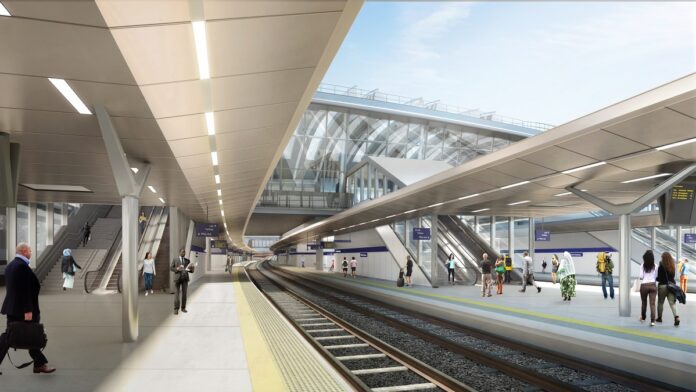
Elizabeth line passengers using HS2’s Old Oak Common station will benefit from level boarding after the rail industry agreed an engineering solution to reduce the step and gap between trains and platforms.
HS2 Ltd, Network Rail, Transport for London and the Department for Transport have agreed changes to platforms 5 to 8 that will allow many passengers with reduced mobility to board and leave Elizabeth line trains independently, without requiring a ramp or staff assistance.
The Department for Transport has approved an exemption from the usual national platform height requirements, enabling the platforms to be constructed at a height optimised for the Elizabeth line’s Class 345 trains while continuing to meet applicable accessibility requirements.
It represents a significant change from the previous design, under which the platforms would have been constructed to the standard national rail height and passengers requiring step-free boarding would have needed assistance ramps.
The issue has been under consideration for several years, with earlier work examining different options for providing level boarding at Old Oak Common.
Tracks lowered to create level boarding
Delivering the revised design will involve lowering the tracks serving platforms 5 to 8 and installing solid concrete slab track through the station rather than conventional ballast.
The platforms must still accommodate a range of passenger and freight trains, maintaining operational flexibility on the Great Western Main Line.
As a result, level boarding will specifically be available for Elizabeth line passengers when trains use their normal platforms.
For passengers, the benefits extend beyond wheelchair users. Reducing the horizontal and vertical gap between train and platform should also make boarding easier for older passengers, people travelling with luggage and parents and carers using pushchairs.
Rail Minister Lord Hendy said: “Everyone should be able to travel confidently and independently on our rail network, so I’m delighted that passengers using the Elizabeth line at Old Oak Common will benefit from level boarding and seamless step-free access.
“This is a practical improvement that will make journeys easier for thousands of people and shows what can be achieved when the rail industry works together to put passengers first.”
Step-free interchange between Elizabeth line and HS2
Old Oak Common is being developed as a major interchange between HS2, the Elizabeth line, Great Western Main Line and Heathrow Express services, providing connections to more than 100 destinations.
The station will become the Elizabeth line’s 42nd stop.
Its six underground HS2 platforms will also be step-free, meaning passengers transferring between HS2 and the Elizabeth line will be able to make a step-free journey through the station.
The significance of the Elizabeth line connection is particularly important because TfL expects its services to account for around 90% of interchanges at Old Oak Common.
TfL has previously pushed for the station to provide level boarding rather than simply step-free access to platform level. Earlier feasibility work considered lowering the tracks as one potential solution.
Mark Wild, HS2 Ltd Chief Executive, said: “Old Oak Common is set to become one of the best-connected new stations ever built in the UK and delivering step-free access here is vital for passenger safety and accessibility.
“This engineering solution shows what can be achieved when HS2, Network Rail, Transport for London, the Department for Transport, train operators and accessibility groups work together to prioritise passengers.
“The new station is projected to boost the west London economy by £10 billion over the next decade. We remain focussed on safely opening the railway from Old Oak Common to Birmingham Curzon Street in 2037 and creating a station that provides better journeys and supports growth for generations to come.”
Collaboration through HS2 Reset
The revised solution has emerged through the new Old Oak Common area delivery model established as part of the wider HS2 Reset.
It brings together organisations responsible for designing, constructing and eventually operating different elements of the station, with the level-boarding solution requiring coordination between infrastructure, rolling stock and operational requirements.
Rupert Walker, Major Programme Director at Network Rail, said: “Old Oak Common will be one of the UK’s most important transport interchanges, connecting people to more than 100 destinations across the UK. Making sure customers can move through the station and onto Elizabeth line services as independently and seamlessly as possible has been a key priority for everyone involved.
“By providing level boarding for customers using platforms 5 to 8, we’re making it easier for Elizabeth line customers to travel independently. This means more people will be able to travel with confidence, access new opportunities and benefit from the exceptional connectivity that Old Oak Common will provide.
“This outcome has only been possible through a huge joint effort by teams in HS2, Network Rail, Transport for London, the Department for Transport, train operators and accessibility groups, all working together to create a more accessible railway for everyone.”
Conventional platform construction next
Construction of Old Oak Common’s six underground high-speed platforms has now been completed, allowing work to move towards the eight conventional platforms at ground level.
These will serve the Elizabeth line, Great Western Main Line and Heathrow Express.
Andy Lord, London’s Transport Commissioner, said: “Elizabeth line passengers are expected to account for around 90 per cent of interchanges at Old Oak Common, so level boarding is vital for the safety and accessibility of our customers.
“The platforms will also be step-free from the street, benefitting local residents as well as those travelling through the station, and supporting the growth in homes planned in the area.
“The solution that has been achieved highlights the importance of collaboration in the rail industry and with stakeholders, and it is fantastic news that Old Oak Common will join the Elizabeth line’s 41 stations that provide step-free access.”
Old Oak Common’s development is also expected to act as a catalyst for regeneration across west London. The wider area is being planned around the connectivity created by HS2 and the Elizabeth line, with the station central to proposals for substantial housing and commercial development.
For the rail industry, the design change provides a practical example of accessibility requirements influencing core railway engineering rather than being addressed retrospectively.
Lowering the tracks and altering the platform relationship requires infrastructure, rolling stock and operational requirements to be considered together. At a station expected to handle significant interchange volumes, designing greater independence into the platform-train interface from the outset should reduce reliance on manual assistance while making the station easier to use for a much wider range of passengers.


