


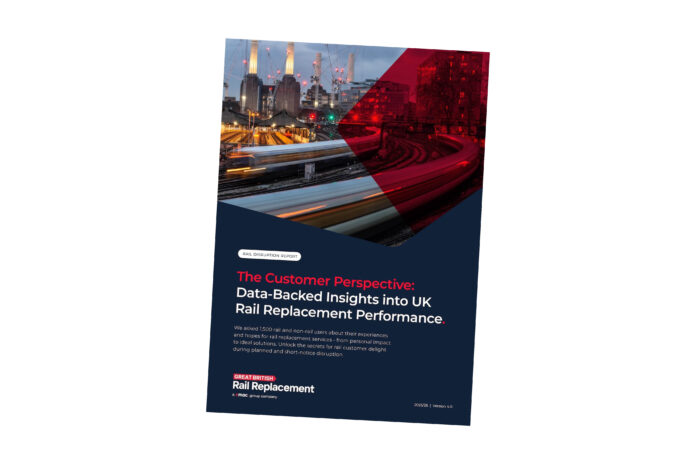
A new national survey has found that confidence in how rail disruption is managed across Great Britain is continuing to decline, with 92% of customers believing that performance has either worsened or failed to improve over the past year.
The research, carried out by Great British Rail Replacement, gathered views from more than 1,500 rail users and non-users across the UK. The findings point to disruption as one of the most persistent and damaging issues affecting passenger trust, with inconsistent rail replacement services emerging as a major source of frustration.
Passengers highlighted unclear signage, inconsistent station announcements and a lack of real-time updates as key reasons for dissatisfaction, reinforcing perceptions that disruption management remains below expectations across much of the network.
The survey also revealed significant concerns around accessibility, safety and fairness. Only 2.8% of passengers with accessibility needs said that rail replacement services fully meet their requirements, while 30% reported being left with no viable alternative when services were disrupted. Women travelling alone reported heightened safety concerns, with 33% relying on others to complete journeys during disruption. Rural passengers also appear to be disproportionately affected, with 19% saying they had cancelled travel plans altogether due to disruption.
Commenting on the findings, Ian Jeffrey, Director at Great British Rail Replacement, said:
“Incidences of rail disruption are increasing, with customers facing more than 380,000 train cancellations across Great Britain in the past year. Disruption is when customers judge the railway most, and replacement services too often add to the stress.
“Great British Railways has a real chance to set a clear national expectation for what good looks like, so rail customers know they will be supported properly wherever they travel. National standards, real-time communication and accessibility built in from the start would turn replacement from a negative experience into one that protects confidence in the railway.”
Alongside the survey, Great British Rail Replacement has published a White Paper setting out proposals for the modernisation of rail replacement services as Great British Railways prepares to unify planning and standards across the network. The paper calls for the introduction of a national standard covering information accessibility, vehicle quality, staff training, performance measurement and contingency planning.
The proposals also recommend greater investment in real-time passenger communication, faster mobilisation for both planned engineering works and short-notice disruption, transparent regional performance reporting, and closer collaboration with specialist operators using technology-enabled delivery models.
The research suggests that customer expectations are continuing to rise. While disruption has become more frequent, replacement services are often perceived as poorly coordinated, leaving passengers stranded, waiting or paying out of pocket for alternatives. One in three respondents said they would welcome cheaper replacement tickets, while many called for more frequent services and clearer information. More than 63% said they would cancel, postpone or change their mode of travel if they knew a rail replacement service was in place.
Great British Rail Replacement argues that better planning, coordination and communication could help close this gap. By improving real-time updates, raising vehicle standards and embedding accessibility from the outset, operators could provide more dependable alternatives during disruption.
The White Paper concludes that disruption does not need to undermine passenger confidence. With clearer standards, stronger communication and higher-quality replacement services, periods of disruption could become an opportunity for the rail industry to demonstrate reliability, rebuild trust and put the customer experience at the centre of service delivery.