


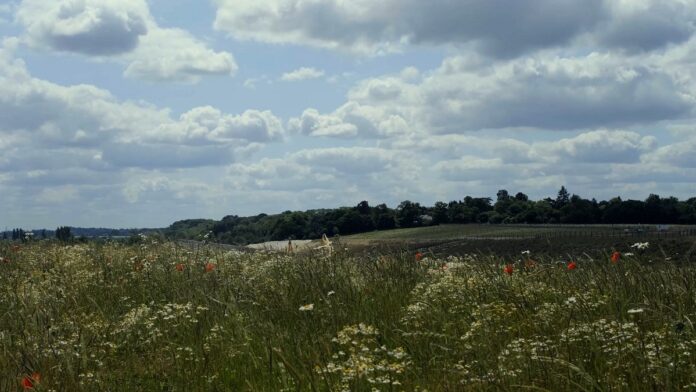
The company behind Britain’s new high-speed railway, HS2 Ltd, has revealed how progress on a major environmental project is helping wildlife to thrive. Over 100 hectares of chalk grassland are being recreated at the southern portal of the Chiltern Hills tunnel, using three million tonnes of excavated chalk.
Known as the Colne Valley Western Slopes project, the scheme is transforming 127 hectares of former agricultural land on the Buckinghamshire-Hertfordshire border. The area is being restored to a biologically diverse grassland, a habitat reminiscent of the rare chalk downlands found in the Chilterns. It is being seeded with plants that thrive in chalky soils, such as kidney vetch and sainfoin, and over 50,000 native trees will be planted, including new beech woodlands and declining species like box and juniper.
Alice Williams, an environment manager at HS2 Ltd, said: “Chalk grasslands are unique to southeastern England, but the area they cover has been shrinking for centuries because of reasons including population growth and farming. They support a wide variety of wildflowers, insects, birds and animals, and are crucial for an area’s biodiversity, so when an opportunity comes along to add to the total chalk grassland area – in this case HS2’s Chiltern Tunnel – it needs to be seized.”
Williams explained that the tunnel’s construction, combined with HS2’s commitment to reusing excavated material on-site, provided a rare opportunity to create this new habitat.
She added: “The tunnel took over three years of continuous boring to complete and produced three million tonnes of chalk. Such is the volume of chalky material produced by the tunnelling, that the Western Valley Slopes project has increased Hertfordshire’s chalk grassland area by almost one fifth. In some places the chalk is up to 20 metres deep.”
The new habitat, now in the second year of a three-year landscape creation phase, is already attracting a variety of wildlife. Bird species such as yellowhammer, skylarks, and red kites are regular visitors, along with dragonflies and rare butterflies like the marbled white and Essex skipper.
Once established, the land is expected to be managed with low-impact methods like conservation cattle grazing. Some areas, including cycle paths, bridleways, and viewing points, will be open to the public once HS2 is operational.