


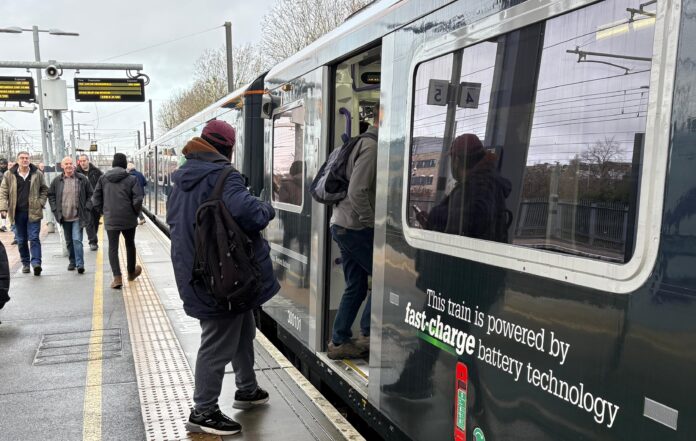
Great Western Railway (GWR) has introduced the UK’s first battery-only powered train into passenger service, marking a significant milestone in the decarbonisation of Britain’s rail network.
The Class 230 battery train entered service on Saturday 31 January, replacing its diesel counterpart on the Greenford branch line. Its first passenger working was the 05:30 departure from West Ealing to Greenford, following nearly two years of testing and development.
The train has been at the centre of a 22-month fast-charge technology trial, designed to demonstrate how battery-electric trains could operate reliably on routes where continuous electrification is not feasible or desirable. Until now, it has been used exclusively for trials, but its move into regular passenger operation marks a shift from experimentation to real-world deployment.
Last year, the same unit set a new world record for the longest distance travelled by a battery-electric train on a single charge, covering 200.5 miles. This surpassed the previous record of 139 miles set in 2021, providing further evidence of the maturity and potential of battery technology for rail.
GWR’s engineering director, Dr Simon Green, said the introduction into passenger service was a crucial step as the operator looks to replace its ageing diesel fleet. He said the fast-charge trial had shown that battery technology can offer a reliable and efficient alternative for powering electric trains on partially electrified routes, and that operating the train in service would provide valuable insight for both GWR and the wider industry. He also paid tribute to the late Adrian Shooter, whose vision underpinned the project.
Network Rail’s Western route director, Marcus Jones, described the move as a major step forward for sustainable rail travel. He highlighted the collaborative work between GWR and Network Rail, including the installation of fast-charge battery banks and extensive safety reviews, which enabled the train to enter service. He added that battery-powered trains will play an important role in meeting the rail industry’s net-zero ambitions.
Findings from the trial were published by GWR in a white paper last summer, exploring how discontinuous fast-charging at station stops can support battery-electric operations. As part of its future rolling stock strategy, GWR expects battery trains to routinely cover more than 60 miles between charges, a requirement the record-breaking trial has already demonstrated is achievable.
The train, unit 230001, will initially operate on Saturdays, with the intention of increasing services later in the year as GWR continues to assess performance in day-to-day operation. GWR is also working with the Department for Transport and other train operators to build the investment case for wider deployment of battery-powered trains across the UK network.


