


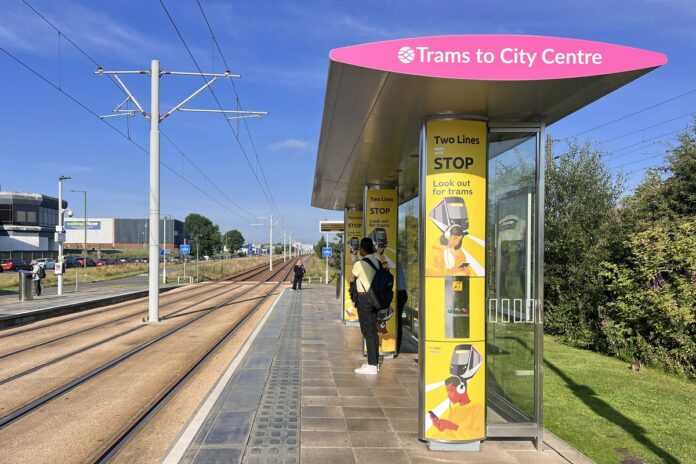
A national tramway safety campaign aimed at reducing pedestrian collisions is delivering measurable results, with new research indicating a clear shift in public behaviour.
The campaign, centred on the message “Two Lines = STOP”, has been adopted across the UK’s second-generation light rail systems. According to a recent survey, up to 70 per cent of people who had seen the campaign’s distinctive graphics reported changing how they behave near tramways or when crossing tracks.
The study gathered responses from hundreds of people in areas where trams operate in close proximity to pedestrians, providing insight into how effectively the campaign is resonating with the public.
Carly Swift, Marketing and Communications Manager at the Light Rail Safety and Standards Board (LRSSB), said the findings demonstrate tangible progress in addressing one of the sector’s most persistent safety risks.
“The initiative has been embraced by all the UK’s second-generation light rail systems, and this study shows it is having a real impact on tackling the leading risk to tramway safety,” she said.
“The campaign has proved particularly successful in Edinburgh and Nottingham, but it is also delivering positive results in other cities, including Blackpool, Sheffield and the West Midlands.
“Overall, feedback on the campaign has been extremely encouraging, with nearly three quarters of those interviewed saying it delivers a clear and consistent message, with the core instruction to stop and look for trams before crossing landing strongly.”
The results were presented at a recent meeting of senior light rail safety leaders, where plans for the next phase of the campaign were also discussed.
Don McClurg, Head of Safety and Standards at Edinburgh Trams and Chair of the LRSSB’s Heads of Safety Group, welcomed the findings.
“These results show that the campaign is making a real difference to tramway safety,” he said.
“They also illustrate the real-world benefits of taking a data-led approach to identifying threats to tramway safety and finding the most appropriate solutions.”
The campaign forms part of wider efforts across the light rail sector to improve safety outcomes through targeted, evidence-based interventions.


