


Railway stations across the UK are being recast as far more than transport hubs, with new analysis positioning them at the centre of economic growth, regeneration and investment. A recent report by Great Western Railway, Growing Places: Railway Stations – Engines of Economic Growth, sets out the scale of this shift and, crucially, what it means for the rail supply chain.
For SMEs, the message is clear. The opportunity is substantial, but it is evolving. Value is no longer created solely through infrastructure delivery; it is increasingly tied to the wider economic ecosystems that stations enable.
From transport nodes to economic anchors
The report makes a persuasive case that stations are now functioning as economic anchors. Their influence extends well beyond passenger flows, shaping patterns of housing, employment and commercial activity.
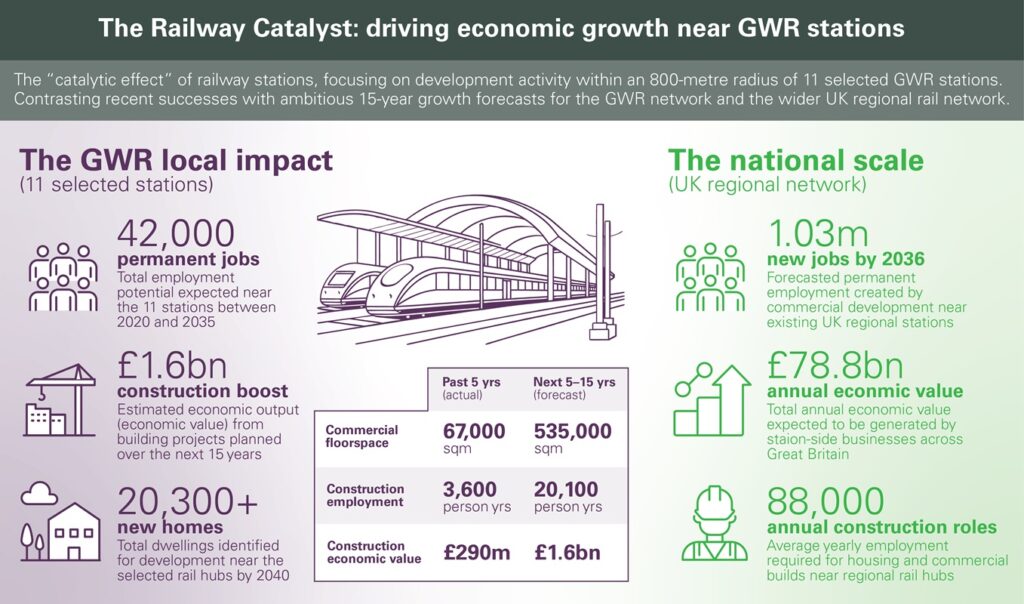
Analysis of 11 Great Western Railway stations illustrates the point. By 2035, these locations are expected to support nearly 42,000 permanent jobs and generate more than £3.2 billion in annual economic value. Alongside this, construction activity linked to these sites is forecast to reach £1.6 billion over the next decade to 15 years.
These figures underline a structural relationship between rail connectivity and growth. Stations act as focal points for development, enabling higher-density urban environments and improving access to labour markets. In practical terms, they bring businesses, workers and customers closer together, reducing friction in the economy.
Scaling up to a national opportunity
While the report focuses on a defined sample, its wider projections suggest a national growth story of considerable scale.
By 2036, development around regional stations could support more than 1 million jobs and contribute £78.7 billion annually to the UK economy. Construction demand alone is expected to sustain around 88,000 roles each year.
This growth is not evenly distributed. The South East accounts for a significant share in absolute terms, reflecting existing economic strength and connectivity. However, other regions, including the South West, the Midlands and Wales, are also set to benefit, particularly where new stations or upgrades unlock constrained areas.
For SMEs, this uneven distribution matters. Opportunity is not everywhere, but it is highly concentrated around specific locations. Understanding where these growth nodes are emerging will be critical to securing work.
The rise of station-led development
A key insight from the report is the intensity of development within an 800-metre radius of stations. These areas are becoming focal points for mixed-use schemes that combine housing, commercial space and amenities.
Across the GWR stations analysed, more than 20,000 new homes are planned. Commercial development is led by office and laboratory space, with over 428,000 square metres identified, alongside retail, leisure and industrial uses.
This mix reflects a shift towards knowledge-based, high-value economic activity. Office and research space attract sectors such as technology, life sciences and professional services, while residential development supports population growth and local demand.
For SMEs, the implications are significant. The rail sector’s economic footprint is expanding into areas traditionally seen as separate, including property development, urban planning and service provision. Businesses that can operate across these boundaries, or partner with those who do, will be better placed to capture value.
A shift towards high-value employment
The nature of job creation around stations is also changing. The report suggests that around 80 per cent of roles generated in these areas will be high-skilled and higher-paid, particularly in sectors such as technology, research and professional services.
This has a dual impact for SMEs.
On one hand, it raises the bar. Demand is shifting towards more specialised, knowledge-intensive capabilities. Firms working in digital rail, data analytics, advanced engineering or consultancy are likely to see increased demand.
On the other, it creates wider economic spillovers. As high-value employment grows, so too does demand for supporting services, from facilities management and maintenance to retail and hospitality. SMEs do not need to be directly involved in rail delivery to benefit, but they do need to understand how local economies are evolving.
Construction offers immediate access
While long-term economic impacts are substantial, the most immediate opportunity for SMEs lies in construction and development.
The report highlights more than 20,000 person-years of construction employment linked to the GWR stations alone over the next 10 to 15 years. At a national level, this rises to tens of thousands of roles annually.
For SMEs operating in civil engineering, specialist contracting, materials supply or plant hire, this represents a sizeable pipeline. However, access will not be automatic. Much of this work is already planned, with procurement routes and delivery structures taking shape.
Timing, therefore, is critical. SMEs that engage early with Tier 1 contractors, developers and local authorities are more likely to secure a position within supply chains. Those that wait risk being locked out.
Connectivity as a business advantage
Beyond direct economic output, improved rail connectivity delivers measurable productivity gains. Faster, more reliable links enable better business-to-business interaction, expand labour markets and support urban density.
These benefits have a direct bearing on how and where companies operate. Locations with strong rail connections become more attractive for investment, offering access to talent and markets.
For SMEs, this presents both an opportunity and a strategic consideration. Proximity to well-connected stations can enhance competitiveness, making it easier to attract staff and clients. At the same time, improved connectivity allows businesses to operate across wider geographies without relocating, opening up new markets.
Social value and sustainability in focus
The report also reinforces rail’s contribution to social and environmental outcomes. Improved access to education, employment and services supports greater inclusion, particularly for younger people and lower-income communities.
Environmentally, rail plays a central role in reducing emissions by encouraging a shift away from road transport. This aligns with wider net zero targets and policy priorities.
For SMEs, these factors are increasingly tied to commercial success. Public and private sector clients are placing greater emphasis on social value and sustainability within procurement processes. Demonstrating alignment, whether through low-carbon solutions, local employment or community engagement, is becoming a prerequisite rather than a differentiator.
What SMEs should do next
Taken together, the report’s findings point to a clear set of actions for SMEs looking to capitalise on station-led growth.
Understanding the geography of opportunity is the starting point. Growth is clustered, not uniform, and aligning with local development plans is essential.
Early engagement is equally important. Building relationships with key stakeholders, including contractors, developers and local authorities, increases the likelihood of securing work.
SMEs should also broaden their perspective. Opportunities extend beyond traditional rail infrastructure into property, services and technology. Those willing to operate across these areas will find more avenues for growth.
Investment in capability will be required. As demand shifts towards higher-value activities, skills in digital, engineering and consultancy will become more important.
Finally, aligning with social value priorities is no longer optional. Sustainability, inclusion and community impact are now central to how projects are funded and delivered.
Opportunity with conditions
The report presents an optimistic picture, but it is not without caveats. The projected benefits depend on continued investment, effective coordination and successful delivery.
For SMEs, this means the opportunity is real, but it is not guaranteed. Capturing value will require a proactive approach, combining strategic positioning with the ability to adapt to a changing market.
Railway stations may be driving growth, but the extent to which that growth is realised will depend on the businesses that gather around them.