


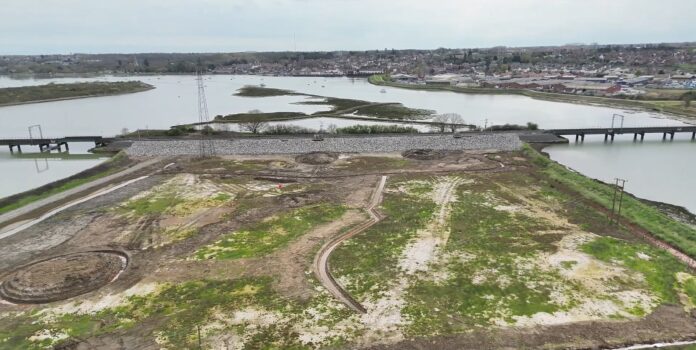
A former wetland in Suffolk has been restored to its natural state as part of a project aimed at improving biodiversity and strengthening the resilience of the railway to climate change.
The 6.9-hectare site at Cattawade, near the London to Norwich line, had originally been drained almost 180 years ago to protect the railway embankment. The work removed a valuable wetland habitat and disrupted local ecosystems.
Now, in a first-of-its-kind scheme in the East of England, Network Rail has worked with QTS to return the land to a functioning wetland using nature-based engineering solutions.
The project included the installation of nearly 4,000 tonnes of granite and erosion-resistant rock to form a protective barrier along the embankment. New water channels have been created to allow controlled flow across the site, alongside raised mounds designed to provide nesting areas for wetland birds.
The restored habitat is already supporting the return of species such as curlews, avocets and oystercatchers, as well as the rare sea aster mining bee.
John Minshull, Network Rail’s Senior Asset Engineer, said the scheme demonstrates how engineering and environmental goals can be aligned.
“This project shows what can be achieved when environmental ambition and engineering come together,” he said. “It recreates a vital habitat while also improving the railway’s resilience to climate change.”
The wetland is also expected to help manage water flow around the railway, reducing flood risk and enhancing the effectiveness of the embankment protection.
The project forms part of Network Rail’s wider environmental strategy in the Eastern region, which includes plans to improve biodiversity at 14 additional sites. The programme aims to create more than 116 hectares of biodiverse land by 2035.
Russell Knight, Head of Sustainability for Network Rail’s Eastern region, said the organisation has a key role to play as a major landowner.
“Restoring this site helps support wildlife and shows how natural systems can help address the challenges of climate change,” he said.
The initiative comes against a backdrop of long-term decline in UK wetlands, with estimates suggesting around 75% have been lost over the past three centuries. The Cattawade project is intended as a local response to that wider trend, while also supporting the long-term sustainability of the railway.


