


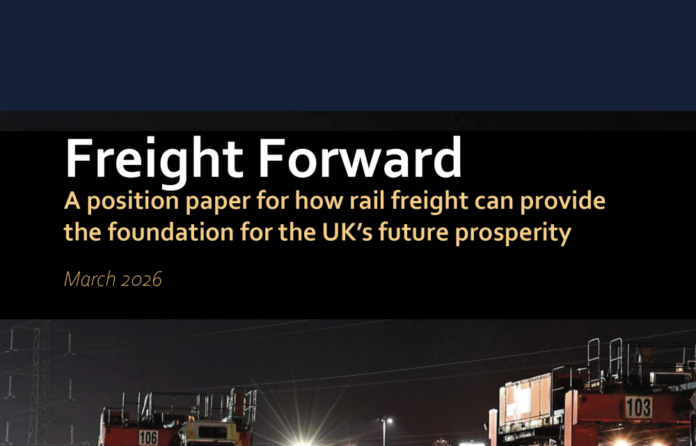
Rail freight is being repositioned as a central pillar of the UK’s economic future, with new analysis warning that businesses across the supply chain must adapt quickly or risk missing out on a significant growth opportunity.
A new position paper, Freight Forward, published by the Rail Freight Group, sets out a clear vision for how the sector will support national priorities ranging from infrastructure delivery to energy security and international trade. The message is unambiguous: rail freight is no longer a supporting function, but a strategic asset that will shape how goods move across Britain in the coming decades.
At present, rail freight already plays a substantial, if often overlooked, role. It moves around a quarter of all containerised goods from UK ports, contributes £2.45 billion annually to the economy, and removes more than 1.6 billion lorry kilometres from the road network each year . Yet despite this, its visibility in policymaking and public discourse has lagged behind its importance.
That is beginning to change.
Growth targets signal a shift in national priorities
Central to the report is the Government’s ambition to grow rail freight by 75% by 2050 . This target is not simply about increasing volumes; it reflects a broader shift in how the UK intends to deliver economic growth, decarbonisation, and resilience.
Rail freight is positioned as critical to three key national priorities: building new homes and infrastructure, transforming the economy through clean energy and advanced manufacturing, and strengthening resilience against global shocks. Each of these areas will generate significant demand for the movement of materials, much of which is expected to be met by rail.
Large-scale construction programmes, including new towns, transport projects and water infrastructure, will require the movement of vast quantities of aggregates and materials. Rail is already proving its value here. On major schemes such as HS2, freight trains are reducing the need for tens of thousands of lorry movements, improving both efficiency and environmental performance.
Similarly, the transition to net zero is expected to drive demand for rail freight. From transporting materials for offshore wind farms to supporting nuclear and hydrogen infrastructure, rail offers a scalable and lower-carbon alternative to road haulage.
A more competitive, lower-carbon logistics model
One of the report’s most striking conclusions is that the traditional trade-offs in freight are beginning to disappear. Rail is no longer simply a greener option; it is increasingly competitive on cost, reliability and scale.
Freight trains produce around 76% less carbon dioxide per tonne than HGVs and can remove an average of 76 lorries from the road in a single journey . At the same time, rail avoids congestion, offers consistent journey times, and achieves high levels of punctuality, with more than 90% of services arriving within 15 minutes of schedule .
For businesses, this combination is becoming increasingly important. Rising fuel costs, ongoing driver shortages, and growing pressure to meet environmental targets are reshaping procurement decisions across the logistics sector. As a result, rail is moving from a niche solution to a mainstream requirement within supply chains.
Major retailers and manufacturers are already adapting. Tesco, for example, uses rail to transport hundreds of millions of cases of goods each year, removing tens of thousands of lorry journeys. Automotive firms such as Toyota have also integrated rail into their logistics operations, cutting delivery times and emissions simultaneously.
Intermodal logistics becomes the norm
Rather than replacing road freight entirely, the report highlights the growing importance of intermodal logistics, where rail is used for long-distance transport and road for first and last mile delivery.
This model is expected to dominate future supply chains. Rail provides the efficiency and scale for trunk routes, while road retains flexibility for local distribution. The result is a more balanced and resilient system.
For the freight industry, this represents a structural shift. Businesses that rely solely on road haulage may find themselves at a disadvantage as customers increasingly favour integrated solutions. Conversely, companies that can combine rail and road effectively are likely to benefit from new opportunities.
SMEs face a pivotal moment
For small and medium-sized enterprises, the implications are particularly significant. While large operators are already investing in rail capabilities, SMEs risk being left behind if they do not respond quickly.
The report suggests that future growth will be closely tied to access to rail infrastructure, including terminals and strategic freight interchanges. As demand increases, these assets are likely to become more constrained, making early positioning critical.
At the same time, SMEs have a clear opportunity to play a role in the evolving market. Intermodal logistics creates demand for a wide range of services, from first and last mile delivery to warehousing, consolidation, and digital coordination.
There is also growing demand for innovation. Advances in technology, including real-time tracking, predictive maintenance, and AI-driven planning, are beginning to reshape rail freight operations. SMEs that can offer digital solutions or integrate with these systems will be well placed to compete.
Resilience and security drive long-term demand
Recent disruptions have exposed vulnerabilities in the UK’s supply chains, from driver shortages to fuel crises and global instability. Rail freight has demonstrated its value in these situations, providing a reliable alternative when road networks are under pressure.
The report argues that this resilience will become even more important in the years ahead. As the UK seeks to reduce reliance on global supply chains and increase domestic production of critical materials, rail will play a key role in connecting new production sites to manufacturing hubs.
This includes sectors such as critical minerals, where demand is expected to rise sharply due to the growth of electric vehicles and renewable energy. Rail offers a practical solution for moving these materials efficiently and sustainably across the country.
Reform and investment will shape the market
The transition to Great British Railways is identified as a major opportunity to support freight growth. The report calls for a stable and transparent framework that ensures fair access to the network, encourages investment, and protects capacity for freight services.
Infrastructure investment will also be essential. Expanding rail freight will require new terminals, upgraded routes, and increased electrification. Collaboration between government, industry, and regional authorities will be critical to delivering these improvements.
Encouragingly, there are already signs of progress. Upgrades to key routes and ports are enabling longer trains and higher capacity, while digital technologies are improving efficiency and visibility across the network.
A clear direction of travel
The overarching message of the Freight Forward report is that rail freight is set to become a cornerstone of the UK’s economic strategy. Its role will extend far beyond transport, supporting growth, sustainability, and resilience across multiple sectors.
For the freight industry, the direction of travel is clear. Rail-integrated logistics will define the next phase of development, and businesses that align with this shift stand to benefit.
For SMEs, the challenge is to move quickly. Building relationships, securing access to infrastructure, and developing intermodal capabilities will be essential steps in staying competitive.
The opportunity is substantial, but so is the risk of inaction. As rail freight moves into the mainstream of UK logistics, those who adapt early are likely to shape the market. Those who do not may find themselves increasingly on the margins.


