


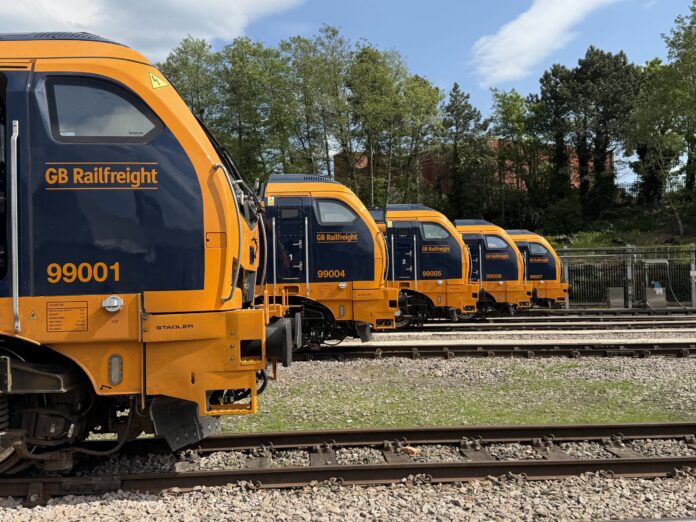
GB Railfreight has published its 2026 Sustainability Report, setting out progress across emissions reduction, climate resilience, biodiversity, safety, employee wellbeing and social value, while positioning the arrival of its new Class 99 locomotives as a major step forward for UK rail freight decarbonisation.
The report presents GBRf’s sustainability strategy as a long-term programme built around three phases: Commence, Advance and Complete. The business says it remains in the “Commence” phase, covering 2024 to 2028, with a focus on putting the right data, governance, tools and operational foundations in place before scaling activity between 2029 and 2035 and working towards its longer-term goals by 2050.
At the heart of the report is a simple but important message for the wider freight and logistics market: rail freight is already a low-carbon alternative to road, but the sector still has further to go.
GBRf says it moves more than 52,000 trainloads each year and describes itself as “the low-carbon backbone of the UK’s national supply chain”. According to the report, rail freight can cut carbon emissions by up to 76 per cent per tonne-kilometre compared with road haulage, while removing significant numbers of lorry movements from the highway network.
However, the company is clear that relying on rail’s existing carbon advantage is not enough. Its 2026 report details work already under way to reduce emissions intensity, increase renewable energy use, improve operational efficiency and prepare for cleaner traction.
GBRf’s reported total emissions rose from 166,879 tCO2e in 2022 to 180,582 tCO2e in 2024, reflecting business growth and improved measurement across emissions scopes. More encouragingly, emissions intensity improved over the same period, falling from 27,267 tCO2e per million total diesel train miles in 2022 to 25,803 tCO2e in 2024. GBRf attributes this to efficiency gains supported by driver education, fuel management and the use of biofuel blends.
The most significant operational development is the introduction of the new Class 99 bi-mode locomotive fleet, which is due to enter service from spring 2026. GBRf has ordered 30 of the locomotives, with full rollout expected across core freight corridors during 2026 and 2027.
The Class 99s are designed to operate on both electric and non-electrified routes, allowing GBRf to make greater use of existing electrified infrastructure without sacrificing route flexibility. The report states that the bi-mode technology can deliver an emissions reduction of around 58 per cent per journey compared with a Class 66 diesel locomotive, based on both vehicles operating on diesel only.
GBRf also highlights the future-proofed design of the Class 99, noting that the locomotive has been built with modularity in mind. Space has been allocated for future technologies such as hydrogen fuel cells, battery systems or other low-carbon alternatives once they become commercially and operationally viable.
Alongside new traction, the report points to growing use of renewable fuels. Since January 2025, GBRf has entered agreements with several customers to move goods using Hydrotreated Vegetable Oil, known as HVO. The report says HVO accounted for around 10 per cent of overall fuel purchases, with 5.2 million litres procured in 2025, contributing to a reduction of more than nine per cent in Scope 1 emissions.
The company has also transitioned all sites to 100 per cent renewable electricity contracts from the start of 2025, a move expected to deliver annual savings of around 900 tCO2e. GBRf is also expanding onsite generation, including additional solar PV at its Peterborough headquarters, and is exploring battery storage to support future electricity demand as its road vehicle fleet moves towards electric by 2032.
Climate resilience is another major theme. GBRf completed a physical climate risk assessment across its locations in 2023, refreshed in 2024, modelling eight major climate hazards under 1.5C and 3C warming scenarios. The report identifies flooding, particularly coastal inundation, as the main physical climate risk across its estate, with extreme wind also noted.
By the end of 2026, GBRf aims to complete a system-level climate risk assessment covering supply chain pressures, network disruption and energy availability. By 2028, it plans to develop site-specific resilience plans for high-risk locations and align fully with Taskforce for Climate-related Financial Disclosures recommendations.
The report also broadens sustainability beyond carbon. GBRf has reviewed its landholdings to identify opportunities for nature enhancement and is preparing to establish a biodiversity and habitat baseline in 2026. It plans to roll out tailored biodiversity improvements across all operational landholdings by 2030, where conditions allow.
Staff-led nature projects already feature strongly. The report highlights initiatives at Bescot, Port of Tyne, Eastleigh and Melton Mowbray, where employees have created depot gardens, bird and bat habitats, raised beds and green spaces. GBRf is also a sponsor of Yorkshire Wildlife Trust’s Potteric Carr Nature Reserve, located close to its Doncaster office.
Waste management remains an area of active improvement. GBRf says it has removed all single-use plastics from operations apart from water bottles provided to drivers, where it is still seeking a practical alternative that maintains reliable access to clean drinking water. Recycling and organic waste bins have been introduced across sites, while a successful recycling model at Test Tracks in Melton is now being rolled out more widely.
The social side of the report is equally prominent. GBRf has refreshed its Health & Safety strategy around a three-pillar framework covering operational standards and compliance, engineering standards and compliance, and occupational health and safety. A five-year plan sets out 12 focus areas, including active leadership, facilities improvement, fatigue management, competence training, risk assessment and data management.
Employee wellbeing is also a major priority. GBRf has established dedicated onsite medical facilities in London and Doncaster, expanded access to Health Shield benefits for employees and families, and launched a health roadshow offering checks and wellbeing conversations across offices and depots.
On skills and development, the company has introduced a new e-learning platform, embedded a formal appraisal process, and is expanding coaching, mentoring and apprenticeship pathways. Its target is to reach 100 per cent compliance training completion by the end of 2026.
Community impact remains a defining feature of GBRf’s sustainability activity. The company says its people have helped raise around £1 million for charities since 2011. Its current partnership with Great Ormond Street Hospital Children’s Charity has already raised £205,000 towards a £400,000 target to fund an early years classroom within a new Children’s Cancer Centre.
GBRf’s Back on Track programme, currently active in Ipswich and Peterborough schools, supports students who may not thrive in mainstream education through mentoring, CV support, interview practice and careers advice. The company now plans to expand the programme to a third school in Doncaster.
A notable governance development is GBRf’s adoption of the RSSB Rail Social Value Tool, which the company says it will integrate into project planning and impact assessment. This is intended to improve transparency and help ensure social value is measured consistently across its activities.
The report also points to a stronger internal sustainability structure, with new roles introduced across safety, sustainability, people, risk, social value and governance. GBRf says this reflects a shift from sustainability as a reporting function towards sustainability as part of day-to-day business decision-making.
David Golding, Safety and Sustainability Director at GB Railfreight, said the report reflected the company’s commitment to delivering lasting value for customers, colleagues, communities and the planet. He said GBRf’s purpose as “the low-carbon backbone of the UK’s national supply chain” was now shaping decisions across the business.
For the wider rail freight sector, the report lands at an important moment. Decarbonising freight transport will require cleaner traction, better use of electrification, lower-carbon fuels, stronger supply chain engagement and a clear commercial case for modal shift. GBRf’s report does not suggest that all the answers are already in place. In fact, it is frank about areas where data, systems and supplier visibility still need to improve.
But it does show an operator moving from broad ambition into practical delivery. The arrival of the Class 99 fleet, the growing use of HVO, the switch to renewable electricity, stronger climate risk planning and a more structured approach to social value all point in the same direction.
For customers under pressure to reduce supply chain emissions, and for policymakers looking to cut carbon from UK freight, the message is clear: rail freight already has a strong sustainability case. The next challenge is to scale it.
Image credit: Tony Middleton


