


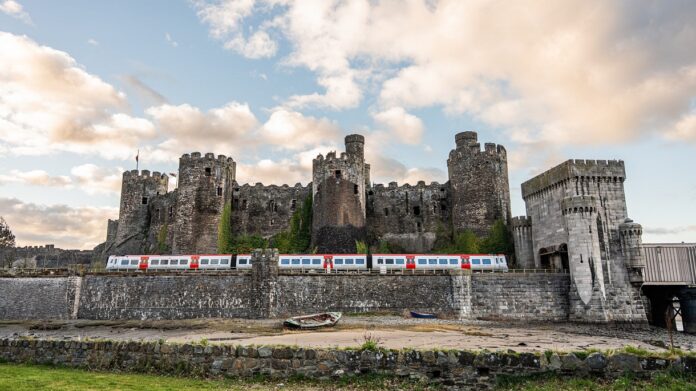
Transport for Wales (TfW) recorded 34.9 million rail passenger journeys during 2025/26 as growing demand, improving customer satisfaction and higher revenues contributed to another year of growth across the organisation.
Figures published in TfW’s 2025/26 Annual Report show rail passenger numbers increased by 9.9% year-on-year, a rate of growth above the wider UK rail industry average.
Rail revenue increased by 8.9% to £190.3 million, continuing the upward trend recorded since 2022/23, while customer satisfaction climbed 3.3 percentage points to 87.7%.
Growth was also recorded across the bus services managed by TfW, with passenger numbers on the TrawsCymru network increasing by 5.2%.
The results come alongside significant progress on TfW’s infrastructure programme, particularly across the South Wales Metro.
Electrification of 170km of the Core Valley Lines has now been completed, while the new Walnut Tree Depot at Taff’s Well has officially opened as part of the transformation of rail services around Cardiff and the South Wales Valleys.
Performance on the TfW-owned Core Valley Lines also improved significantly during the year. Some 92.6% of trains operated within three minutes of their scheduled time, compared with 85.7% in 2024/25.
TfW has also continued the expansion of pay-as-you-go rail travel. Almost four million journeys, 3.94 million, were made using the technology during 2025/26, with further rollout now progressing in north-east Wales.
Deputy Minister for Transport Mark Hooper said: “Transport for Wales is doing an exceptionally good job in improving passenger experiences across Wales, which is a great base for us to build upon to keep moving in the right direction.
“Together, we will continue to build a more integrated and better-connected transport network, delivering reliable, accessible, and value-for-money services that improve people’s daily lives across Wales.”
The latest figures provide evidence that investment in new trains, infrastructure and ticketing is increasingly being accompanied by growth in passenger demand.
TfW has undergone a substantial expansion since its creation, developing from a body established to procure and oversee transport services into an organisation employing more than 4,500 people and directly responsible for significant parts of Wales’ rail and bus network.
Vernon Everitt, Chair of Transport for Wales, said: “Transport is about delivering for the people, communities and businesses we serve.
“For Transport for Wales, this has been a year of steady and sustained improvement in transport and of laying the ground for further progress. We realise there is much more to be done. This will benefit people in every part of Wales for generations to come.
“More and more people are using our services and customer satisfaction is rising. We look forward to continuing on this upward trajectory and delivering for the people of Wales.”
TfW Chief Executive James Price said the organisation’s development over the past decade had been substantial, with its responsibilities now extending well beyond operation of the Wales and Borders rail services.
He said: “Ten years ago, Transport for Wales was an idea on a whiteboard in a Welsh Government office.
“We are now a fully-fledged transport company employing over 4,500 people and running the Wales and Borders rail franchise. We’ve transformed the Core Valley Lines through delivery of the South Wales Metro and we’re operating TrawsCymru and fflecsi buses.
“Most importantly, our passenger numbers are continuing to grow, with our rail passenger numbers up 9.9% on last year while bus passenger numbers on services we manage have grown by over 5%.
“Over the coming years, we’ll keep building and providing for the people of Wales.
“I’d like to take this opportunity to thank all our customers, colleagues and partners who are on this journey with us.”
The combination of rising patronage, increased revenue and improving Core Valley Lines performance will be particularly encouraging for TfW as it moves beyond the major construction phase of parts of the South Wales Metro and focuses increasingly on demonstrating the passenger benefits of the investment.
With further pay-as-you-go expansion and wider integration between rail and bus planned, the next test will be whether TfW can maintain its current rate of passenger growth while continuing to improve reliability and customer satisfaction across the network.


