


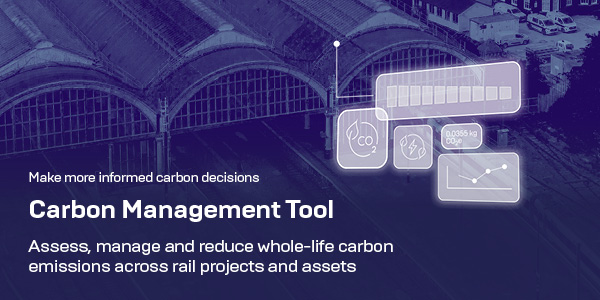
RSSB has launched a new rail-specific Carbon Management Tool designed to help infrastructure teams assess whole-life carbon earlier in project development, when there is greater opportunity to influence design, materials and delivery decisions.
The free Carbon Management Tool (CMT) will become RSSB’s primary carbon assessment platform and is intended to provide organisations across the rail sector with a consistent way of understanding, managing and reducing emissions associated with infrastructure projects and railway assets.
Its introduction targets a significant challenge for rail’s decarbonisation efforts. RSSB says around half of the railway’s greenhouse gas emissions are associated with materials used to construct, renew and maintain infrastructure.
While those emissions can be measured after projects have been designed, RSSB argues that doing so misses many of the opportunities to reduce them.
The CMT is therefore intended to shift carbon assessment further upstream, allowing engineers and project teams to compare alternatives and understand their carbon implications while important decisions are still being made.
Moving carbon from reporting to decision-making
The central principle behind the new platform is that carbon should be considered alongside other project requirements throughout the lifecycle of an asset, rather than calculated retrospectively.
Project teams will be able to use the CMT to assess the carbon consequences of different choices and identify lower-carbon approaches before particular designs and delivery strategies become established.
For infrastructure programmes, that could make carbon assessment a more active part of option selection and project development rather than predominantly a reporting exercise.
Joshua Fisher, RSSB’s Chief Operating Officer, said: “The railway has an important role to play in the transition to a lower-carbon future, but reducing emissions starts long before a project is delivered.
“Too often, carbon is treated as something to measure after key decisions have already been made. By that point, many of the biggest opportunities to reduce emissions have been missed.
“The Carbon Management Tool helps organisations understand the carbon implications of different choices at the point decisions are being made. Developed with the industry, it gives project teams a practical way to compare options, reduce emissions and make better-informed decisions throughout the lifecycle of rail assets.”
Implications for infrastructure supply chain
The launch is particularly relevant to infrastructure designers, contractors and suppliers because embodied carbon from materials represents such a substantial part of rail’s overall emissions.
Reducing that footprint requires decisions about carbon to be considered alongside engineering, cost, performance and asset requirements as projects develop.
That also places greater importance on the quality and consistency of carbon information available throughout the supply chain.
For suppliers, the direction of travel means being able to demonstrate the carbon implications of products, materials and engineering solutions is likely to become an increasingly important part of supporting customers’ project decisions.
For project teams, meanwhile, earlier assessment creates greater scope to examine alternatives rather than attempting to mitigate carbon once specifications and designs have already been determined.
CMT to replace Rail Carbon Tool as primary platform
The CMT is available immediately and is free to use.
RSSB is encouraging organisations currently working with its existing Rail Carbon Tool to begin exploring and adopting the new platform.
The CMT will become RSSB’s primary carbon assessment platform, although further information on the transition from the Rail Carbon Tool, including guidance for existing users, is expected in the coming weeks.
That transition will be important for organisations that have already incorporated the existing tool into their carbon reporting and project processes.
Training programme to support adoption
RSSB is accompanying the launch with a programme of webinars and specialist training intended to help organisations embed the CMT into their work.
A launch webinar will take place on 2 October, providing an introduction to the platform, demonstrations of its functionality and an explanation of how it can support carbon reporting and decision-making.
Two further training courses will follow during October.
Carbon Management Fundamentals, taking place virtually on 14 October, will cover carbon accounting, reporting and reduction principles alongside practical use of the CMT.
A more advanced Whole Life Carbon Assessment course will follow on 21 October, focusing on applying whole-life carbon principles through the platform to inform decisions throughout the lifecycle of railway assets.
Earlier intervention offers greater opportunity
The significance of the CMT for the industry lies less in producing another carbon figure and more in when that information becomes available.
Infrastructure carbon is heavily influenced by decisions made during planning and design. Once materials have been specified, engineering solutions selected and delivery plans established, the scope for substantial changes can become increasingly constrained.
Providing teams with a common rail-specific platform for examining carbon during those earlier stages is intended to make emissions another factor informing the choices that shape a project.
With a substantial proportion of rail’s greenhouse gas footprint associated with constructing, renewing and maintaining infrastructure, achieving meaningful reductions will require carbon management to become part of everyday engineering and project decision-making.
RSSB’s new platform is designed to provide the industry with the means to do that – shifting the emphasis from calculating what a project emitted to understanding what it could avoid emitting before the most important decisions are locked in.


