


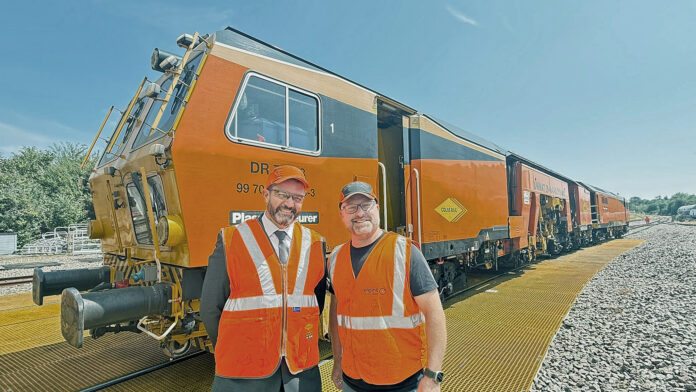
Colas Rail UK is rolling out hydrogen-powered engine carbon cleaning across its entire 31-strong tamper fleet after trials recorded fuel and emissions savings of more than 13%.
The infrastructure services business has incorporated Engine Carbon Clean (ECC) technology into its tamper maintenance strategy following trials at its Rugby depot, with the company forecasting annual savings of more than 550 tonnes of CO2e once annual cleaning is carried out across all 31 machines.
Colas is also looking beyond its tamper fleet. Its freight business is preparing trials on two Class 37 locomotives, with projected savings suggesting wider deployment could potentially reduce emissions by more than 2,800 tonnes of CO2 annually.
The initiative is particularly relevant to the challenge of decarbonising existing rail plant and traction which could remain operational for years while the industry pursues longer-term electrification and fleet replacement programmes.
Trials deliver more than 13% reduction
Two Colas tampers were used for the initial trials at Rugby, with each receiving four three-hour engine cleaning treatments.
ECC uses an on-demand hydrogen generator to produce oxyhydrogen gas, which is drawn through an engine’s air intake. According to developer Advanced Hydrogen Technology Group (AHT), this removes internal carbon deposits without requiring chemicals, additives or the storage of compressed hydrogen.
Following the cleaning programme, Colas’ engineering team was able to reduce engine speeds while maintaining the same operating requirements.
In maximum working mode, engine speed was reduced from 1,995 RPM to 1,520 RPM while performing the same tasks.
Colas says the trials produced fuel and CO2e savings of more than 13%, creating the business case for deploying the technology across its tamper fleet.
Paul Conway, Head of Engineering & Compliance for Colas Rail Services, said: “Over 13% CO2e and fuel savings represents a strong and attractive business case. This easily scalable and non-intrusive solution has now been embedded into our tamper maintenance strategy, with potential to quickly expand across our wider fleet and supply chain – helping us drive a cleaner, more efficient future for rail.”
Carbon reduction through existing assets
The programme represents a different aspect of rail decarbonisation from the large-scale transition towards electric and alternative-fuel fleets.
Rail infrastructure contractors operate substantial fleets of specialist plant, some of which represent major capital investments and can have long operational lives. That creates a requirement to reduce emissions from existing assets alongside decisions over future replacement.
For Colas, improving the efficiency of its current fleet forms part of that approach.
Daniel Ditri, Head of Energy & Carbon at Colas Rail UK, said: “Decarbonisation is a business priority and driving this is a clear, data-led strategy. We are committed to the globally recognised Science Based Targets initiative, aligning with Network Rail’s ambitions – in this instance our target is a 46.5% reduction in Scope 1 and 2 emissions by 2030 – and working with SME innovator Engine Carbon Clean delivers tangible CO2e and cost savings to that end.
“Replacing assets too early is not sustainable, so we are focused on maximising the performance of what we already have.”
Colas forecasts that applying annual engine carbon cleaning across all 31 tampers will save more than 550 tonnes of CO2e each year.
Colas brings cleaning capability in-house
The next stage will also change how the process is delivered.
Colas has become the first company to adopt ECC’s new subscription model, providing it with its own generators so engineering teams can perform cleaning themselves.
Rather than taking machines to a dedicated location or relying on an external team for each treatment, the equipment can therefore be used around the country as part of existing servicing and maintenance schedules.
For a geographically dispersed specialist plant fleet, integrating the process into planned maintenance could make wider deployment considerably easier and reduce disruption associated with introducing an additional maintenance activity.
ECC says its modular system can be applied to engines of different sizes and can work with diesel, petrol, HVO, CNG, LNG and other biofuels.
Daniel Sturgeon, Head of Data and Business Development at Engine Carbon Clean, said: “Our simple and practical innovation is a quick win, delivering measurable reductions today – especially for operators navigating the challenging gap between ambitious climate targets and operational reality.”
Class 37 trials could open route to wider fleet deployment
Attention is now turning to whether the results can be replicated on locomotives.
Colas Freight has engaged ECC to accelerate trials involving two Class 37 locomotives. Based on the level of savings recorded during the tamper programme, the companies say deployment across the locomotive fleet could potentially produce reductions of more than 2,800 tonnes of CO2 annually.
Those figures remain projections at this stage, making the forthcoming locomotive trials important in establishing the actual performance of the technology when applied to different duty cycles and engine types.
The relationship between Colas and ECC began in 2025 when the technology was selected by Colas’ French innovation team for an ESG-related grant through its internal Innoboost competition.
The subsequent move from a two-machine trial to a fleet-wide maintenance strategy illustrates how relatively small changes to existing assets could contribute to nearer-term emissions reduction.
For rail businesses managing ageing diesel plant and traction, the attraction is that efficiency improvements do not necessarily depend on waiting for entirely new fleets or infrastructure. If the savings achieved on Colas’ tampers can be maintained at fleet scale – and replicated during the Class 37 trials – the programme could provide another practical route for reducing both fuel consumption and emissions from assets that still have useful operational life remaining.


