


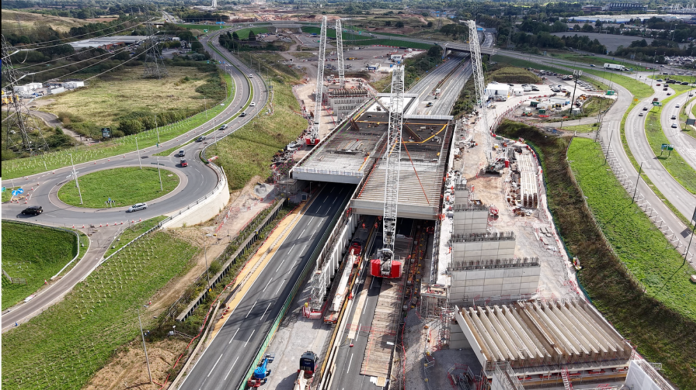
HS2 engineers have completed the last of six major viaduct span installations over the M42 in the West Midlands, bringing a complex summer programme of motorway engineering works close to completion.
The final span for the Water Orton viaducts was moved into position during a weekend closure of the M42, with the motorway reopening at around 4am on Monday 21 September as planned.
At the same time, around three miles to the south, a separate construction team installed the final beams for HS2’s 300-metre-long ‘twin box’ structure near the NEC.
The two operations were coordinated by HS2’s West Midlands construction partner Balfour Beatty VINCI (BBV), which has used four weekend closures over the summer to progress three major structures crossing the motorway.
With the principal bridging operations now complete, engineers can move towards finishing works including parapet installation, concrete pours and preparation of the structures for the railway.
Four weekends of coordinated construction
The programme was divided across four weekends to allow teams to work on the Water Orton viaducts and twin box simultaneously, reducing the overall number of motorway closures required.
National Highways also used the closures to undertake its own works, including demolition of Bickenhill Bridge on the northern side of the M42 Junction 6 roundabout.
Agnes Usciak, HS2 Ltd’s Senior Project Manager, said: “I’d like to thank motorists and local residents for their patience during this huge programme of work – our biggest yet over the motorway network.
“Splitting a huge construction programme into four separate weekends requires meticulous planning, and our engineers executed the entire operation with pin-point precision, ensuring the motorway reopened on time, every time.
“Structural completion of the Water Orton viaducts and the twin box means the end is in sight for our bumper programme of motorway works this year.”
175 beams form roof of NEC ‘twin box’
Near the NEC, a 150-strong team used the September closure to install the final 44 beams over the southbound carriageway.
The 300-metre structure consists of two boxes which will carry HS2 over the M42. The design has been adopted because of the angle at which the high-speed railway crosses the motorway.
Its roof is formed from 175 individual beams weighing between 56 and 92 tonnes.
A 300-tonne crawler crane was used to lift the 23-metre-long beams into position between supporting walls and columns located alongside the carriageway and within the motorway’s central reservation.
The completed structure stands 10 metres high, with two 145-metre-long walls and 46 internal columns supporting a roof weighing approximately 9,800 tonnes.
With the beam installation complete, work can progress to the remaining concrete pours before the structure is prepared for track installation.
1,000-tonne Water Orton spans moved into place
The two Water Orton viaducts form the northern point of HS2’s triangular Delta Junction, which will connect Birmingham with the high-speed main line heading north.
The structures have to negotiate a particularly complex infrastructure corridor, crossing the M42 and A446 as well as the existing Birmingham-Peterborough railway and River Tame.
During the latest closure, a separate 75-strong team installed the final two spans of Water Orton Viaduct 2 across the M42’s southbound carriageway, following similar work on Water Orton Viaduct 1 in August.
Each 45-metre span was assembled from 18 precast concrete segments manufactured locally at BBV’s batching plant at Kingsbury.
Once assembled, the approximately 1,000-tonne spans were transported into position using self-propelled modular transporters before being secured using tensioning cables running through the hollow centre of the viaduct.
The structures were designed by BBV’s Design Joint Venture, comprising Mott MacDonald and SYSTRA, alongside WW+P Architects.
Oliver Shore, Project Director for Balfour Beatty VINCI, said: “The twin box and Water Orton Viaducts are three major structures that cross the busy M42 motorway. In just four weekends, we’ve completed the bridging works on each of them, closing the gap over the north and southbound carriageways.
“This was a huge engineering challenge and I’m so proud of the way our teams have responded. Their skill, dedication and hard work throughout the summer means we can move forward to the next exciting phase of our work.”
Final works continue
Although the main bridging programme has reached an important milestone, work around the M42 is not yet finished.
BBV is due to extend Water Orton Viaduct 2 by another 40 metres to close the remaining gap above Gilson Road.
A further M42 closure is planned from 9pm on 23 October until 5am on 26 October, allowing parapets to be installed on the viaduct sections directly above the motorway.
HS2 intends to use the same weekend to carry out the fourth and final slide of the M6 South Viaduct West deck. The M6 itself will remain open, although the M42 North to M6 North connector road will be closed.
HS2 moves from major structures towards railway systems
The milestone comes as HS2 says construction activity is at its peak, while Chief Executive Mark Wild continues a wider reset intended to improve productivity and control the cost of the remaining programme.
Elsewhere, platforms have been installed at Old Oak Common, the project’s first ‘green tunnel’ has been completed and the Curzon 2 viaduct on the approach to Birmingham Curzon Street is now in position.
The completion of the main M42 bridging operations is another indication of parts of HS2 moving beyond major structural engineering towards the stages needed to create an operational railway.
At Water Orton in particular, the scale of the engineering reflects the complexity of threading a new high-speed railway through existing road, conventional rail, river and utility corridors.
Completing the principal crossings across four coordinated motorway closures allows BBV to move onto finishing works, while reducing the need for further major interventions on one of the West Midlands’ busiest pieces of transport infrastructure.


