


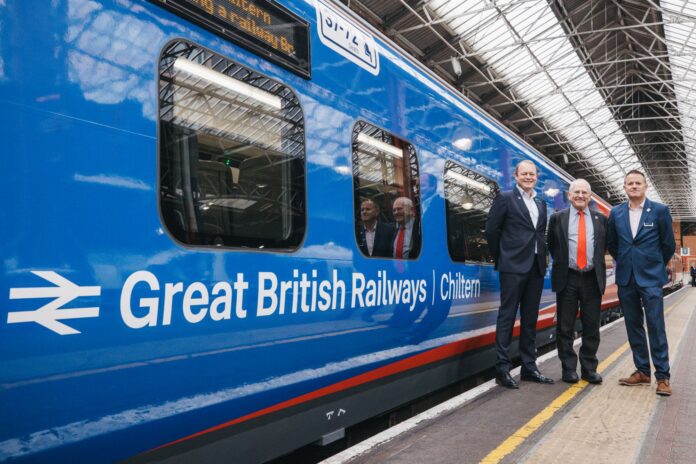
Chiltern Railways has transferred into public ownership, becoming the sixth operator to move under the government’s current nationalisation programme as preparations continue for the creation of Great British Railways.
The operator transferred into public ownership on 20 September, bringing services between London Marylebone, Buckinghamshire, Oxfordshire, Warwickshire and the West Midlands under government control.
The more substantial passenger changes are scheduled to follow from December, when Chiltern plans to introduce 25 additional weekday services, almost 10,000 extra weekday seats and six further Chiltern Explorer trains.
Capacity increase targets overcrowding
Increasing capacity is one of the principal priorities for the operator, particularly on busy services into London.
From the December timetable, Chiltern is set to introduce 25 additional services each weekday, including a half-hourly service throughout the day on the Chiltern Main Line between London and Birmingham.
The changes are expected to provide almost 10,000 additional seats each weekday, alongside nearly 5,000 extra seats on Saturdays and more than 3,000 on Sundays.
Six additional Chiltern Explorer trains are also due to enter service as part of the December timetable, completing a fleet of 13. The trains will provide additional capacity alongside air conditioning, enhanced Wi-Fi and improved accessibility on services between London and the West Midlands.
Meanwhile, a £12m refurbishment of the existing Class 168 fleet is continuing. That programme will provide upgraded Wi-Fi, power and USB charging at every seat and refreshed interiors, with completion planned by 2028.
Tony Baxter, Interim Managing Director of Chiltern Railways, said: “Sunday is a significant milestone for Chiltern Railways and we look forward to working together with the wider rail industry to deliver a better railway for everyone in Great Britain.
“Over the next 12 months, our customers in London, Buckinghamshire, Oxfordshire, Warwickshire and the West Midlands will benefit from more new trains, more services, thousands of additional seats, improvements to stations and on-board facilities and the ability to use their ticket on other operators when faced with disruption – customer improvements made possible thanks to years of planning, dedication and hard work by Chiltern colleagues.
“Public ownership will further strengthen that progress through closer collaboration across the industry, helping us share best practice, drive innovation and focus on what matters most to customers, businesses and communities across our network.”
Stations and passenger information targeted
A package of station and passenger-information improvements is also planned across the network.
This includes refurbished toilets, painting, deep cleaning and graffiti removal, while 200 previously closed parking spaces at Haddenham and Thame Parkway will be reopened.
Five of Chiltern’s busiest stations will receive new signage, while customer information screens, help points and accessible ramps will also be upgraded. The improvements are intended to make journeys easier and provide better information for the almost 20 million passengers using the network each year.
Passengers whose trains are cancelled will also be able to use another operator’s service at no additional cost.
Transfer forms part of wider structural reform
Chiltern’s change of ownership forms part of the wider restructuring of passenger rail ahead of the creation of Great British Railways.
It is the sixth operator to transfer into public ownership under the programme, with Great Western Railway scheduled to follow on 13 December 2026. The government expects the full public ownership programme to be completed by the end of 2027.
The transition comes as the industry prepares for GBR, which is intended to bring track and train functions together under a more unified structure.
Rail Minister Lord Hendy said: “Every transfer into public ownership gives us the chance to tackle the bread-and-butter issues people care about – more frequent, comfortable trains that turn up on time.
“As we set up Great British Railways, we’re putting passengers first. It will not happen overnight, but we will build a railway the country can trust and rely on and that will create growth, jobs and homes.”
East West Rail adds another dimension
Chiltern’s geography also gives the transfer particular relevance to the future development of East West Rail.
The government says public ownership provides a fresh opportunity to deliver East West Rail and its benefits for passengers, adding another dimension to the operator’s role as the network develops.
The more immediate test, however, will come with December’s timetable.
Ownership has changed, but the passenger-facing measure of progress will be whether the planned additional trains, services and seats translate into greater capacity and improved journeys on a network where overcrowding has become a significant concern.
For Chiltern, the transfer therefore represents the beginning of another period of change rather than its conclusion. With new trains, additional services, station improvements and the wider transition towards GBR all ahead, the coming year will provide the first indication of how those changes affect passengers across the route.


