


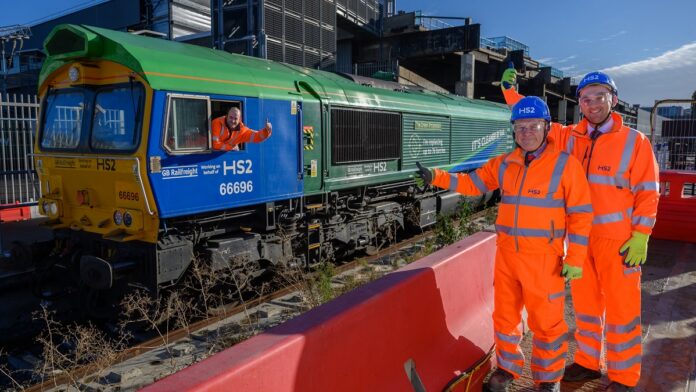
HS2 expects to avoid more than 10,000 heavy goods vehicle journeys by moving up to 170,000 tonnes of excavated material from its Euston station site by rail.
The programme follows trials that transported around 35,000 tonnes between February and September 2026. A further 135,000 tonnes is expected to leave the site over the next ten months as bulk excavation progresses.
HS2 says rail freight produces up to 76% fewer carbon dioxide emissions than road freight when carrying the same weight over the same distance. It has not published a project-specific emissions saving for the Euston programme.
Excavated material destined for reuse in Bedfordshire
Station construction partner Mace Dragados joint venture has begun excavating to around seven metres below ground, where the new HS2 platforms will be built.
Material is loaded beside the disused Track 17 at Euston and transported to Forders Sidings in Bedfordshire for reuse at the Stewartby Brickworks development.
GB Railfreight will operate up to two trains a day. Each can carry approximately 715 tonnes, equivalent to around 45 HGV loads.
Rail Minister Lord Hendy visited the site on 16 November and said:
“Moving this soil by rail will mean thousands fewer HGV journeys through the streets around Euston, helping to reduce disruption for local people, improve road safety and cut carbon emissions.
“This is part of the real progress we are making on HS2. All 23 miles of the tunnels between Old Oak Common and Birmingham have now been dug and more than 80% of the project’s major structures are under construction or complete. Under new leadership, HS2 Ltd is delivering more for every pound having moved 20 million cubic metres of earth – 16% ahead of plan.”
Freight trains scheduled alongside passenger services
The trials established that trains could carry more material than initially anticipated and operate reliably alongside passenger services.
Each train will comprise two locomotives and up to 12 wagons, balancing carrying capacity with the time available for loading and unloading.
Andy Swift, Stations Delivery Director at HS2, said:
“We are committed to reducing the impact of our work on the communities around Euston. Moving material by rail is one of the most effective ways we can reduce the number of construction vehicles using local roads.
“Delivering this programme has required careful planning with Network Rail, GB Railfreight and our construction partners. That collaboration will allow us to move up to 170,000 tonnes of material by rail while passenger services continue to operate at Euston.”
Cllr James Slater, Leader of Camden Council, said:
“For many years, Camden has called for construction materials to be removed from Euston by rail, so it is excellent to see this now being delivered at scale. Taking more than 10,000 lorries off Camden’s roads is a significant achievement that will reduce disruption for our residents and businesses, improve air quality and help cut carbon emissions.
“This is exactly the kind of practical measure that will make a real difference to our communities living alongside the Euston site and on routes in and out of our borough. As construction progresses, we want to see every opportunity taken to further increase the amount of material moved by rail, and we will continue supporting HS2 and partners to explore all options to maximise the benefits that this measure can deliver for our residents.”
Loading facility available until early 2029
HS2 already uses rail to deliver aggregate and tunnel segments and remove excavated material elsewhere along the route.
Patrick Cawley, Director for On Network Works at Network Rail and HS2, said:
“We’re proud to be working with HS2 and our rail industry partners to help make this programme possible. It’s been a real collaborative effort across many different teams to safely accommodate these freight trains alongside the day-to-day operation of one of Britain’s busiest stations, while keeping passengers moving.
“It’s also a great example of what the railway can do best. Moving more materials by rail means fewer lorries on local roads and lower carbon emissions, and we’re pleased that the existing railway is playing such an important role in supporting the delivery of HS2 at Euston.”
Track 17 is expected to remain available until early 2029. HS2 and its partners will explore further uses of the loading facility across the wider Euston development.


