


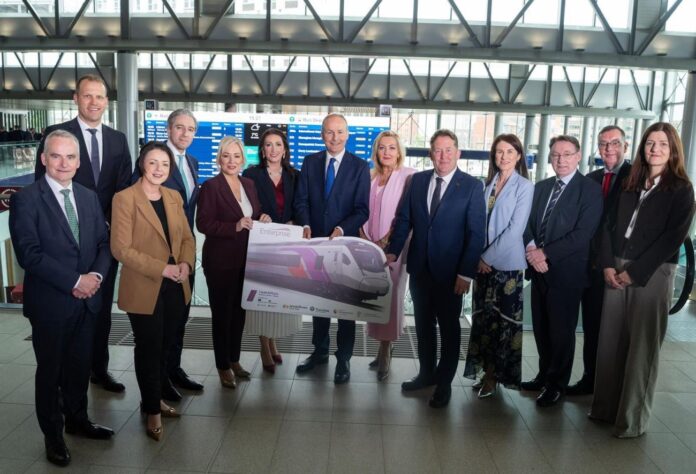
A landmark £548 million cross-border rail investment has formally moved into delivery after ministers from Northern Ireland and the Republic of Ireland signed a major contract with Swiss manufacturer Stadler for a new fleet of Enterprise trains linking Belfast and Dublin.
The agreement, signed at Belfast Grand Central Station on 7 May, will see eight new tri-mode intercity trains introduced on the Enterprise service by late 2028, marking one of the most significant rail investments on the island of Ireland in decades.
Northern Ireland Infrastructure Minister Liz Kimmins and Ireland’s Transport Minister Darragh O’Brien formally signed the contract in the presence of First Minister Michelle O’Neill, deputy First Minister Emma Little-Pengelly, Taoiseach Micheál Martin, Tánaiste Simon Harris and senior UK Government representatives.
The £548m / €698m programme covers both the new fleet and associated infrastructure works. Funding is being jointly provided by the Northern Ireland Executive, Ireland’s Department of Transport and €165m from the PEACEPLUS programme, managed by the Special EU Programmes Body (SEUPB).
The new trains, based on Stadler’s FLIRT platform, have been specifically designed for the Belfast–Dublin corridor and will accommodate around 400 passengers per service.
The fleet will become Ireland’s first tri-mode trains, capable of operating on electric, diesel and battery power, allowing services to continue seamlessly while the route gradually transitions toward electrification.
Passengers can also expect a substantial upgrade in onboard facilities, including step-free interiors, fully accessible boarding at every door, upgraded digital passenger information systems, enhanced luggage and bicycle storage, onboard charging points and a new Enterprise Plus premium section with dining and bar facilities.
Accessibility has been positioned as a central feature of the new trains, with project leaders claiming the fleet will become “among the most accessible intercity fleets in Europe”.
The investment is also expected to support a future express journey time of under two hours between Belfast and Dublin, while enabling the expansion of services to up to 16 trains per direction each day.
First Minister Michelle O’Neill described the deal as “a really significant moment for one of our island’s most important transport links”.
“This new fleet will improve services, enhance the passenger experience and deliver benefits for people and places right across the island,” she said. “This is an investment in our future that will create new jobs, more opportunities and more sustainable travel for years to come.”
Deputy First Minister Emma Little-Pengelly said the investment would strengthen connectivity between businesses, education and tourism across both jurisdictions.
“It is vital that our public transport infrastructure meets the modern needs of people and businesses in both Northern Ireland and the Republic,” she said.
Taoiseach Micheál Martin described the project as “a significant new chapter for cross-border rail connectivity on the island of Ireland”.
“The Dublin-Belfast Economic Corridor is already home to over two million people and the new Enterprise fleet will support the corridor to become even more connected, prosperous and sustainable,” he said.
The project also received strong backing from the UK Government, with Northern Ireland Secretary Hilary Benn highlighting the role of PEACEPLUS funding.
“This is an exciting initiative for the wider region,” Benn said. “PEACEPLUS projects promote peace, opportunity and stability and help generate economic growth.”
For the rail sector, the Enterprise programme represents far more than a fleet replacement.
The project demonstrates how cross-border collaboration, long-term public funding and clear strategic alignment can accelerate major rail modernisation schemes. It also signals growing momentum behind decarbonisation and accessibility across intercity rail networks.
The introduction of tri-mode technology offers a particularly important operational lesson for the industry. Rather than waiting for full electrification, operators are increasingly pursuing transitional rolling stock strategies that allow emissions reduction and service improvements to begin immediately while infrastructure upgrades continue in parallel.
Translink Group Chief Executive Chris Conway said the project would “transform the Enterprise experience”, while Iarnród Éireann CEO Mary Considine described it as “a new era in accessibility and sustainability for the Dublin/Belfast rail line”.
For Stadler, the contract also marks the company’s first train order for the island of Ireland.
Daniel Baer, Executive Vice President of Stadler’s Service Division, said the Enterprise route symbolised “the close cooperation between Northern Ireland and the Republic of Ireland”.
“We are proud to contribute to the modernisation and increased reliability of rail transport on this iconic route,” he said.


