


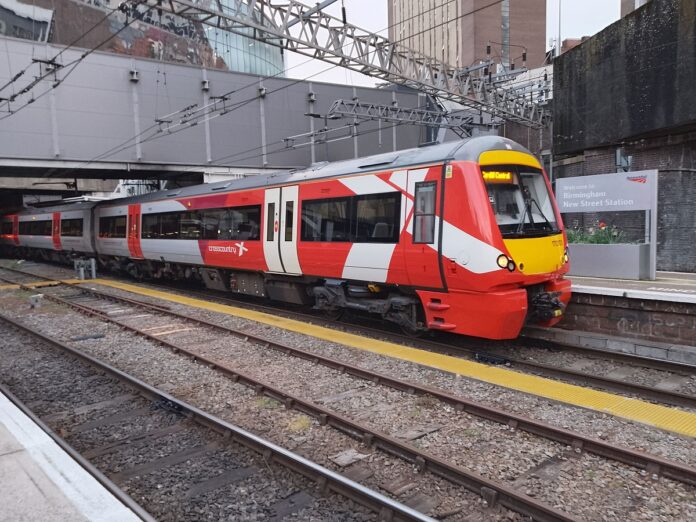
British passenger train operators are facing a sharp rise in diesel traction costs, with new analysis warning that the industry’s exposure to fossil fuel price volatility is becoming a growing financial risk for passengers, taxpayers and the future Great British Railways.
The report, Oil price crisis impact on GB rail operators, produced by CEBR for the Campaign to Electrify Britain’s Railway, estimates that passenger train operators could spend more than £475 million on diesel in 2026-27 if current fuel prices persist. That would represent a ten-year high in diesel spending and leave operators paying £132 million more than last year to run the same level of diesel-powered service.
The central message for rail professionals is clear: Britain’s slow progress on electrification is no longer only a decarbonisation issue. It is now a direct operating cost issue.
According to the analysis, diesel traction costs are projected to be 38.4% higher than in 2024-25. The study attributes this to rising red diesel prices following global oil market disruption, combined with the long-term failure to electrify more of the GB rail network. Red diesel prices reached 123.7p per litre in early April 2026, with the May 2026 average standing at 112.41p per litre, 53% higher than in May 2025.
The report argues that this leaves rail operators highly exposed to international oil price shocks at precisely the moment government energy policy is seeking to reduce dependence on fossil fuel markets.
Electricity remains cheaper per kilometre
One of the most important findings is that electric traction remains cheaper than diesel per vehicle kilometre, despite industrial electricity prices also being at historically high levels.
CEBR estimates that, in 2026-27, Britain’s continued reliance on diesel traction will cost passenger operators £159.4 million more than running the same services on a fully electrified network. The analysis says diesel traction costs per passenger vehicle kilometre are now around one third higher than electric traction.
That figure only covers direct traction energy costs. It does not include wider whole-life savings usually associated with electrification, such as lower rolling stock maintenance costs, improved performance, reduced emissions, higher power output and better capacity.
For rail leaders, that distinction matters. The report is not making the full business case for electrification; it is arguing that even on fuel costs alone, the current position is expensive.
Diesel use is rising again
The analysis also highlights a worrying trend in passenger traction energy use. Diesel consumption on franchised passenger services has risen in recent years, reaching 423 million litres in 2024-25, around 10% higher than in 2022-23.
This reverses earlier progress. Around a decade ago, passenger electricity consumption was rising as new electrification came into use, while diesel consumption began to fall. Since 2022, however, diesel use has started climbing again.
The freight picture is even more stark. The report states that more than 97% of UK rail freight remains diesel-powered, with little progress being made on electrifying freight services. It notes that strategic freight corridors often require relatively limited “infill” electrification to unlock electric operation over longer routes, but that this has not been delivered at scale.
For a sector trying to position rail freight as a low-carbon alternative to road haulage, that is an uncomfortable finding. Rail freight is already cleaner than road, but its long-term competitiveness depends on being able to reduce both emissions and operating costs.
Midland Main Line singled out as a missed opportunity
The Midland Main Line is used in the report as a case study of the cost of stop-start electrification policy.
The route has been committed to for electrification by successive governments, but has also been repeatedly paused. The report says that if electrification to Sheffield had been completed by late 2020, as previously planned, passenger operators would have saved £63.5 million in traction energy costs by April 2026.
Looking ahead, the analysis estimates that the failure to electrify the route will add £18 million in passenger traction energy costs in 2026-27 alone.
The East Midlands Route carries around 11% of all diesel passenger vehicle kilometres on the GB network and around 11% of rail freight tonne kilometres. That makes it a strategically important corridor for both passenger and freight decarbonisation, not a marginal scheme.
The report’s message is that delays do not freeze costs; they transfer them into operating budgets.
A public finance issue for Great British Railways
The timing of the analysis is significant. With rail reform moving towards Great British Railways and a more integrated “track and train” structure, traction energy costs will increasingly sit within a more joined-up public railway balance sheet.
Historically, Network Rail has made infrastructure decisions, while operators have carried much of the traction energy cost. The report argues that this split has weakened the incentive to invest capital in electrification where the main financial benefit appears through reduced operating costs.
Under GBR, that logic changes. The same system responsible for infrastructure planning will also have a clearer interest in reducing the cost of running services.
That could strengthen the case for electrification schemes where capital spending produces long-term operating savings. It could also bring energy procurement, infrastructure strategy and rolling stock planning into closer alignment.
Report calls for a rolling electrification programme
The Campaign to Electrify Britain’s Railway is calling for the Railways Bill to include a requirement for a long-term rolling programme of electrification.
That reflects a wider industry argument: electrification becomes more affordable when it is delivered as a sustained programme rather than as isolated projects. Stop-start delivery increases cost, weakens supply chain confidence, disperses skilled teams and creates avoidable overhead.
The report also points to international comparisons, including India’s rapid electrification of its broad gauge network, to argue that Britain’s pace is not inevitable. In England, just 64km of route has been electrified in the last five years.
For suppliers, engineers and operators, the takeaway is practical as much as political. Electrification is not simply about carbon targets for 2050. It is about shielding the railway from volatile oil markets, reducing operating costs, improving productivity and giving the supply chain enough certainty to invest in skills and capability.
The report’s warning is blunt: Britain’s railway has been left too exposed to diesel. With fuel costs rising, public finances tightening and passenger expectations growing, the price of delay is becoming harder to ignore.