


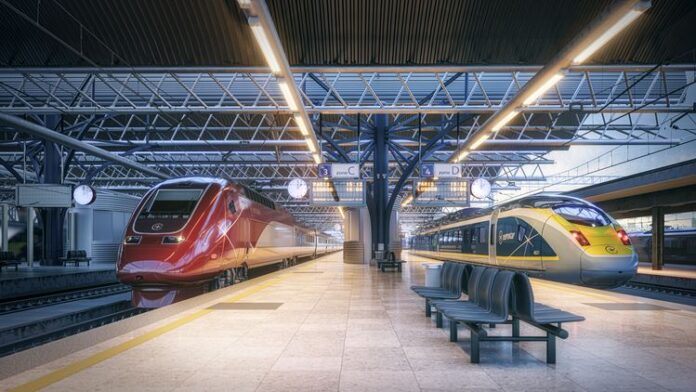
Eurostar has reported another year of passenger growth, carrying 20 million travellers across its network in 2025 while progressing a major investment programme aimed at expanding capacity and launching new international routes.
The high-speed rail operator welcomed 500,000 more passengers than the previous year, representing annual growth of 3%, as demand for cross-border rail travel continued to strengthen across Europe.
Financial results released by the company show revenues exceeding €2 billion during 2025, up 1.7% year-on-year, while EBITDA reached €337 million despite ongoing inflationary pressures and rising infrastructure costs.
Among Eurostar’s strongest performing routes were London-Amsterdam, which recorded passenger growth of 18.3%, alongside increases of 5.8% on London-Brussels services and 5% on London-Paris. Passenger numbers travelling between London and Germany via Brussels also rose by 10%.
The results provide further evidence of growing demand for international rail services as passengers increasingly seek alternatives to short-haul air travel.
A significant focus of Eurostar’s strategy remains long-term fleet expansion. During 2025, the operator progressed plans for a €2 billion investment programme covering up to 50 new trains, with an initial €90 million payment made to Alstom towards the new fleet.
The new rolling stock will support planned growth in capacity and facilitate the introduction of new direct international services, including proposed routes linking London with Frankfurt and Geneva, alongside Geneva connections from Amsterdam and Brussels.
For the rail supply chain, the programme represents one of Europe’s most significant passenger rolling stock investments currently underway and highlights continued confidence in the growth potential of international high-speed rail.
Alongside fleet investment, Eurostar continued work to improve the customer experience across its network. Key developments included the opening of the new Amsterdam cross-Channel terminal, which is expected to significantly increase capacity on the London-Amsterdam route while improving passenger flows through the station.
The operator also continued refurbishment work on its continental PBKA fleet through the ongoing Ruby modernisation programme, while major overhaul activity was carried out on its cross-Channel e320 trains to support long-term reliability and operational performance.
Gwendoline Cazenave, Chief Executive Officer of Eurostar, said the results reflected both the strength of passenger demand and the company’s commitment to future growth.
“Our 2025 results demonstrate the strength of demand to travel with Eurostar and the allure of high-speed, cross-border European rail travel,” she said.
“At the same time, we are concretely investing in the future with a bespoke new fleet on its way, enhanced stations and an improved customer experience.”
The results also reinforce the growing role high-speed rail is expected to play in European decarbonisation efforts.
Eurostar estimates that travelling by train on its core routes can reduce carbon emissions by up to 96% compared with equivalent flights. The operator has also set a target to power its entire fleet using renewable electricity by 2030.
Additional sustainability initiatives include programmes to reduce waste through food redistribution schemes and the conversion of food waste into compost, supporting broader circular economy objectives.
The company’s financial position also strengthened during the year following a refinancing exercise completed in 2024. Eurostar ended 2025 with gross debt of €650 million and has since completed a scheduled repayment of €130 million in April 2026, reducing total debt to €520 million.
For the wider rail industry, Eurostar’s latest results offer a positive signal for international passenger rail, demonstrating continued growth despite economic uncertainty and highlighting the strategic importance of investment in fleet renewal, station capacity and cross-border connectivity.
As new routes and trains move closer to delivery, the company’s expansion plans are expected to create opportunities across rolling stock manufacturing, infrastructure, station development and rail technology supply chains throughout Europe.
Image credit: Eurostar


