


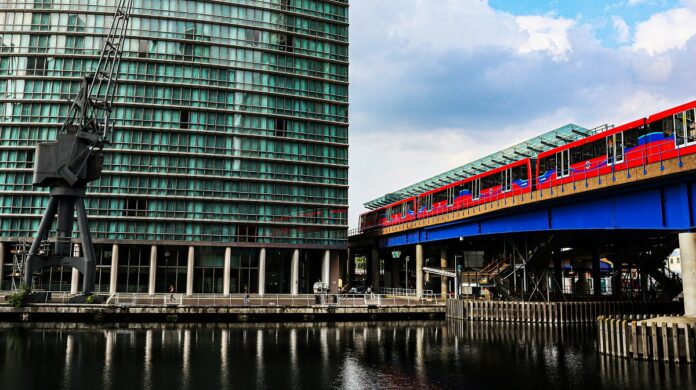
The first of the new generation of Docklands Light Railway trains has returned to passenger service after TfL and manufacturer CAF completed modifications and an extensive testing programme to address performance problems in low adhesion conditions.
The milestone restarts the introduction of the 54-train fleet after the new units were withdrawn from passenger operation in November 2025 as a precaution following an issue affecting the performance of one train.
TfL said changes have now been made to the trains’ braking systems, alongside the installation of equipment designed to improve adhesion between the wheels and track. Additional measures have also been introduced at key locations across the DLR network to reduce the impact of low adhesion.
Following testing and assurance across a range of operating conditions, the first modified train has returned to service, beginning what TfL says will be a carefully controlled phased reintroduction.
Fleet rollout resumes after withdrawal
The new trains will initially be reintroduced on services between Stratford International and Woolwich Arsenal.
Rather than returning the fleet simultaneously, TfL intends to increase the number of new trains in operation gradually while closely monitoring their performance.
TfL is continuing to work with CAF and its suppliers to finalise the full rollout programme, with a timetable for the introduction of all 54 trains yet to be confirmed.
The cautious approach follows the discovery last year of an issue affecting train performance in low adhesion conditions – circumstances commonly associated with contamination between the wheel and rail that can affect braking and traction.
TfL withdrew the new trains in November 2025 while the issue was investigated with CAF and a technical solution developed.
Stuart Harvey, TfL’s Chief Capital Officer, said: “We’re pleased that the first of our new DLR trains has returned to customer service following the completion of a thorough programme of modifications, testing and assurance.
“Safety is always our top priority, and we took the decision to remove the trains from service as a precaution while we worked with CAF to investigate the issue and implement a solution.
“I apologise for the delay in reintroducing the trains but am pleased this marks an important milestone in delivering a modern new fleet for the DLR. As we begin the phased reintroduction of the trains, customers will start to benefit from more spacious and accessible journeys, while we continue to monitor performance and introduce further trains into service.”
Braking and adhesion improvements introduced
Resolving the problem has involved both modifications to the rolling stock and measures across the infrastructure.
TfL said enhancements include changes to braking systems and equipment intended to improve grip between the wheels and rails, together with measures aimed at reducing low adhesion at specific locations.
The subsequent testing and assurance programme has been intended to demonstrate the effectiveness of those changes under a range of operating conditions before passenger operation resumes.
For TfL and CAF, the phased return represents an important point in a fleet programme which had encountered a significant setback shortly after the first new trains entered service.
Performance during the coming months will now be closely watched as additional units are introduced and the modifications are tested through day-to-day operation.
10% capacity increase
Once fully deployed, the new fleet will replace the DLR’s oldest trains, some of which have been operating for more than 30 years.
The CAF trains represent a substantial change for passengers, with walk-through interiors providing around 10% more capacity alongside air conditioning, real-time travel information and mobile device charging.
Accessibility has also been central to the specification. Each train includes three dedicated wheelchair spaces and three multi-use areas, providing additional space for passengers with mobility requirements as well as those travelling with pushchairs, bicycles or luggage.
The additional capacity is intended to accommodate growing demand across east and south-east London, including Stratford, Woolwich Arsenal, the Royal Docks and Isle of Dogs.
Mayor of London Sadiq Khan said: “These modern new trains are fantastic and will transform travel for millions of Londoners, significantly improving comfort, accessibility and reliability.
“The additional capacity will also support further growth, particularly in parts of the Royal Docks and the Isle of Dogs where the DLR is the most-used mode of transport, supporting new jobs and homes.”
Fleet investment linked to housing growth
The replacement programme is also closely connected to wider development plans across east London.
The new trains form part of a broader programme supported by £257m from the Ministry of Housing, Communities and Local Government’s Housing Infrastructure Fund.
That investment reflects the role additional DLR capacity is expected to play in enabling thousands of new homes by ensuring the transport network can accommodate increased demand generated by development.
The programme therefore extends beyond replacing ageing rolling stock. Increased capacity, accessibility and reliability are intended to provide the transport capability needed to support further population and employment growth around some of the DLR’s busiest corridors.
For the rail industry, however, the immediate focus will be on the performance of the modified trains. With the technical changes and assurance programme completed, TfL can restart the fleet transition – but the gradual rollout means successful operation of the first returning units will be an important test before the remaining trains are brought into passenger service.


