


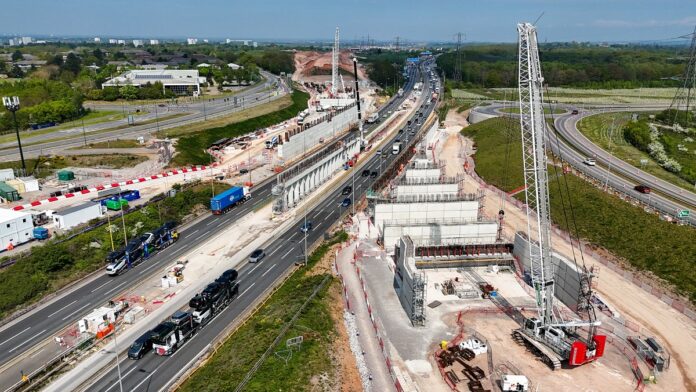
HS2 is preparing to begin its largest motorway construction programme to date this summer, with major engineering works set to take place across the M42 and M6 as the high-speed railway continues to take shape in the West Midlands.
The six-month programme will see three major structures installed over key motorway sections, marking a significant visible milestone for the project as railway infrastructure starts physically bridging live carriageways.
The works include the construction of a 300-metre-long twin box structure above both carriageways of the M42 near Birmingham Business Park, which will allow the railway to pass over the motorway once complete. At the same time, two single-track viaducts near Water Orton will be extended over the M42/M6 Toll interchange, while another twin-track viaduct will be installed above the M6 near Chelmsley Wood.
HS2 Ltd and construction partner Balfour Beatty VINCI (BBV) said the programme has been carefully planned alongside National Highways to reduce disruption, with the number of planned motorway closures cut from nine to six by combining multiple work packages into the same weekends. All closures will take place between 9pm Friday and 5am Monday to avoid peak commuter periods.
The first major operation begins on Friday 26 June 2026 with installation of the roof deck for the M42 twin box structure. Engineers will install 175 beams weighing up to 92 tonnes using a 300-tonne crawler crane over four weekend closures.
At Water Orton, engineers are taking a different approach to complete two viaducts which will eventually carry services into Birmingham Curzon Street and the Washwood Heath depot. Rather than continuing cantilever construction over the motorway, the remaining sections are being assembled beside the carriageway and will later be moved into position using self-propelled modular transporters.
Meanwhile, installation of the M6 South Viaduct West will involve another highly complex engineering operation using a restrained slide technique, building on methods previously used successfully on the route. Two stages of the sliding process will take place above live traffic, limiting the need for motorway closures to a single weekend in August.
Agnes Usciak, HS2 Ltd’s Senior Project Manager for the works, said the project team had worked extensively to condense the programme into the smallest possible number of closures while maintaining safety.
“The progress we’re making on the viaducts and structures next to the M6 and the M42 is already clear to see, and over the next six months, we’ll start bridging the gaps above the carriageways,” she said.
BBV Project Director Oliver Shore added that engineering innovation had played a major role in reducing disruption, referencing the contractor’s previous achievement of sliding a viaduct into place above a live motorway.
The works underline the increasing pace of visible civil engineering activity on HS2 despite the wider project reset currently being led by HS2 Ltd Chief Executive Mark Wild, which aims to improve efficiency and reduce costs across the programme.
For the supply chain, the programme highlights the scale of specialist engineering, logistics and planning capability now being deployed across HS2 as the project transitions further into complex systems integration and infrastructure delivery.
The operations also demonstrate how modular construction and off-site manufacturing are becoming increasingly central to major rail infrastructure projects. From precast beam manufacturing in Leicestershire to the use of transporters and live-slide techniques, contractors are relying heavily on modern construction methods to minimise disruption while accelerating delivery.
The motorway works are particularly significant given the strategic importance of the affected routes. The M6 and M42 serve Birmingham Airport, the NEC and key logistics corridors across the Midlands, making minimising disruption a major operational challenge.
HS2 and BBV said they have spent several months working with Birmingham Airport, the NEC Group and National Highways to coordinate the programme and communicate diversion plans to motorists and businesses.


