


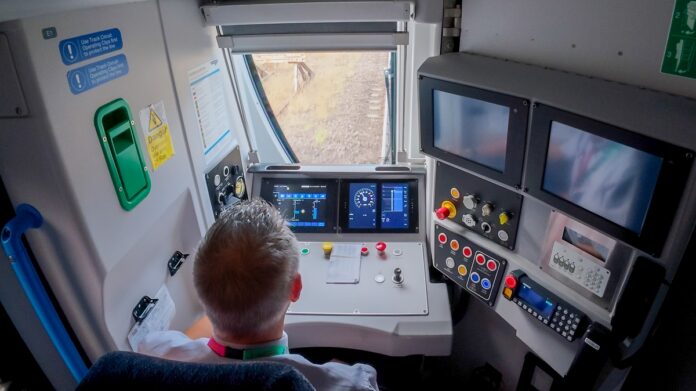
Passenger trains have begun operating under digital in-cab signalling on the East Coast Main Line for the first time, marking a major step forward for the £1.4 billion East Coast Digital Programme.
The 08.05 Great Northern service to Moorgate became the first passenger train to use the European Train Control System (ETCS) on the main line when it departed Welwyn Garden City on Monday 31 August.
The milestone begins the operational introduction of ETCS across the 15-mile section between Welwyn and Hitchin. Great Northern’s Class 717 trains can now transition into and out of the digital system as they enter and leave the route.
The infrastructure has initially been commissioned as an overlay, allowing trains to operate using either conventional lineside signals or digital in-cab signalling. This will enable passenger services to continue running while drivers are trained and additional fleets are prepared for ETCS operation.
More train fleets and passenger services are expected to begin using the system from 2027.
Moving signalling into the driving cab
ETCS replaces the information traditionally provided by lineside signals with instructions displayed directly to the driver in the cab.
The system tells drivers how far their train is authorised to travel and the maximum permitted speed. It also continuously supervises the train’s movement and can intervene, including bringing the train to a stop, if it detects that the permitted speed or movement authority could be exceeded.
Its introduction on one of Britain’s busiest and most important railway corridors represents considerably more than a change to signalling equipment.
Once ETCS is fully introduced and all trains on the route are operating digitally, the programme is expected to reduce the railway’s reliance on physical trackside assets. It should also allow train movements to be managed more effectively, particularly when services are recovering from disruption.
The long-term intention is to create a more reliable, efficient and flexible railway, while improving safety through continuous speed supervision.
Traditional signalling cannot be removed immediately because trains without ETCS equipment must continue to use the route during the transition. The overlay arrangement between Welwyn and Hitchin therefore provides a live operational environment in which operators can train drivers and build experience before digital operation is extended further.
The introduction will require the coordination of infrastructure, onboard equipment, operating procedures, driver training and safety assurance across several organisations. It is this system-wide change, rather than the installation of technology alone, that makes the East Coast Digital Programme one of the most complex modernisation schemes currently being delivered on Britain’s railway.
‘A landmark moment’
Rail minister Lord Hendy said the first digitally signalled passenger movement demonstrated the Government’s commitment to improving the performance of the East Coast Main Line.
“This is a landmark moment for this vital main line,” he said. “Backed by £1.4 billion of Government investment, it’s a clear demonstration of our commitment to building a more reliable, more efficient railway that gets people where they need to be.
“This is exactly the kind of transformation that will underpin Great British Railways as we deliver a simpler railway for passengers, with track and train working together as one to improve our network for the people who use it.”
The East Coast Main Line carries more than 20 million passengers each year and is shared by long-distance, regional, commuter and freight operators. Introducing a new signalling system while maintaining daily operations requires close coordination between Network Rail, train operators, technology suppliers and the wider rail supply chain.
Ellie Burrows, Network Rail regional managing director, described the first passenger operation as the beginning of a fundamental change in how the route is controlled.
“This is the start of a generational change in how the East Coast Main Line, which carries more than 20 million passengers each year, is operated,” she said.
“Digital signalling will give passengers and freight customers a more capable and higher-performing railway, not just on the East Coast but ultimately across the country.
“I’m grateful to passengers for their patience while the testing work was carried out, and I want to thank all industry colleagues involved in getting through the rigorous process of testing, assurance and approvals that has led to this milestone.”
Northern City Line experience supports rollout
Govia Thameslink Railway, which operates Great Northern, has already introduced digitally controlled passenger services on the Northern City Line between Moorgate and Finsbury Park.
The experience gained from that deployment has helped the industry prepare for the more extensive and operationally demanding introduction of ETCS on the East Coast Main Line.
Adrian Gogay, infrastructure director at GTR, said: “This is a massively important moment for the railway, introducing digitally controlled passenger services to the busy East Coast Main Line for the first time, promising passengers in the future more reliable, more efficient, greener and even safer services.
“The lessons we learned together as an industry switching on in-cab signalling in central London between Moorgate and Finsbury Park have proved immensely important for us all. I’m very proud of our collaboration and the dedication shown by our drivers, operational colleagues and industry partners, whose expertise and commitment have made this achievement possible.
“This stretch of digitally controlled track between Welwyn and Hitchin provides the opportunity for all operators to train drivers ready for the system to be extended still further.”
Great Northern’s Class 717 fleet is already equipped for ETCS operation. Its use on the newly commissioned section allows the programme to move from infrastructure testing and assurance into regular passenger service, while retaining conventional signalling for other trains.
Digital twin used to reduce disruption
Siemens Mobility is serving as the train control partner and systems integrator for the programme.
The company tested and validated the ETCS installation using its digital-twin integration facility in Chippenham, Wiltshire. By reproducing elements of the railway and signalling system in a controlled environment, the project team was able to undertake parts of the integration and testing process away from the live operational railway.
Rob Morris, joint chief executive officer and managing director for rail infrastructure and software at Siemens Mobility UK&I, said the first passenger operation demonstrated the industry’s readiness to introduce digital signalling on a major intercity route.
“As the train control partner and systems integrator, we’ve successfully delivered the European Train Control System, testing and validating it remotely at our digital-twin integration lab in Chippenham, Wiltshire, to minimise disruption to services while maintaining the highest standards of safety,” he said.
“A decade of delivering digital signalling on projects such as Thameslink and more recently the Northern City Line has shaped how we’ve approached this programme, and that experience now carries forward as we work with our industry partners on future schemes to transform rail travel and transport for millions of passengers.”
The start of passenger operation between Welwyn and Hitchin is an important practical test of the industry’s ability to manage the transition from conventional to digital signalling.
The immediate change for passengers will be limited, as the route remains in overlay operation and only selected trains are initially using ETCS. Its wider significance lies in establishing the operational experience, driver competence and system confidence needed for a broader rollout from 2027.
As more fleets are equipped and more drivers trained, digital operation will progressively become a routine part of running the East Coast Main Line. The eventual removal of conventional lineside signalling will unlock the programme’s full benefits, but the first passenger journey under ETCS represents a decisive step towards that outcome.


