


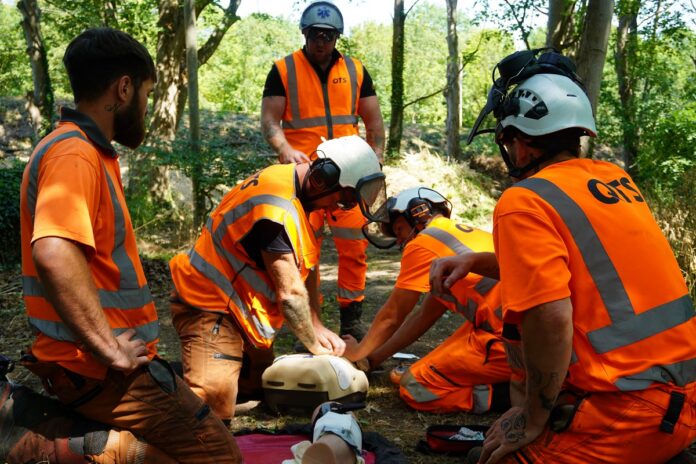
QTS Group has introduced a new programme of practical first aid drills designed to test how effectively rail teams respond when a serious medical emergency happens on site.
Rather than relying solely on classroom-based first aid training, the rail contractor is putting employees through realistic workplace scenarios covering major bleeding, cardiac arrest, burns, spinal injuries, crush injuries and electrocution.
The exercises are designed to test not only whether individuals know how to administer first aid, but whether an entire site team can respond effectively under pressure, an important distinction in safety-critical rail environments where access, communication and evacuation can all complicate an emergency response.
Testing the whole emergency response
The programme is being led by Andrew Sullivan, Assistant HSQE Advisor at QTS Group, who developed the drills using experience gained during 17 years in the security industry, managing mechanised arboriculture operations on remote sites and, more recently, training as a volunteer rescue team medic.
Scenarios incorporate the types of pressures teams could encounter during a genuine railway emergency, including noise, poor weather, passing trains and distressed casualties.
Participants are tested on communication and delegation alongside first aid, including securing the scene, contacting emergency services and organising the safe evacuation of a casualty.
It reflects a growing recognition that competence during an emergency extends beyond the person holding the first aid qualification. On remote or difficult-to-access rail sites in particular, the actions of colleagues during the first few minutes can have a significant impact on the outcome.
“Classroom training gives our teams the knowledge, but these scenarios let them turn that knowledge into practice,” Sullivan said.
“Out on site you’ve got the noise, the weather, trains passing, a casualty who might be screaming or bleeding. We build all of that pressure into the scenario to make it as realistic as we can.
“Emergencies are rarely managed by one person on their own, it’s a teamwork issue, and it can be the difference between life and death.”
First minutes can be critical
The initiative also highlights the particular emergency-response challenge facing infrastructure teams working across geographically dispersed railway sites.
QTS said that for every minute a casualty does not receive effective CPR, their chance of survival falls by around 10%, while a catastrophic bleed can become fatal within minutes.
Those timescales mean waiting for professional emergency responders may not be sufficient, particularly at remote worksites where gaining access to the casualty can itself take time.
ORR figures cited by QTS show 860 RIDDOR-specified injuries across rail infrastructure since 2016, alongside 23 workforce fatalities over the same period. Wales & Western has also recorded five workplace cardiac arrests, two of which were fatal.
For contractors, the figures reinforce the importance of moving beyond compliance-based first aid provision towards ensuring people can actually apply their training when conditions are difficult.
Sullivan added: “You don’t rise to the occasion, you fall to the most basic level of your training. So we drill the basics over and over again, make sure the team knows exactly what they’re doing, and make it second nature. That gives the casualty the best possible chance.”
From training certificate to practical competence
The drills build on QTS Group’s existing health and safety framework and dedicated in-house safety team, but their wider relevance for the rail supply chain lies in testing whether established procedures work when placed under realistic pressure.
Rail construction and maintenance environments can combine heavy machinery, electrical equipment, moving trains, difficult terrain and restricted site access. An emergency response plan may therefore be technically sound on paper while still being difficult to execute effectively in practice.
By rehearsing incidents in the environments where they could actually happen, teams can identify weaknesses in communication, equipment, responsibilities and evacuation arrangements before those weaknesses are exposed during a genuine emergency.
For an industry where safety training is extensive but the consequences of getting an emergency response wrong can be severe, QTS’s approach provides a practical reminder: having trained first aiders on site is important, but ensuring the whole team knows what to do in those crucial first few minutes can matter just as much.


