


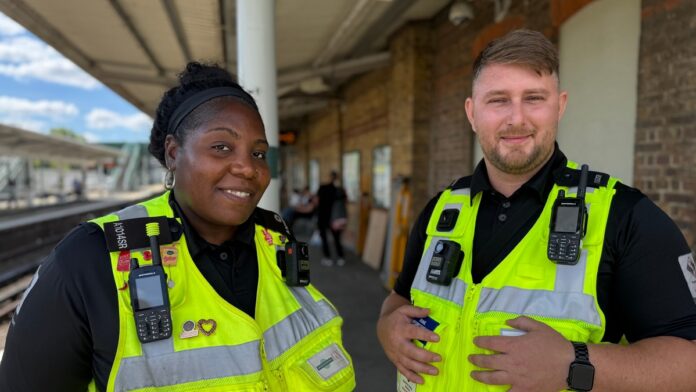
Rail companies and British Transport Police (BTP) have stepped up patrols across Sussex and south London following a sharp increase in trespass and anti-social behaviour on the railway.
A coordinated ‘week of action’ is targeting known hotspots across the network, combining additional security patrols, public engagement and drone technology as the industry looks to reduce incidents that put people at risk and cause disruption to train services.
Figures show anti-social behaviour incidents across the railway in Sussex and south London increased by 29% during July and August 2025, while the overall number of recorded incidents was 39% higher than in November and December.
During July and August, 398 incidents were recorded, including 203 separate cases of trespass.
The latest operation brings together Network Rail, Govia Thameslink Railway (GTR) and BTP, with activity concentrated at stations and locations identified as particularly vulnerable to trespass, crime and anti-social behaviour.
The action follows a £2.5 million investment by GTR in Travel Safe Officers as part of its Anti-Social Behaviour Improvement Plan. The operator has doubled the number of officers, providing an increased visible presence on trains and at stations alongside frontline railway staff and BTP.
The investment is intended to deter crime, reassure passengers and improve the intelligence available to railway security teams.
GTR has also strengthened information sharing with organisations including the Brighton Crime Reduction Partnership and updated its Zero Harm incident reporting application to provide better information about where security resources are most needed.
The week of action produced results from its first day, when BTP officers apprehended a suspected cable thief in connection with an incident in June. Network Rail staff and station CCTV helped officers identify the individual before an arrest was made after he was spotted walking through a station.
Other measures being deployed include targeted patrols at known hotspots, increased awareness of how passengers can report trespass and concern-for-welfare incidents, conversations with members of the public about what to do if they see somebody on the railway, and the use of drones to identify trespassers.
Paul Langley, Network Rail’s Head of Security, Crime and Resilience, said: “Trespass and concern for welfare incidents are among the biggest causes of delays across our route and our priority is always to keep people safe while minimising disruption to customers.
“That’s why alongside our industry partners, we will be focusing our activity at certain stations each day this week, making targeted interventions to help deter incidents. These interventions will aim to improve the safety of everyone who travels on our railway and make the railway more reliable for our customers.”
Mike Boyce, GTR’s Head of Security and Policing, said: “This week of action exemplifies the work we do every day in close partnership with our colleagues at the BTP, Network Rail and other organisations up and down our huge network.
“All of our passengers and staff should be safe and, importantly, feel safe when they travel and use our stations. We’ve undertaken a lot of work to bolster our existing security presence including doubling the headcount of our Travel Safe Officers, improved information sharing with partners like the Brighton Crime Reduction Partnership, and updated our incident reporting app – Zero Harm – to gather better intelligence on where our resources are most needed.
“If you see our people out onboard your trains or at your local station this week, say hello and find out about what they’re doing to help keep you safe.”
Trespass remains major national safety challenge
The operation comes amid a wider industry push to reduce trespass across Britain’s railway.
More than 19,000 trespass incidents were recorded nationally during 2024/25, resulting in 19 accidental fatalities and 85 serious injuries.
Network Rail recently launched another phase of its ‘No Second Chances’ campaign after research suggested members of the public continue to underestimate the risks involved in entering railway infrastructure.
The campaign highlights behaviours including entering the railway to retrieve dropped possessions, crossing tracks as a shortcut and standing dangerously close to operational lines.
Surrey resident Dinusha Ilanperuma is supporting the campaign after suffering life-changing injuries following a trespass incident when she was 15.
After stepping onto the tracks to retrieve a shoe while returning home from a party, she slipped while climbing back onto the platform and came into contact with an electrified rail.
She suffered third-degree burns and extensive nerve damage and spent two weeks in hospital.
Dinusha said: “I’m lucky to be alive. I still have the scars from that night, and it so easily could have been much worse.
“My friends had to watch as I was electrocuted. When I woke up in the hospital, people told me they could smell the burnt flesh on my skin. It was horrible hearing that. I don’t want anyone to ever have to experience what I went through.
“I want people to stop and think. To realise the dangers of trespassing on the railway. To ask themselves: is that really worth risking my life over?”
Network Rail is distributing a campaign toolkit across the industry to increase awareness of trespass risks, while educational resources aimed at younger people are also being provided through its Switched On rail safety programme.
The activity comes ahead of the introduction of statutory rail safety education in schools in England from September 2026.
For operators and infrastructure managers, reducing trespass has implications beyond personal safety. Incidents can require lines to be closed or trains slowed while police and railway teams respond, creating delays that can spread rapidly across the network.
The combination of increased security personnel, improved intelligence sharing, technology and education therefore forms part of a broader effort to prevent incidents before they occur, protecting passengers while improving the reliability of railway operations.


