


Britain’s railway generated £12.4 billion in passenger fare income during 2025/26, an increase of 4% on the previous year, according to the latest annual Rail Industry Finance statistics published by the Office of Rail and Road (ORR).
However, revenue growth continues to lag behind passenger demand, with journeys increasing by 6% and passenger kilometres rising by 5%.
The figures highlight the continuing financial challenges facing Britain’s railway as it prepares for the transition to Great British Railways (GBR), with government funding still accounting for almost half of operational industry income despite sustained passenger recovery.
Total income and funding across the railway reached £36.5 billion during the year, comprising £27.1 billion for operating and maintaining the network and £9.4 billion in new investment.
Government support remains significantly above pre-pandemic levels
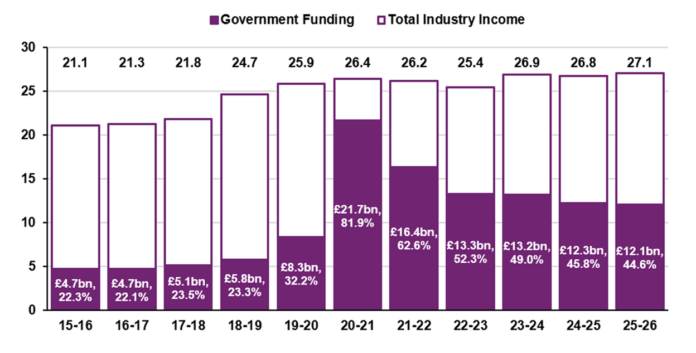
Government financial support for operating the railway fell by 1% to £12.1 billion, accounting for 45% of operational industry income, compared with 46% in the previous year.
While this represents a substantial reduction from the pandemic-era peak of £21.7 billion, government support remains considerably higher than the £8.3 billion provided in 2019/20, when it accounted for 32% of operational income.
The ORR attributes the slower growth in passenger revenue to several factors, including the impact of the Elizabeth line, where journeys are relatively shorter and fares lower, a wider trend towards shorter passenger journeys and changes in how regulated fares have been set.
Overall operational industry income increased by 1% to £27.1 billion, while expenditure excluding financing costs remained unchanged at £24.3 billion.
When financing costs are included, expenditure rose by 2% to £27.3 billion.
Infrastructure funding and private investment decline
The figures also reveal a reduction in investment, with implications for businesses operating across the rail supply chain.
Government funding for new infrastructure fell by 12% to £8.7 billion, of which £6.5 billion was allocated to HS2.
Meanwhile, private sector investment in the railway decreased by 17% to £600 million.
The continued concentration of government infrastructure investment in HS2, alongside declining private investment, raises questions about the breadth and stability of future opportunities across the wider railway network.
For contractors, manufacturers and specialist suppliers, predictable investment pipelines remain critical to maintaining workforce capacity, supporting innovation and improving productivity.
The figures come as the Government’s independent review into rail infrastructure delivery costs examines how greater investment certainty, improved procurement and more consistent programme sequencing could reduce the cost of delivering railway projects.
Operator dividends fall as rolling stock leasing margins increase
The ORR’s report also examines the financial performance of train operators and rolling stock leasing companies.
Thirteen of the 20 train operators covered by the report were expected to pay dividends totalling £158 million, a reduction of 21% compared with the previous year. Publicly owned operators accounted for 34% of expected dividend payments.
Rolling stock leasing companies (ROSCOs) recorded an increase in net profit margins of three percentage points to 22%.
However, dividends paid by ROSCOs fell by 59% to £116 million.
Financial sustainability remains a challenge for GBR
The latest figures underline the scale of the financial challenge facing railway reform.
Although passenger numbers and fare income continue to grow, the railway remains significantly more reliant on government support than before the pandemic.
For GBR, the challenge will be to translate rising passenger demand into stronger financial performance while controlling operating costs, maintaining infrastructure investment and providing the supply chain with sufficient certainty to invest in future delivery capabilities.
Increasing passenger numbers alone will not resolve the railway’s financial challenges. How effectively that growth translates into revenue, alongside improvements in operational and infrastructure delivery efficiency, will be central to establishing a more financially sustainable railway.


