


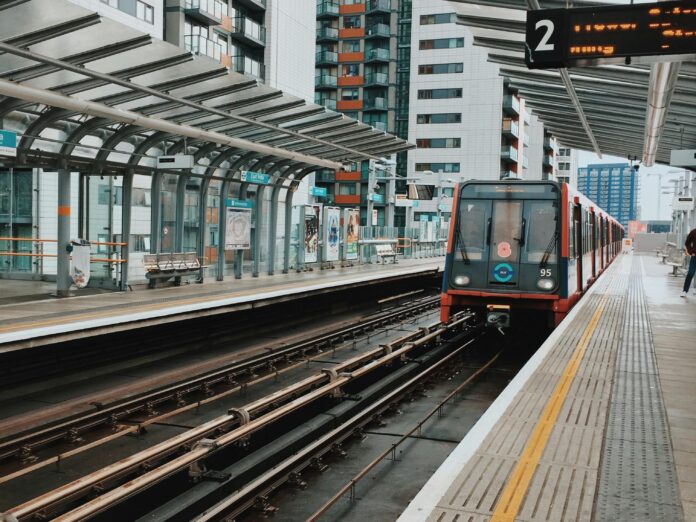
Transport for London has stepped up industry engagement on the proposed Docklands Light Railway Thamesmead Extension, a £1.35bn programme that would deliver a 3km cross-river link between Gallions Reach and Thamesmead via Beckton Riverside.
The scheme, known as TEX, would create a new southern branch of the DLR’s east route, unlocking long-planned growth on both sides of the Thames and reshaping connectivity in east and south-east London.
At its core, the project comprises a new grade-separated junction tying into the existing DLR east route, a viaduct section descending to ground level near a new Beckton Riverside station, and a twin-bore tunnel of around 1.5km beneath the Thames. A second new station would serve Thamesmead, alongside a turnback siding west of the extension to enable future service uplifts.
Docklands Light Railway Limited, a wholly owned subsidiary of TfL, is expected to act as the contracting authority.
Defining the delivery model
TfL has now entered the next phase of Preliminary Market Engagement, seeking detailed input from suppliers on how best to package and deliver the works. An Industry Day is scheduled for 25 February 2026, with a commercial-focused market sounding questionnaire to follow.
The authority is clear that this is not a conventional pre-procurement exercise. Instead, it is asking the market to help shape the strategy.
Suppliers with experience of major urban rail schemes are invited to comment on buildability, concept design maturity, phasing, work package structuring and contracting approaches. Early contractor involvement is anticipated, with a multi-stage procurement model currently favoured.
The works are expected to run from March 2027 to December 2033, with construction likely to commence in 2028 and complete by 2033. The estimated total value stands at £1.62bn including VAT.
A complex, multi-discipline programme
The scope spans the full spectrum of rail systems delivery. On the services side, this includes civil and building design, MEP and security design, ground investigations and overall design leadership.
Construction works would cover enabling packages, major civils, tunnelling, permanent way, traction power, telecoms, station buildings and landscaping. Associated goods range from mechanical and electrical equipment to core construction materials and industrial machinery.
The breadth of relevant CPV classifications, from architectural services and software systems to transport equipment and installation services, reflects the programme’s integrated nature. This is not a single civil contract but a complex assembly of systems and structures that must operate as one.
Carbon, cost and whole-life performance
TfL has signalled that the TEX programme will also act as a test bed for a revised delivery model aimed at driving efficiency and embedding carbon reduction from the outset.
The authority is seeking innovative approaches that reduce whole-life cost and align with its net zero objectives. That includes construction methodology, materials strategy, systems integration and asset performance over time.
For suppliers, this presents both a challenge and an opportunity. With tunnelling, urban interfaces and system integration at its heart, TEX demands proven capability at scale. Yet the engagement process suggests TfL is open to rethinking traditional packaging and risk allocation to secure better outcomes.
Unlocking east London growth
While procurement strategy is the immediate focus, the wider context is regeneration. Beckton Riverside and Thamesmead are earmarked for substantial development. A fixed-link DLR connection would materially improve accessibility, supporting housing delivery and employment growth.
The addition of a turnback facility also signals longer-term ambition, enabling capacity enhancements on both the Thamesmead branch and the wider east route.
For the market, the next milestone is the 30 April 2026 engagement deadline. With the programme at an early yet pivotal stage, those shaping the delivery model now are likely to influence how one of London’s most significant rail extensions of the next decade is built.


