


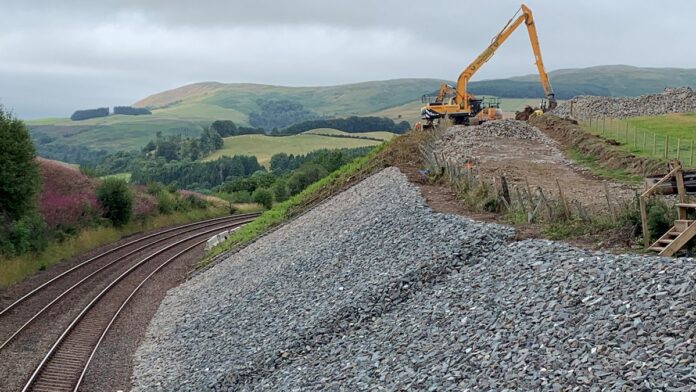
Network Rail has invested £130 million in strengthening Scotland’s railway against extreme weather over the past two years, as rising temperatures, heavier rainfall and more volatile conditions place increasing pressure on ageing infrastructure.
The spending represents an important milestone in a wider £400 million programme of weather and climate resilience work planned between 2024 and 2029.
Around £73 million has so far been invested in earthworks and £37 million in drainage. The work is intended to reduce the risk of flooding, landslips, rockfalls and infrastructure failures across a network that is particularly exposed to severe weather.
For Scotland’s railway, this is no longer principally a question of preparing for occasional winter storms. Climate change is altering the conditions in which infrastructure must operate throughout the year, bringing wetter winters, more intense downpours, hotter summers, longer growing seasons and rising coastal risks.
The challenge is compounded by the age and geography of the network. Much of the railway was constructed more than a century ago, while routes outside the Central Belt frequently run along coastlines, cross watercourses or pass through steep-sided glens and cuttings.
In parts of the north-west Highlands, average annual rainfall already exceeds 3,500mm, rising to more than 4,000mm in the wettest locations. Drainage systems and earthworks designed for historic weather patterns must therefore cope with both high background rainfall and increasingly concentrated extreme events.
David Harkin, weather resilience and climate change adaptation strategy manager at Network Rail Scotland, said: “We see first hand the impact severe weather can have on the railway. In truth, our railway was built for a climate that no longer exists, and careful planning and action are required to manage that challenge.
“Our role is to understand those risks in detail and make informed decisions that reduce disruption and improve safety. This work is continuous and is essential if we’re to stay ahead of the challenges the railway faces today.”
A warmer and wetter operating environment
The change in Scotland’s climate is already measurable.
Network Rail’s Climate Ready Plan for Scotland’s Railway says the country’s average annual temperature has risen by around 0.8°C compared with the earlier part of the 20th century. Average annual rainfall has increased by more than 100mm.
The ten warmest years recorded in Scotland have all occurred since 1997, while 2022 became the country’s warmest year on record. A temperature of 34.8°C at Charterhall in the Scottish Borders that July set a new Scottish record.
Future conditions are expected to bring warmer, drier summers and milder, wetter winters. That does not mean summer rainfall ceases to be a risk. Even if seasonal rainfall totals fall, heavy convective downpours are expected to become more intense.
This distinction matters for the railway. A large volume of rain falling over a short period can overwhelm drains and culverts, scour foundations and saturate earthworks before operational teams have much time to respond. Prolonged rainfall creates a different but related problem, gradually increasing water pressure within slopes and reducing their stability.
Dry and hot conditions bring their own risks. High rail temperatures can lead to track buckling or require temporary speed restrictions, while heat can affect signalling, electrical equipment, switches and crossings. Extended dry periods can also change soil conditions and weaken vegetation that helps stabilise cuttings and embankments.
The interaction between hazards is becoming increasingly important. Saturated ground, for example, may make trees more vulnerable to high winds. Vegetation growth can block drainage, while landslips can damage cable routes and signalling equipment. Coastal flooding may prevent drainage systems from discharging effectively at the same time as waves and erosion threaten the railway itself.
Network Rail Scotland’s climate risk assessment found that around 22% of identified risks involved combinations of weather drivers or natural hazards rather than a single cause. Without further intervention, the organisation expects risks to rise across every major infrastructure asset class, with earthworks, track and structures receiving the highest average risk scores by the 2050s.
Weather is already affecting performance
The changing climate is not solely a long-term asset-management concern. It is already affecting day-to-day railway performance and imposing costs on the industry.
Network Rail’s plan says adverse and extreme weather has been recorded as the leading cause in 8% of ScotRail services missing their punctuality or reliability target since 2012. Weather may also have been a contributing factor in other incidents attributed to damaged assets.
Since 2006/07, Network Rail has paid more than £145 million in Schedule 8 compensation in Scotland for weather-related disruption. High winds accounted for approximately £46 million and flooding for £41 million, followed by snow at £22 million and poor rail adhesion at £15 million.
The figures underline the commercial case for preventative investment. Strengthening slopes or increasing drainage capacity can be expensive, but repeated closures, emergency repairs, speed restrictions and compensation payments also carry substantial costs.
There is a wider strategic issue. Rail is expected to support economic growth and the movement of more passengers and freight, while contributing to Scotland’s decarbonisation objectives. Those ambitions depend on services being sufficiently reliable for customers to choose rail with confidence.
Liam Sumpter, managing director of Network Rail Scotland, said: “Rail is central to Scotland’s economy and to the communities it connects every day. Our focus is on building a railway that people can continue to depend on and encourages more passengers and freight companies to choose rail with confidence.
“That means looking ahead and making the right long-term decisions now. By continuing to invest in resilience, we’re supporting sustainable growth and helping ensure the railway remains a reliable choice for the future.”
Investment focused on slopes and drainage
The £130 million programme includes work on several of Scotland’s principal passenger and freight routes.
Around £20 million has been invested on the West Coast Main Line to improve soil slopes, rock cuttings and drainage systems. The work is intended to reduce the likelihood of landslips, rockfalls and flooding affecting the route.
On the Highland Main Line at Charleston, a £2.85 million project has installed improved drainage and strengthened neighbouring earthworks. The scheme is designed to reduce flood risk and the operational restrictions that can follow heavy rainfall.
A further £2 million has been spent at Ratho, between Edinburgh and Glasgow, to make a steep rock face beside the railway safer and reduce the risk of material falling onto the line.
On the West Highland Line, £3 million has been invested at Falls of Cruachan following a landslip. The project has strengthened the hillside above the railway and is intended to improve the route’s ability to withstand more frequent severe weather.
Between Aberdeen and Inverness, an £850,000 scheme at Old Kinaldie has improved drainage to help the railway accommodate heavier rainfall and reduce flood risk.
These schemes illustrate why drainage and earthworks cannot be treated as separate systems. If water is not collected, channelled and discharged effectively, it can destabilise the slopes supporting or bordering the railway. Equally, movement of soil, rock and vegetation can block drains and culverts, increasing the probability of flooding.
The work therefore has to extend beyond clearing drains or repairing isolated slope failures. It requires an understanding of entire catchments, including water originating beyond the railway boundary, and how slopes, structures, vegetation and drainage interact during intense weather.
Lessons from Carmont
Scotland’s approach to extreme weather has been shaped significantly by the fatal derailment at Carmont, near Stonehaven, in August 2020.
Three people died and six were injured when a passenger train struck debris washed onto the track following exceptionally heavy rainfall and derailed. The Rail Accident Investigation Branch subsequently made 20 safety recommendations, covering the management of extreme weather, civil engineering work, operational decision-making and train design.
The accident demonstrated the difficulty of balancing safe operation with the need to avoid imposing widespread restrictions every time severe weather is forecast. Forecasting can identify areas at risk, but intense convective rainfall can be highly localised and develop quickly.
The industry’s response has therefore combined physical improvements with better forecasting, inspection and operational control.
Network Rail Scotland has established a 24-hour weather desk staffed by trained meteorologists within its integrated control operation. New forecasting tools have been introduced, additional drainage and geotechnical specialists recruited, and aerial survey capability strengthened.
Wireless earthwork-failure detection equipment has also been deployed at 130 sites across the Scottish route. These tiltmeters can provide live warnings of movement at vulnerable slopes, supporting a faster operational response when conditions deteriorate.
The Office of Rail and Road continues to monitor Network Rail’s delivery of the Carmont recommendations and its wider weather resilience plans. The regulator has said operators must continue adapting if the network is to remain safe and reliable as climate risks evolve.
From reacting to weather to planning for change
Physical investment remains central to resilience, but Network Rail’s strategy recognises that the railway cannot simply build its way out of every climate risk in a single control period.
The £400 million allocated for 2024 to 2029 will renew and strengthen assets, but the network must also decide which locations need further intervention, when work should take place and what standard future assets must meet.
Network Rail Scotland has consequently launched an adaptation pathways programme combining climate science with the practical knowledge of railway engineers and operational teams.
The approach is intended to identify the routes and assets most vulnerable to future change, model hazards at specific locations and assess potential responses. Economic, environmental and social factors will be considered alongside engineering requirements.
Rather than relying on a single forecast of future climate conditions, adaptation pathways allow investment to be staged as risks develop. A site may initially require improved monitoring and maintenance, followed by drainage enhancement or slope strengthening if defined risk levels are reached. In the most exposed locations, longer-term options could involve substantial reconstruction, new protection or even the relocation of infrastructure.
This is particularly important because decisions about railway assets frequently have consequences lasting several decades. Renewing infrastructure to suit historic conditions risks locking vulnerability into the network, while designing every asset immediately for the most severe long-term scenario may be neither affordable nor proportionate.
The programme is intended to give Network Rail a clearer basis for prioritising expenditure and incorporating future climate risk into later control-period plans.
Infrastructure risks extend beyond the railway boundary
Network Rail Scotland has also co-founded the Climate Ready Infrastructure Scotland Forum, bringing together infrastructure owners and operators facing common climate risks.
The railway depends on other networks, including electricity, telecommunications, roads, water and drainage. A rail asset may remain operational but still be unable to provide a service if power supplies fail, access roads flood or neighbouring land directs water and debris towards the track.
Cooperation is also necessary where responsibility for watercourses, hillsides, trees or drainage sits outside the railway boundary. Extreme weather does not respect asset ownership, and resilience measures delivered in isolation can simply move risk from one organisation or location to another.
Cabinet Secretary for Economy, Tourism and Transport Stephen Flynn said the investment would help protect services that are critical to passengers, freight customers and communities.
“I welcome Network Rail’s continued investment to strengthen and future-proof our railways against the growing challenges posed by extreme weather and climate change,” he said.
“The services provided by Scotland’s rail network are critical, keeping Scotland moving by allowing passengers and freight to move safely. It is vital we build a rail network which is resilient to reduce disruption and protect communities.
“This funding, part of the Scottish Government’s £400 million programme of investment, will help ensure we are prepared for the growing impact of climate change on the transport network, which has become a year-round challenge.”
The £130 million spent to date represents substantial progress, but the scale of the remaining challenge is clear. Scotland’s railway must simultaneously manage infrastructure built for past conditions, respond to today’s weather and plan assets capable of operating in a markedly different future climate.
That makes resilience a permanent part of railway planning rather than a programme with a fixed end date. The test will not simply be how much money is invested, but whether that investment produces fewer failures, better-targeted operational restrictions and a network that can continue carrying passengers and freight safely as the climate around it changes.


