



‘Britain does not lack infrastructure ambition. It lacks consistency in turning that ambition into deliverable work.‘
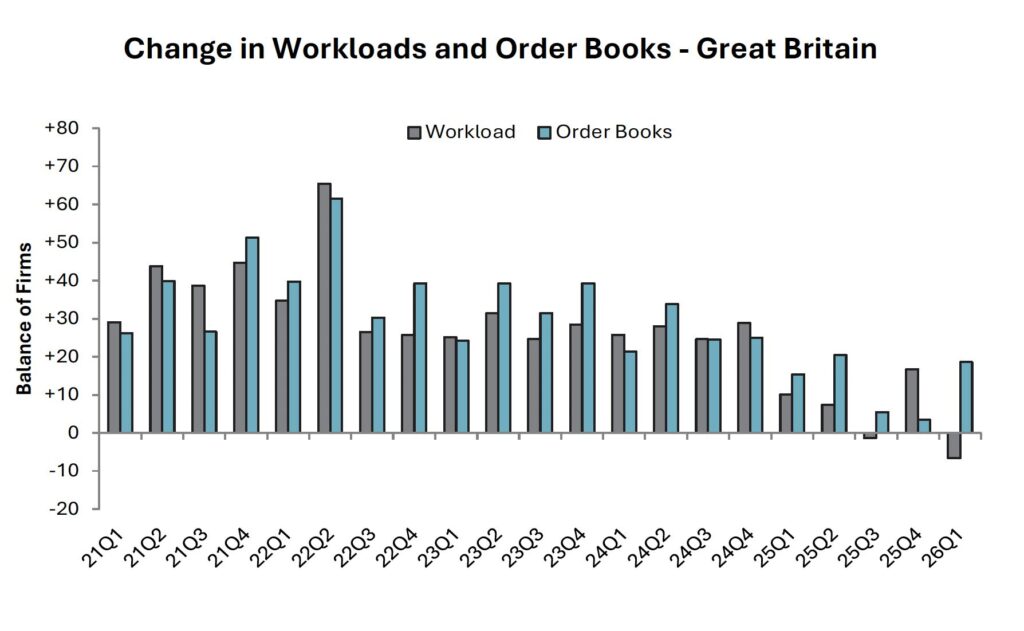
That is the wider message behind the Civil Engineering Contractors Association’s latest Workload Trends Survey. The headline finding, that civil engineering workloads fell during the first quarter of 2026, matters well beyond the performance of a single quarter. It exposes the persistent gap between projects announced, projects anticipated and projects actually reaching the supply chain.
On balance, 7% of contractors reported lower workloads than a year earlier. Overall, 27% of firms saw an increase, one third experienced a fall and 40% reported no change.
Those figures sit awkwardly alongside a national agenda that places infrastructure at the centre of economic growth, regional connectivity and industrial renewal. If delivery matched the rhetoric, contractors should be building capacity rather than managing gaps in their workloads.
CECA Director of Policy and Public Affairs Ben Goodwin said: “While it is disappointing to see workloads fall in the first quarter of the year, the wider picture is one of a sector that remains resilient and is looking ahead with confidence.
“Order books have strengthened, expectations for the next 12 months remain positive, and firms are continuing to expand their workforces. This shows that civil engineering contractors are ready to deliver the infrastructure the economy needs.”
There are certainly reasons for optimism. On balance, 19% of firms reported stronger order books, the highest rise in three quarters. Over the next 12 months, 60% expect workloads to increase, 55% anticipate growth in new work orders and 38% expect repair and maintenance orders to rise.
But anticipated work cannot employ apprentices, pay for new equipment or provide the confidence needed to expand. A pipeline only supports investment when businesses can see when projects will be procured, how they will be packaged and whether the dates attached to them are credible.
This is particularly important for rail. The sector is already contending with constrained renewals budgets, uncertainty over future enhancement programmes and a long-running stop-start approach to major infrastructure investment. Contractors cannot retain specialist teams indefinitely while waiting for policy commitments to become funded contracts.
When schemes are repeatedly delayed, the consequences are cumulative. Skilled people leave, equipment is moved elsewhere and smaller suppliers become less willing or able to carry the cost of bidding. When delivery eventually accelerates, the industry faces reduced capacity, higher prices and increased programme risk.
Goodwin said: “But optimism in the pipeline must now be matched by delivery on the ground. Where workloads are falling, particularly in key areas such as preliminary works, communications, and strategic roads, there is a risk that delays will weaken confidence and make it harder for businesses to invest in people, plant and productivity.”
The survey shows those pressures are already visible. More than half of firms are dissatisfied with the availability of skilled operatives, while 48% report dissatisfaction with the supply of staff. Meanwhile, 57% recorded higher tender prices for new construction and improvement work, with 56% reporting increases for repair and maintenance.
This creates an uncomfortable contradiction. Britain needs contractors to invest in skills and productivity, but too often asks them to do so against a backdrop of uncertain workloads and shifting delivery dates. The industry is then criticised when shortages emerge or tender prices rise.
The answer is not simply another list of prospective projects. Government and infrastructure clients must establish stable programmes with realistic funding, clear procurement timetables and fewer avoidable pauses between development and construction.
Earlier contractor involvement would also help projects draw on practical delivery expertise before designs, costs and schedules become difficult to change. Faster decisions are important, but so is making better-informed decisions before schemes reach the market.
Goodwin added: “Under Sir Keir Starmer, the Government has rightly identified infrastructure as central to growth, resilience and national renewal. To turn that ambition into reality, the Government must work with clients and industry to provide clear, stable and deliverable pipelines of work, backed by efficient procurement, early contractor involvement and faster decision-making.”
The civil engineering sector remains confident because it can see the scale of the work Britain needs. That confidence should not be mistaken for an unlimited ability to absorb delay.
For rail and the wider infrastructure market, the warning is clear: capacity cannot be switched off when spending slows and restored instantly when political priorities change. If the Government wants infrastructure to drive growth, it must give the businesses expected to deliver it something firmer than future promise.


