


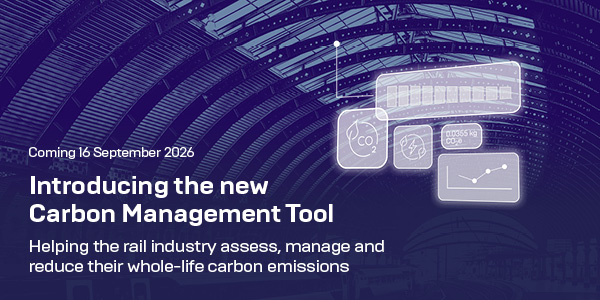
RSSB is preparing to launch a new Carbon Management Tool designed to help rail organisations understand the whole-life carbon impact of projects and make better-informed investment and design decisions.
The new platform builds on more than a decade of experience from the Rail Carbon Tool but expands the focus beyond individual calculations to provide a broader approach to carbon management across the lifecycle of railway assets and infrastructure.
It comes as carbon performance increasingly becomes a consideration not only for sustainability teams, but for engineers, designers, project managers, asset owners, consultants and suppliers making decisions about how railway projects are designed, constructed, operated and maintained.
Bringing carbon into earlier project decisions
A central aim of the new tool is to move carbon assessment further towards the beginning of project development.
Some of the biggest opportunities to reduce embodied and operational carbon occur during concept development and design, when choices around materials, construction methods, asset specifications and maintenance strategies can still be changed relatively easily.
Once projects progress into detailed design and construction, those opportunities can become considerably more difficult and expensive to capture.
RSSB’s Carbon Management Tool is intended to give project teams the information needed to compare different approaches before those decisions become locked in.
Users will be able to assess whole-life emissions, compare design and delivery options and identify lower-carbon solutions while using rail-specific carbon data.
Whole-life approach to railway assets
Rather than concentrating solely on construction, the platform will allow organisations to examine carbon throughout an asset’s lifecycle, from concept and design through construction, operation and maintenance to eventual decommissioning or end of life.
That could prove particularly valuable as the railway faces decisions around the renewal and replacement of ageing infrastructure.
Understanding the carbon consequences of extending an asset’s life, refurbishing it or replacing it entirely can provide another evidence point alongside traditional considerations such as cost, safety, performance and reliability.
The tool is also intended to improve consistency between organisations when assessing carbon, helping project teams, clients and suppliers work from a more common approach.
For businesses increasingly being asked to demonstrate their environmental performance through procurement and project delivery, RSSB says the platform can also support sustainability reporting and wider carbon reduction objectives.
Carbon management becoming a supply chain issue
The launch has implications beyond major infrastructure owners.
As rail clients strengthen sustainability requirements within contracts and procurement frameworks, suppliers are increasingly expected to understand and demonstrate the carbon impact of the products, materials and services they provide.
A common rail-specific methodology could therefore help SMEs and larger suppliers quantify their contribution more consistently, while giving buyers better information when comparing potential solutions.
It also creates an opportunity for carbon considerations to become part of normal engineering and commercial decision making rather than a calculation carried out once designs have effectively been determined.
RSSB says the Carbon Management Tool has been developed following feedback from industry users and reflects the railway’s evolving sustainability requirements.
The platform is intended for use across the sector, including by sustainability professionals, engineers, designers, project managers, consultants, asset owners and suppliers.
Its effectiveness, however, will ultimately depend on how widely it becomes embedded within project development and procurement. The real opportunity is not simply to measure railway carbon more accurately, but to use that information early enough to change decisions and deliver lower-carbon infrastructure.


