


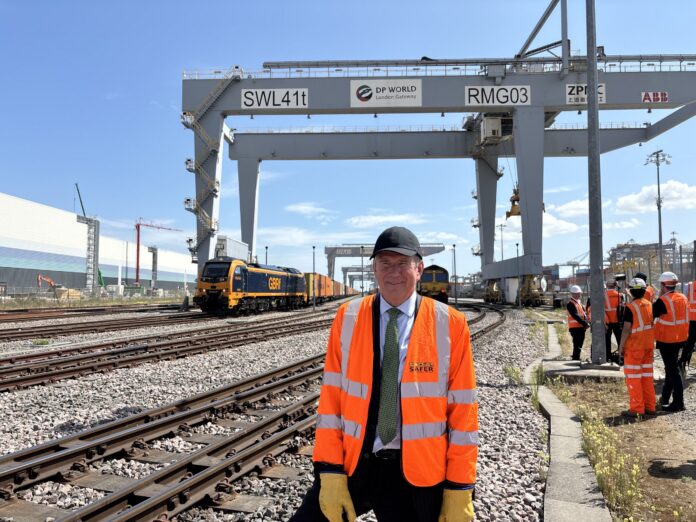
GB Railfreight has operated the first commercial service using its new Class 99 locomotive, bringing one of the UK freight sector’s most significant fleet investments into revenue-earning operation.
Locomotive 99001 departed DP World London Gateway with an intermodal service for Maritime Transport’s Hams Hall Rail Freight Terminal in the West Midlands, following years of development, testing and certification.
The milestone matters beyond the introduction of a new locomotive. With only around 40% of Britain’s railway electrified, freight operators face a difficult balance between reducing their reliance on diesel and retaining the flexibility to serve terminals and routes beyond the electrified network.
The Class 99 has been designed specifically to address that challenge.
Hybrid capability targets freight’s diesel dependence
Developed by Stadler and introduced by GBRf in partnership with Beacon Rail, the Class 99 can operate electrically beneath overhead wires before switching to its onboard engine on non-electrified sections.
GBRf says the locomotive can reduce emissions by more than half on a typical journey, with renewable fuel providing a further route to reducing emissions when electric operation is unavailable.
Crucially for freight operators, that can be achieved without restricting the destinations trains can serve.
For the wider sector, the arrival of the fleet provides an opportunity to make greater use of existing electrification while retaining the operational flexibility currently offered by diesel locomotives.
John Smith OBE, Chief Executive Officer of GB Railfreight, said: “Four and a half years ago, we set out to bring a locomotive to the UK that would redefine what rail freight could deliver. Today, with the first commercial Class 99 service departing London Gateway for Hams Hall, we’ve achieved exactly that.
“The Class 99 combines lower emissions, better performance and a modern, safer working environment for our drivers. It’s the result of an incredible effort from teams across GBRf, Beacon Rail and Stadler, and marks the start of a new chapter for rail freight in Britain.”
Performance could be as important as emissions
While much of the attention surrounding the Class 99 has focused on decarbonisation, its performance characteristics could prove equally important as the Government pursues its target of growing rail freight by 75% by 2050.
Freight services need to compete for capacity on an increasingly busy mixed-traffic railway. Faster acceleration can reduce the performance differential between freight and passenger trains, potentially making freight paths easier to accommodate and improving overall network utilisation.
That combination of power, flexibility and lower emissions could therefore strengthen the commercial case for moving additional traffic from road to rail.
Maritime Transport has already trialled the locomotive and is now using the Class 99 on its London Gateway to Hams Hall operation.
John Bailey, Managing Director – Intermodal at Maritime Transport, said: “The locomotive can operate under electric power on electrified sections and continue over the rest of the network using renewable fuel, reducing emissions without restricting where services can run.
“This will be increasingly important as we continue to grow our intermodal offering, moving more freight from road to rail and integrating those services with our expanding eHGV fleet to cut emissions on the essential road journeys at either end.”
Investment converging across the logistics chain
The first commercial working also comes as investment in locomotives, ports, terminals and road fleets increasingly converges around the growth of intermodal freight.
DP World is expanding rail capability at London Gateway as it seeks to increase the proportion of containers moving inland by train.
Kris Adams, CEO UK Ports and Terminals at DP World, said the Class 99 would help the business “utilise the full capacity of our rail terminals at London Gateway, carrying more containers, operating more sustainably and generating less noise than older models”.
For Stadler, the commercial launch represents the culmination of more than four years of work to adapt the locomotive to the requirements of the British network.
Ralf Warwel, UK and Ireland Sales Director at Stadler, described the introduction as “an important step forward in the decarbonisation of the sector”, demonstrating that lower-emission technology could be introduced without sacrificing the flexibility required by freight operators.
A practical bridge towards a lower-carbon railway
The Class 99 does not remove the case for further railway electrification. Instead, its significance lies in what it can deliver while substantial gaps in the electrified network remain.
Rail freight cannot afford to wait for complete electrification before tackling diesel emissions, particularly if the sector is simultaneously expected to accommodate significant volume growth.
Hybrid locomotives offer one practical response: maximising electric operation where infrastructure already exists while preserving access to ports, terminals and industrial locations beyond the wires.
With the first Class 99 now carrying commercial freight, the industry will be watching closely to see whether the promised improvements in emissions, performance and network integration translate into everyday operation.
If they do, the Class 99 could prove important not simply as a replacement for ageing locomotives, but as an enabler of the next phase of British rail freight growth.


